

Energy demands of data centers
Digital transformation boosts demand for data centers in Brazil, with the market growing 15% annually to reach US$ 1.3 billion by 2020. Data centers operate 24/7, requiring uninterrupted power for processing, cooling, and critical operations. An hour of outage can result in losses of US$ 84-108 thousand per company. Solutions include 45-2,250 kVA power generators on standby with automatic transition, as well as temporary use for maintenance and capacity increase.
Power generation on Oil and Gas platforms
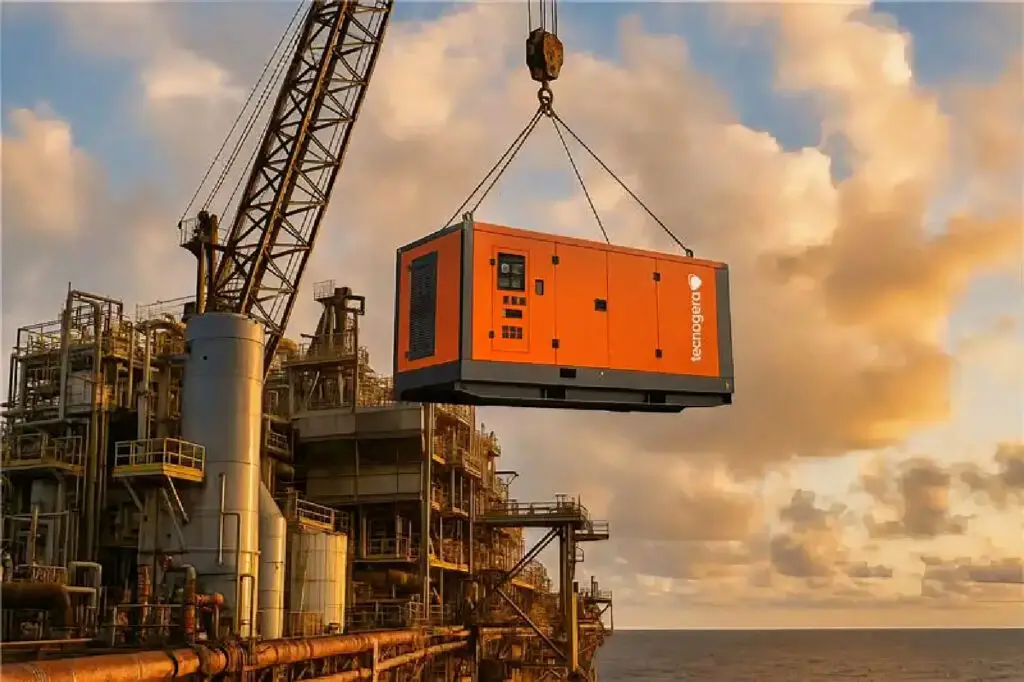
Oil platforms are true floating cities that require large amounts of energy to operate. This article explores how power generation is carried out on offshore platforms, the logistical challenges, the necessary safety measures, and the economic impact of the oil sector in Brazil.
The use of power generators by thermoelectric plants
The lack of rain and low water storage levels in reservoirs, especially in the Northeast region, continue to concern the productive sector and government agencies. Even though energy rationing is still being ruled out, some measures, such as adopting the level 2 red flag tariff charged on electricity bills, are already being implemented. The potential activation of thermal power plants, which are more costly to operate, aims to supplement the deficient energy matrix of hydroelectric plants, whose water reservoirs are at increasingly lower levels due to the water crisis.
Major events require expertise and technical capability
When hiring temporary power solutions, one of the key criteria to evaluate is the rental company’s experience and capability. What types of events has the company serviced, and what generation capacity was provided are essential questions. Thus, companies that have supplied temporary power for complex events should be prioritized in the selection process.
Tecnogera celebrates participation in Brazil WindPower and marks milestone of 2000 commissioned turbines
At the end of August, Tecnogera participated in Brazil WindPower, an event that brought together national and international companies from the wind energy sector in Rio de Janeiro. Tecnogera’s performance in the wind energy sector has been quite impressive, with 2000 turbines commissioned in the first half of 2017.
Renewable Energy on the Rise
Bloomberg, through its energy sector analysis arm, Bloomberg New Energy, released a study indicating a significant drop in wind and solar energy costs in the coming decades. According to the study, this trend is expected to accelerate the adoption of renewable sources. Researchers predict that solar energy costs will fall by more than 60% by 2040.
Rainy January leads to increased power supply outages
January 2017 recorded the highest rainfall in the last five years, with over 340mm in just 20 days according to Inmet. While beneficial for reservoirs, storms cause power supply interruptions, impacting businesses and consumers. In 2016, a single storm left over 320,000 customers without power in Porto Alegre. The solution to avoid losses lies in using standby power generators, which automatically activate during supply failures, ensuring operational continuity.
Technological Advances and Temporary Power
The supply of power through diesel generators began to strengthen in the 1970s, bolstered by the country’s infrastructure investments at the time. Since then, generators have been key allies in providing power, especially in regions not connected to the National Interconnected System (SIN).
The high cost of electricity and its impact on Brazilian industry
Electricity is essential and strategic for the operation of industries across the country and in various sectors. However, its cost significantly impacts business performance in the country. Data from 2015 by the Federation of Industries of the State of Rio de Janeiro (Firjan) shows that Brazilian energy is the third most expensive in the world.
Discover the operating principles of a three-phase induction motor
The induction motor is a type of electric motor that operates using two rotating magnetic fields. It is a device widely used in industrial activities, especially those involving power generation. The stator remains fixed to the motor housing and functions to conduct energy and convert it into electricity.