When hiring temporary power solutions, one of the key criteria to evaluate is the rental company’s experience and capability.
What types of events has the company serviced, and what generation capacity was provided are essential questions.
Thus, companies that have supplied temporary power for complex events should be prioritized in the selection process.
In this context, what could be considered a major event?
This topic is debatable, but there is one event that, from any perspective, is considered massive.
It’s a sporting competition watched on TV by billions of people worldwide, broadcasted to nearly every country.
We are, of course, talking about the Olympics, an event that is superlative in every aspect.
The last Olympic Games were hosted in Rio de Janeiro.
The company chosen by the Brazilian Olympic Committee to provide temporary power for the 25 game venues, and the opening and closing ceremonies was Tecnogera, which met the entire technical scope and extremely tight deadlines, ensuring the event’s energy security.
There was great anticipation regarding the structure of the Rio 2016 Games.
Due to the complexity and scale of the event, it required the full commitment of the entire supply chain to ensure everything went smoothly.
Tecnogera provided temporary power for unforgettable moments that will remain in the memory of sports fans for a long time: the opening and closing ceremonies.
The opening, for example, featured 20,000 meters of fiber optic cables and over 100 projectors.
Maracanã, a global football icon, was illuminated by Tecnogera
The structure set up with Tecnogera’s participation ensured power supply for all 78,000 people attending the event at Maracanã, as well as for the more than 6,000 volunteers performing on the field.
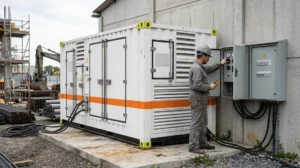
Tecnogera’s generators served as the primary power source for all equipment used.
Just for the opening ceremony, 30 generators of various capacities were used, totaling 18 MVA, enough to power a city of 150,000 inhabitants.
The equipment was divided into four distinct plants within the stadium.
Tecnogera was responsible for the connections, installing transformers, panels, and 1,600 meters of electrical cables.
As if the responsibility for the spectacle wasn’t enough, Tecnogera also took on the responsibility for generating power for the TV broadcast.
Maracanã stadium numbers:
- Three thousand light fixtures
- 17 elevators
- 12 escalators
- 292 restrooms
- 60 bars
Tecnogera at Engenhão
The company also provided temporary power for competition venues like the Nilton Santos Olympic Stadium, where the athletics events took place.
Besides Tecnogera’s equipment, Jamaican Usain Bolt shone there.
His achievements were watched worldwide thanks to the electrical power structure set up by the Olympic committees and Tecnogera.
The temporary power ensured that nearly 60,000 spectators present could follow all the competitions with ease.
Engenhão, as the stadium is popularly known, is a grand structure with 72 ticket booths and 57 electronic turnstiles distributed across four wings.
The stadium also features 60 restrooms and 22 bars, along with a 3,650 m² area with various shops.
Two giant screens broadcasted the events live for those inside the stadium, and two more electronic scoreboards recorded the game results.
The electronic scoreboard measured 30 meters long by nine meters high, the largest ever installed in a stadium.
Besides athletics, the stadium also hosted eight Olympic football matches.
A true marathon for the Tecnogera team.
Beach Volleyball Arena
The Beach Volleyball Arena also had the company’s support.
The company ensured power supply for the 12,000 spectators present each day of competition.
Throughout the Olympics, over 400,000 people passed through the venue.
The Arena was set up on Copacabana Beach, in an area of 62,000 square meters, and was the first arena built for Olympic games on a beach.
The structure included a central court for games, five for training, and two for warm-up.
The primary power for the Beach Volleyball Arena was provided by Rio de Janeiro’s energy utility, Light, through the Leme substation.
Tecnogera’s generators operated in stand-by mode.
Deodoro Sports Complex
The Deodoro Sports Complex, hosting women’s basketball, modern pentathlon, rugby, and fencing, was also powered by Tecnogera’s generators.
Although it didn’t receive as much media attention as Maracanã, the Deodoro Complex was one of the largest competition venues at Rio 2016 and, therefore, one of the most demanding in terms of power supply.
The space, with a capacity to host 72,000 people, covers an area of 2.5 million square meters.
The site housed several Olympic facilities supported by Tecnogera, such as the BMX Olympic Center, Hockey Olympic Center, Canoe Slalom Stadium, Mountain Bike Track, Youth Arena, Deodoro Stadium, Deodoro Aquatic Center, Olympic Equestrian Center, and the National Shooting Center.
The complex hosted competitions in canoe slalom, cycling (BMX and mountain bike), field hockey, shooting, modern pentathlon, basketball (women’s only), rugby, and equestrian (jumping, dressage, and eventing).
It took a lot of power to ensure so many competitions took place, in front of billions of people watching on TV.
Rio 2016 Summary
With energy delivery deadlines four times shorter than previous Olympic editions, Tecnogera delivered 87 MW of power across 25 different competition venues, with nearly 300 generator sets interconnected by 1,500,000 meters of electrical cables, ensuring the perfect functioning of all transmission, timing, and necessary infrastructure systems.
The numbers reflect the grandeur of the world’s largest sporting competition.
After all, Tecnogera generated power for lighting systems, TV, radio, and internet transmission, timing equipment, medical services for athletes and spectators, among many others.
Still unsure which temporary power rental company to hire for your next event?
Contact the company chosen by Rio 2016.