The question usually comes in the wrong format. "Is a generator or battery more worthwhile?" treats both as if they solved the same problem.
The generator sustains the operation during the hours of outage and the battery covers the moment of the drop. **Resilient energy** is the arrangement that combines both, and it is defined by two measures that the operation itself already has: how long the load can withstand without power and how long it needs to stay up. Follow through to the end to see how to determine each one.
Executive summary
- Battery covers the moment of outage and generator covers the duration, like layers of the same arrangement.
- Two numbers decide: how long the load tolerates without power and how long it needs to stay up.
- Hybrid makes sense when the operation has a load that cannot tolerate flickers and needs long autonomy.
Index
- The two numbers that define the arrangement
- What each technology solves
- When the hybrid is worthwhile
- The most expensive mistake of this choice
- Frequently asked questions about resilient energy
- Conclusion
The two numbers that define the arrangement
Before comparing equipment, answer two questions about your critical load.
1. How long can the load tolerate without power
This is the acceptable **transfer time**, and it varies greatly between equipment.
Servers, line automation, and medical equipment cannot tolerate even a fraction of a second. Pumps, lighting, and air conditioning can tolerate a few seconds without consequence. Ovens and cold chambers can tolerate minutes but pay a high price to return to normal operation.
2. How long does the load need to stay operational
This is the necessary **autonomy time**, and it comes from the history of interruptions in your region.
Each distributor reports to ANEEL how many hours per year the average customer was without power and how many times, using the DEC and FEC indicators from Module 8 of PRODIST. The number for your municipality is public, and it is from this that Tecnogera starts to propose autonomy, instead of adopting a standard off-the-shelf solution.
Together, they form the answer
Low tolerance and short autonomy require a battery. High tolerance and long autonomy require a generator. Low tolerance with long autonomy requires both, and that’s where the hybrid comes in.
What each technology solves
| Criterion | Battery bank and UPS | Generator set |
|---|---|---|
| How quickly it starts | instantaneous, without perceptible interruption | seconds, after starting |
| How long it sustains | minutes | hours or days, as long as there is fuel |
| What limits | installed capacity, and expanding is expensive | fuel and refueling plan |
| Maintenance | bank replacement at the end of its useful life | periodic preventive and load testing |
| Where it shines | electronic load that does not tolerate flicker | entire operation for a long period |
Why the battery doesn’t replace the generator
Extend battery autonomy is expensive and takes up space, because each additional hour requires more bank. To sustain a plant for six hours, the cost and area make it unfeasible in most cases.
Why the generator doesn’t replace the battery
The generator needs to start, synchronize, and take over, and this takes seconds. For servers and automation, seconds are a drop.
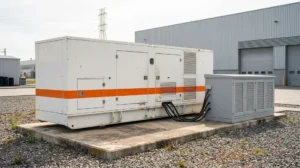
Furthermore, the sizing of the generator set has its own standard, ABNT NBR ISO 8528, which deals with application classes and the working regime of the set. Choosing the wrong regime shortens maintenance.
When the hybrid pays off
A hybrid system is the arrangement where battery and generator work in series: the battery holds the moment, the generator takes over the duration.
The classic case
Operation with server room, line automation and continuous process, in a region with frequent interruptions. The battery prevents a flicker from shutting down the system, and the generator sustains it until the grid returns.
The case that surprises
Operation in a remote area, where the grid is unstable and the distance increases service costs. There, the hybrid reduces the time the generator needs to run, which cuts fuel and maintenance.
What the hybrid is not
Hybrid requires sizing like any other arrangement. Poorly sized hybrid has the cost of both systems and the autonomy of neither.
That’s why Tecnogera starts with load assessment and the site’s interruption history before proposing an arrangement.
The most expensive mistake of this choice
Sizing for the entire plant when the risk is in a fraction of it.
The critical load is usually a small and expensive subset: server room, control system, process cooling, safety pumps. Protecting only it changes the size of the investment by a large factor.
The other mistake, less common and more serious, is the reverse: protecting the office and leaving the process exposed. There, the investment exists and the risk remains intact.
Frequently asked questions about resilient energy
Battery or generator, if I have to choose one?
It depends on what your load cannot tolerate. If it fails with a flicker, battery first. If it withstands seconds but needs hours of autonomy, generator. Choosing only one leaves a known gap in the arrangement.
How much autonomy time do I need?
It comes from the interruption history of your unit, which the distributor provides, compared with the public indicator of the municipality. Estimating here is costly in both directions.
Is a hybrid system more expensive?
In initial investment, yes, because there are two systems. In operation, it can be cheaper, because the generator runs fewer hours. The calculation depends on the frequency of interruptions at the site.
Can I rent instead of buying?
Yes. Temporary energy is the usual path for construction, seasonal contingency, main system maintenance window, and feasibility testing before investing in own equipment.
Do I need N+1 redundancy?
N+1 redundancy means having one more set than necessary, and it exists to cover failure or maintenance without downtime. It’s worthwhile when the operation cannot stop even during the maintenance of the contingency itself.
Conclusion
Resilient energy is about layering to cover different problems. The battery buys the moment, the generator buys the time, and the critical load defines how much of each.
Tecnogera sizes this arrangement based on the actual load and the site’s interruption history, and provides temporary energy for the period the operation needs it. If you already know what cannot stop, bring the list and the engineering team will handle the rest.
Last updated: September 2026.