Almost every company that depends on power has a contingency plan stored somewhere, with the generator in the yard and the contract signed. The question that is rarely answered: when the power goes out at three in the morning on a Sunday, will this setup work?
The electrical contingency plan test is what separates those who have a plan from those who have a file. Follow along to the end to understand what needs to be tested, how often, and which numbers to record in each drill.
Executive summary
- A generator that has been idle for months reaches the critical moment with a dead battery, and this is the number one failure.
- Automatic load transfer fails as often as the generator, and it is almost never rehearsed.
- A test that doesn’t generate numbers is useless for comparison, and without comparison, there is no trend.
Index
- Why the electrical contingency plan fails at the exact moment
- What to test in the electrical contingency plan
- How often to test
- What to record in each test
- When rental solves the test and operation
- Frequently asked questions about the electrical contingency plan test
- Conclusion
Why the electrical contingency plan fails at the exact moment
The electrical contingency plan often fails because power outages don’t give warnings: when they happen, the document needs to work with whoever is on duty, in the dark, and without time to read.
The most common causes of this failure are off the paper, in operational details that only appear when someone tests the setup.
Generator start failure
The number one reason for generator start failure is a discharged battery: an emergency generator that sits idle for months reaches the critical moment with a dead battery, aged fuel, or a clogged filter.
It’s almost never a major defect, but rather the accumulation of small maintenance tasks that no one addressed because the equipment wasn’t in use.
Automatic transfer that was never activated
The automatic load transfer is the device that detects the outage and switches the power to the generator, and being an electrical device with contacts and programmed logic, it also needs to be exercised.
If no one tests the transfer, it may have oxidized contacts, a poorly configured wait time, or be turned off since the last panel intervention. The generator starts, and the load remains without power.
Fuel autonomy calculated on paper
Fuel autonomy is usually estimated by nominal consumption, and actual consumption depends on the applied load. A tank sized for eight hours at full load may last much less with repeated starts, or much more if the load is at 40%.
Without measuring in operation, autonomy is an expectation, not a fact.
What to test in the electrical contingency plan
The useful test of the electrical contingency plan is not running the generator idle for five minutes, but reproducing, as much as possible, what happens in a real outage.
Real load test
The generator load test with the building or plant’s actual load shows three things that the idle test hides:
- If the start sustains the motors’ inrush peak
- If the voltage and frequency remain stable under load
- If the cooling system handles the load
These are the tests that ABNT NBR ISO 8528 addresses for generator sets, and that’s why the results are recorded with voltage and frequency numbers, not with the impression of those in the room.
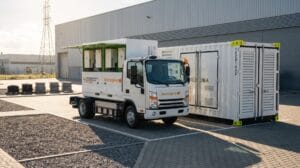
Where it’s not possible to transfer the actual load, the load bank solves it, as it simulates the demand in a controlled manner and allows for continuous operation measurement. It’s worth the investment when there is critical equipment and no window to shut down the plant.
Simulated power outage
The simulated power outage is the complete test: someone opens the main breaker, and the entire operation responds. It measures the time to transfer, the behavior of sensitive equipment, and most importantly, what people do.
Most of the failures discovered in simulations are not technical, but rather procedural issues that no one knew about, keys that were in manuals, or outdated on-call phone numbers.
Network return
The network return is the least rehearsed part and the one that causes the most damage: when the utility company restores power, the load needs to return in an orderly manner, with the generator shutting down only after a stabilization period.
Poorly adjusted return causes a second shutdown, now with hot equipment and without warning.
How often to test
The frequency depends on the risk of each operation, and it’s worth following three ranges:
- Start without load: monthly. Confirms battery, fuel, and starting system
- Load test: quarterly, or semiannually for low-risk operations
- Complete simulation, with induced outage: annually, or semiannually in hospitals, data centers, and continuous process industries
In addition, every generator preventive maintenance plan needs to record the hour meter, fluid level, and measured consumption. Maintenance without records doesn’t allow for comparison, and without comparison, there is no trend.
Those who conduct the test also have rules: NR 10, from the Ministry of Labor, defines the qualifications for those working on energized electrical installations, and in hospitals, the contingency also adheres to ABNT NBR 13534.
What to note in each test
A test that doesn’t generate numbers is of little use, and the minimum spreadsheet to record each test has six fields:
- Time between the outage and the power restored by the generator
- Voltage and frequency under load, at the beginning and end
- Operating temperature after thirty minutes
- Fuel consumption measured during the period
- Behavior of critical equipment during the transfer
- Observed failures and who was responsible for each correction
With two or three recorded cycles, the important things become apparent: whether the transfer time is increasing, if consumption has risen, or if the temperature is higher than in the previous test.
When rental solves the test and operation
Not every company needs to buy a generator to ensure operational continuity. In three situations, rental is usually the most direct path.
Test window
The test window is when renting a generator during the simulation keeps the operation powered while the equipment is evaluated under real load, without risk to production.
Gap found
The gap found appears when the test shows that the current generator does not support the load that the plant has come to require, and temporary equipment covers the period until the definitive solution.
Scheduled shutdown
The scheduled shutdown is the maintenance of the main generator, which needs to happen without leaving the operation uncovered at any time.
How Tecnogera enters the test
Tecnogera operates generator rentals with 24-hour service and telemetry, with technical teams in 28 units, and delivers the load bank when there is no window to shut down the plant.
To receive a proposal, provide the load, the deadline, and the city of operation.
Frequently asked questions about the electrical contingency plan test
Is testing the generator without load sufficient?
It is not sufficient because the no-load test confirms that the engine starts, but does not show voltage stability, thermal behavior, or the ability to sustain the equipment’s starting peak.
What is the minimum test frequency?
The minimum frequency is monthly start-up, quarterly load test, and annual full simulation, and critical operations shorten these periods by half.
What is a load bank?
The load bank is equipment that simulates electrical consumption in a controlled manner, allowing the generator to be tested under real load without relying on the operation, and is the path when there is no shutdown window.
How long can the generator take to assume the load?
The time depends on the project, and in systems with automatic transfer, it usually takes seconds. What matters is knowing this number and checking if critical equipment can tolerate the wait.
Does a UPS replace a generator?
The UPS does not replace the generator because it supports the load for minutes and is used for safe shutdown or to cover the interval until the generator takes over. Long autonomy remains the role of the generator.
Why does the generator fail to start even with up-to-date maintenance?
The most common reasons are a battery at the end of its life, aged fuel in the tank, and failure in the preheating system. All appear in periodic tests and go unnoticed in visual inspections.
Does fuel sitting in the tank go bad?
Diesel degrades over time, especially with humidity and temperature variations. In rarely used equipment, it’s worth monitoring the fuel’s age and planning for renewal.
Who should participate in the drill?
Maintenance, operations, security, and those responsible for on-call duty participate in the drill, as the goal is to test procedures and communication, not just equipment.
Can the test damage the equipment?
A well-conducted test reduces risk instead of increasing it, and what usually damages equipment is leaving it idle for long periods and then activating it for the first time in a real situation.
Can you test without stopping operations?
Yes, with a load bank or with a rented generator taking over the power supply during the test. This is the method used in hospitals and data centers.
Conclusion
The electrical contingency plan is not evaluated by the thickness of the document, but by the last recorded test, with number, date, and responsible party.
Those who test discover small problems during business hours, and those who don’t test discover big problems at night. Tecnogera provides generators and load banks for the first column of this equation, with the test happening without stopping the plant.