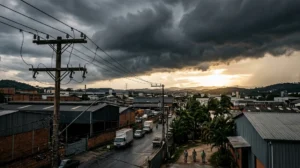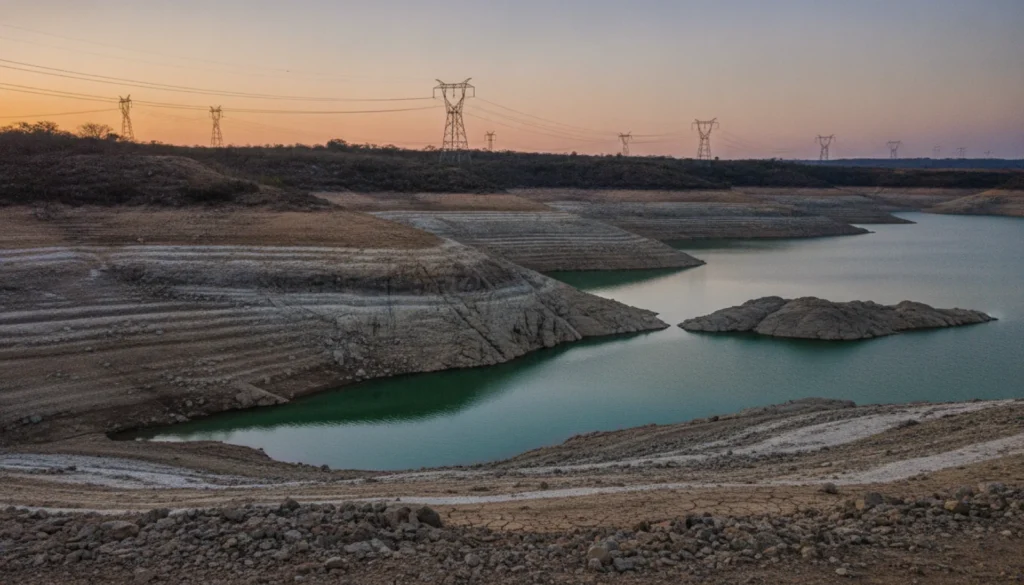
When the news talks about low reservoirs, most companies hear it as distant news. The electricity bill is what brings the real warning, three months later, and by then the decision has already been made for you.
The **water crisis and energy supply** are connected by a path that almost no one follows, and it has public signals months in advance. Follow along to see what to watch, what it costs, and what to decide before rationing becomes an issue.
Executive summary
- Drought rarely causes blackouts in Brazil. What it does is make energy more expensive and increase the risk.
- Reservoir levels and the tariff flag are public and anticipate the squeeze by months.
- Those who depend on continuous processes decide earlier, because during rationing equipment becomes scarce.
Index
- Why drought affects the price before affecting the power
- The three public signals that anticipate the squeeze
- What the company decides, and when
- Frequently asked questions about water crisis and energy
- Conclusion
Why drought affects the price before affecting the power
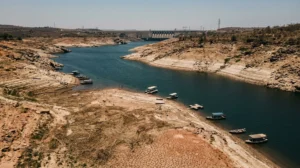
The Brazilian electricity matrix is predominantly hydroelectric. When it rains little and reservoir levels drop, the system switches sources.
This switch triggers thermal generation, which costs more per megawatt-hour than hydroelectric. The cost is passed on and appears on the bill of those who consume through the **tariff flag**. This is how the water crisis and energy supply meet in the cash register before they meet in the circuit breaker.
Blackout is something else
It’s worth separating two risks that are often confused.
Power outages due to network failure come from windstorms, lightning, construction, and equipment failure, and happen all year round, with or without drought.
Rationing comes from prolonged scarcity and is a public policy decision, announced in advance. It is rarer, but when it happens it affects the entire region at the same time, and that’s when the generation equipment disappears from the market.
The cost comes first, and it is measurable
The tariff flag is the mechanism that passes this extra cost to the consumer, and it changes from month to month according to the system’s condition.
For an operation that consumes a lot, the difference between one flag and another over a semester is enough money to pay for a good part of a contingency project. The cost of energy rises without formal notice.
The three public signals that anticipate the squeeze
All three are published by the sector’s own agencies and updated at no cost.
1. Reservoir levels
The National Electric System Operator publishes the storage level of reservoirs by subsystem, with history. It is the most direct indicator, and it moves slowly, which gives time to react.
What to look at is the trend against the same period of the previous year.
2. The month’s tariff flag
The flag is announced by ANEEL monthly and reflects the generation condition. A sequence of more expensive flags is a sign that the system is relying on thermal power. It is the trigger that makes Tecnogera sought after by high consumption operations, before any rationing announcement.
3. The quality of supply in your region
Regardless of drought, each distributor reports to ANEEL how many hours per year the average customer was without power and how many times. These indicators are the DEC and FEC, defined in the Module 8 of PRODIST.
They vary greatly between cities served by the same distributor, and the one in your municipality is the cheapest step of the entire evaluation.
What the company decides, and when
Water crisis and energy supply become concrete decisions in three scenarios, and the response changes depending on what the operation cannot afford to lose.
If the process is continuous
Furnace, oven, cold chamber, automated line, and server room cannot tolerate interruption without incurring losses beyond downtime.
For these cases, the question is how large the contingency is. The sizing starts with the critical load, which is the subset that cannot be turned off. The working regime of the set has its own standard, ABNT NBR ISO 8528, and choosing the wrong regime compromises maintenance.
If consumption is high and costs are tight
Here the discussion is about the cost of energy at the end of the month. Operations with high consumption can use their own thermal generation during peak hours, when the tariff is more expensive, and this is an engineering decision with a calculable return.
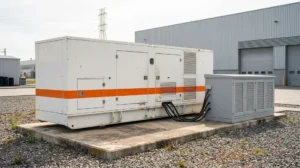
Tecnogera sizes this scenario based on the real consumption curve of the operation, because the return depends on how many hours per month the equipment will run.
If the risk is rationing
The risk of rationing is the scenario where a late decision costs more. When the announcement is made, the entire market seeks temporary energy at the same time.
Those who already have a contract or sized project get through the period. Those who start looking after the announcement join a queue.
Frequently asked questions about water crisis and energy
Can the water crisis cause a blackout in my company?
Directly, it’s rare. Scarcity makes energy more expensive and increases the risk of rationing, which is announced. Localized blackouts have other causes, such as windstorms, lightning, and network failures, and occur regardless of drought.
How do I know if my region is at risk?
By looking at three public things: the reservoir levels at ONS, the tariff flag of the month, and the quality indicators of your distributor’s supply, which ANEEL publishes by municipality.
Is it worth having a generator just because of the drought?
It depends on what the operation loses per hour of downtime and how much it spends on energy. In continuous processes, the calculation usually balances out due to risk. In high consumption, it usually balances out due to peak hour costs.
Rent or buy?
Rental is a good solution for a defined period, construction, seasonal contingency, and feasibility testing before investing. Buying makes sense when the use is permanent and the company wants the asset.
How far in advance do you need to decide?
Enough time to size, hire, and install without rushing. In a scenario of announced rationing, equipment availability drops quickly, making early decisions cheaper than urgent ones.
Conclusion
For those running an operation, drought is a matter of cost and risk, and both have public advance notice. Reservoir levels, the month’s flag, and your distributor’s indicator tell you what’s coming months in advance.
Tecnogera sizes contingency based on critical load and actual consumption curve, and works with temporary energy for the period the operation needs it. Operational continuity is decided before the crunch arrives. If your operation can’t afford to stop, request a sizing before it becomes headline news.
Last updated: September 2026.