Oil and gas operations often take place in remote, hard-to-reach locations with strict regulatory requirements, where power supply failures have a direct impact on production and safety.
Temporary energy emerges as a strategic solution both to meet specific demands and to sustain continuous operations in regions without robust electrical infrastructure.
How power generation works on platforms
On oil platforms, power generation occurs through gas turbines or diesel generators.
These units are responsible for providing the necessary energy for the operation of all platform systems, including lighting, communication systems, drilling equipment, and oil and gas processing.
Campos Basin
This power generation scheme occurs similarly on any other platform in operation.
The 32 offshore units of the Campos Basin Exploration and Production Business Unit, for example, are capable of generating 400 megawatts of energy. This amount is enough to supply a city of two million inhabitants.
The platforms located in the Campos Basin currently have about 30 power-generating turbines and almost 50 diesel generators. All this production is used in lighting, communication, and equipment systems.
An interesting fact: the units need to have a diesel engine even when all the platform’s energy is supplied by a gas turbine. This way, if there is no gas production, the diesel generator provides energy for communication systems or to illuminate escape routes.
The energy challenges of the Oil and Gas sector
Platforms, support bases, and sites linked to the oil and gas chain often operate far from traditional distribution networks. This requires self-generation solutions, with high reliability and the ability to operate continuously for long periods, often in adverse weather and logistical conditions.
Logistics for the use of power generators on Oil and Gas platforms
The use of generator sets is quite common in various economic sectors. However, when it comes to generators for offshore platforms, there are some challenges that need to be overcome.
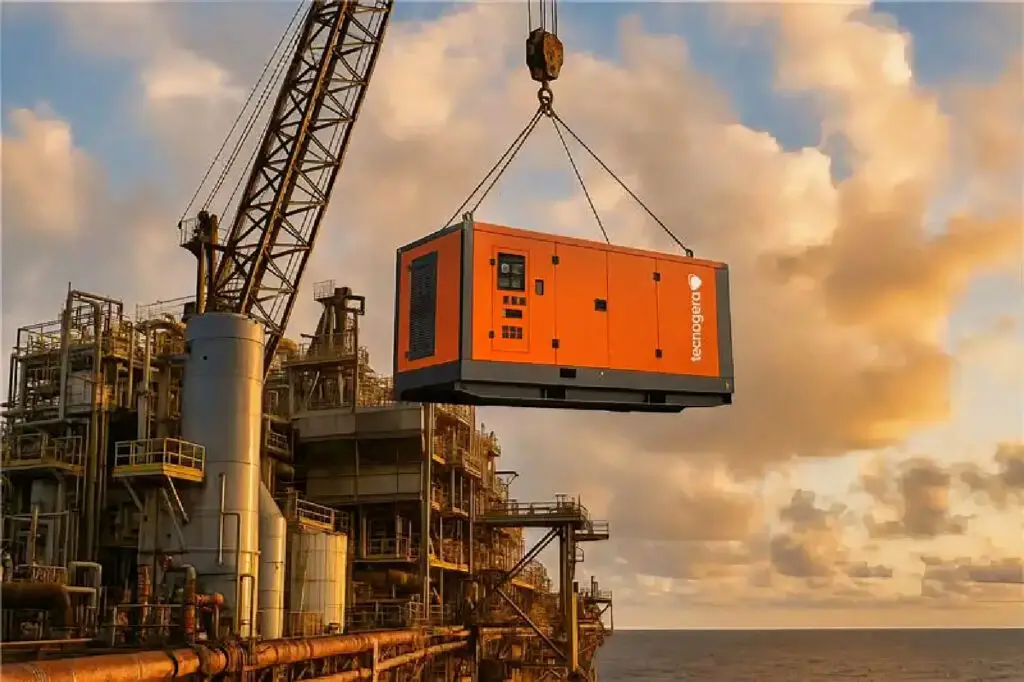
Oil exploration and production platforms have space and weight limits that must be respected. Power generator sets are transported to these units by ships and unloaded using cranes.
These cranes, however, have limitations in their transport capacity. Therefore, those responsible for power generation must always find, at the planning stage, the generators with the best generation capacity and, at the same time, lighter.
Furthermore, the oil market in Brazil is quite demanding regarding the nationalization index of equipment. Petrobras, for example, requires that most parts of a power generator be manufactured in Brazil.
Fortunately, the market already offers robust, lightweight equipment (up to 14 tons, ideal for unloading on platforms) with a nationalization index that can reach 90%.
Safety on oil and gas platforms
Safety is one of the pillars of oil and gas operations, especially on offshore platforms, where activities occur in remote environments, with high operational complexity and exposure to risks.
In these locations, any failure can compromise the integrity of workers, assets, and the continuity of production, making prevention a priority at all stages of operation.
Drilling, maintenance, cargo handling, and power generation activities are among the most critical and require strict control procedures. Therefore, companies in the sector adopt safety management systems, continuous monitoring, preventive and predictive maintenance of equipment, as well as specific protocols for emergency response.
Training and safety culture
Risk reduction depends not only on the technology employed but also on the qualification of the teams. Periodic training, emergency drills, correct use of personal protective equipment (PPE), and compliance with operational procedures are fundamental practices to strengthen the safety culture on platforms.
In addition to professional training, technical inspections and periodic audits ensure that equipment, electrical systems, power generation units, and other assets operate within industry standards, contributing to increased operational reliability.
Safety in temporary power generation
Power generation is a critical activity on oil and gas platforms, as various essential systems depend on the continuous supply of electricity.
In temporary operations or during scheduled maintenance shutdowns, generator sets play a strategic role in ensuring the continuity of activities without compromising the safety of the facility.
For this reason, the equipment used must be designed to operate in harsh environments, with features such as automatic protection systems, remote monitoring, corrosion-resistant components, fire protection, and emergency shutdown devices.
Additionally, periodic maintenance and proper sizing of the solution are essential to reduce operational risks and increase energy availability.
Regulation and compliance
Operations on oil and gas platforms follow a series of standards and technical requirements aimed at protecting workers and the facility. In Brazil, the NR-37 establishes safety and health guidelines for work on oil platforms, defining requirements related to risk management, training, emergency plans, habitability, fire-fighting systems, and offshore working conditions.
In addition to NR-37, operations must meet the requirements of regulatory bodies and technical standards applicable to electrical systems, power generation, and operational safety. Compliance with these regulations helps reduce risks, ensure production continuity, and increase operational reliability in offshore environments.
Major companies operating in the oil and gas sector in Brazil
Brazil is one of the world’s leading oil producers and attracts investments from major national and international companies, especially in offshore exploration and production projects.
Among the main companies operating in the oil and gas sector in Brazil are:
- Petrobras
- Shell
- TotalEnergies
- Equinor
- ExxonMobil
- bp
- Repsol Sinopec Brazil
- Petrogal Brazil
- CNOOC Petroleum Brazil
These companies participate in exploration, development, and production projects in different sedimentary basins, contributing to the growth of the industry and the expansion of national energy infrastructure.
How does temporary power serve the Oil and Gas sector?
Tecnogera serves the oil and gas sector with high-power generators, hybrid solutions, and specialized logistics for remote areas, including transportation, installation, and supply.
The 24/7 technical support ensures that any unforeseen issues are resolved quickly, minimizing the impact on critical operations that cannot stop.
Does your operation need reliable power in any location? Discover Tecnogera’s solutions!