Amperage is the measure of the intensity of electrical current flowing through a conductor over a specific time period. Essentially, it indicates the number of electrons passing through a circuit point to make devices work.
Understanding this concept is key to ensuring operational safety and energy system efficiency in any project. At Tecnogera, we prioritize this knowledge to offer robust solutions in generators and cutting-edge infrastructure to meet diverse demands.
Technical Definition of Amperage and Its Unit of Measurement
The official unit of current measurement is the ampere (A), named after physicist André-Marie Ampère, a pioneer in electromagnetism. Physically, one ampere represents the flow of approximately 6.24 trillion electrons passing through a point each second.
While “amperage” is widely used in everyday language, the technically correct term is electric current, the standard term in engineering. In Tecnogera’s solutions, we use this metric to precisely size equipment and prevent any supply failures.
The Role of Electrons in Current Conduction
Electric current arises when electrons move in an orderly fashion through a conductive material, such as copper wires. This movement occurs due to a potential difference, creating the necessary flow to power motors and machines.
The intensity of this movement defines the system’s amperage: the more electrons flowing simultaneously, the greater the load supported.
Monitoring this flow is essential to maintain the integrity of power generators and industrial electrical panels.
Difference Between Amperage, Voltage, and Power
Understanding the difference between these terms prevents errors in electrical network sizing and choosing supplies for each company and project. Each measure plays a role in delivering the necessary energy for your business’s productivity and continuity.
- Voltage (tension): the “pressure” that pushes electrons through the conductor, measured in Volts (V).
- Amperage (current): the actual volume of electrons flowing, measured in Amperes (A).
- Power: the total work done by the system in a specific time, measured in Watts (W).
The Relationship Between Amperage and Power
The basic relationship is defined by the formula P = V × I, where P is power, V is voltage, and I is current. To find a device’s amperage, simply divide the power by the operating voltage (I = P / V).
For example, a 2200W machine connected to a 220V network consumes an exact current of 10 Amperes. This simple calculation is the basis for Tecnogera to define the best generator rental plan for your needs.
How Does Amperage Work in Practice?
In practice, amperage determines how much a cable or component can handle without physical damage or overheating. Incorrect use can cause load loss and even compromise operational continuity, such as on construction sites, logistics centers, and general industries.
Why Does Amperage Affect Cable Heating?
When electrical current flows through a conductor, the material’s resistance generates heat, a phenomenon known as the Joule Effect. If the amperage exceeds the wire’s capacity, excessive heat can melt the plastic insulation.
This uncontrolled heating poses a high risk of fires and severe failures in temporary power systems. Therefore, choosing certified materials is a safety pillar in all electrical engineering projects.
The Importance of Proper Cable and Conductor Sizing
Correct sizing of cables and conductors follows strict standards, such as NBR 5410, which defines the necessary gauge, i.e., the wire’s cross-sectional area in mm², according to the nominal current. Undersized cables increase resistance, raising energy consumption and wear on connected equipment.
Tecnogera’s technical team conducts detailed load studies to ensure each conductor operates within a safe range. This prevents unscheduled downtimes and maintains energy efficiency at optimized levels for client success.
What is the Relationship Between Amperage and Energy Consumption?
Electrical consumption is the result of power multiplied by usage time, usually measured in kWh on bills. Since amperage is part of the power formula, it directly influences the final energy cost for the company.
A high amperage device demands more from the system and, if used for extended periods, significantly increases operational costs. Managing this demand is a strategic step for companies seeking to reduce expenses without losing productive performance.
Types of Electrical Current
There are two main forms of electricity transport: Direct Current (DC) and Alternating Current (AC). Each has unique characteristics that define its application in batteries, distribution networks, or large industrial machines.
Direct Current (DC)
In direct current, electrons flow in a single direction, maintaining constant polarity over time. It’s the standard used in batteries, internal electronic circuits, and modern photovoltaic solar energy systems.
Its main limitation is the difficulty of long-distance transmission without significant voltage losses in the network. However, it is essential for stable energy storage and the operation of electronic security devices.
Alternating Current (AC)
Alternating current reverses its direction periodically, allowing voltage to be easily increased or decreased by transformers. This model is the global standard for public energy distribution and building electrical networks.
Most industrial generators produce Alternating Current to power high-power motors and lighting. Tecnogera offers modern equipment that ensures the stability of this frequency to protect your entire infrastructure.
How Does Amperage Influence the Choice of Power Generators?
When choosing a generator, the total load amperage is the determining factor for the motor and alternator size. An inaccurate calculation can result in generator overload or excessive fuel consumption in oversized machines.
It’s necessary to add the nominal current of all equipment and consider startup peaks, which require higher amperages. Tecnogera provides specialized consulting to identify the ideal generator set for each application scenario.
How to Measure Amperage in an Electrical Circuit?
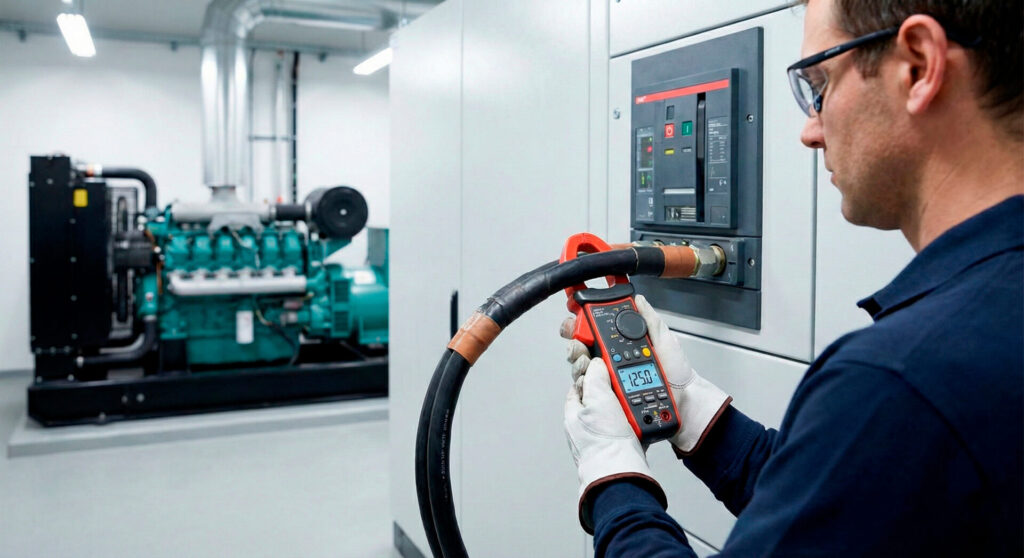
Accurate measurement is crucial for diagnosing failures and preventive monitoring of industrial power systems. Using the correct tools ensures that information reflects the circuit’s operational reality without risks to the technician.
- Clamp Meter: allows measuring current through the magnetic field, without needing to open or interrupt the circuit.
- Multimeter: requires series connection with the load, more common for low electronic amperage measurements.
- Safety: always use appropriate PPE and check if the instrument supports the evaluated location’s voltage category.
Amperage Measurement Instruments and Their Functioning
- Digital Ammeters: offer precise and instant readings on LCD screens, facilitating quick technical analysis in the field.
- Analog Ammeters: use a needle over a scale, useful for observing very gradual current variations.
- Current Sensors: integrated into automation systems for remote monitoring and constant electrical network protection.
Applications of Ohm’s Law
Ohm’s Law (I = V / R) allows calculating current by knowing the circuit’s voltage and total resistance. If the resistance of a load drops drastically, the amperage rises, helping identify insulation problems.
In a 120V system with 12 Ohms resistance, the current flowing will be exactly 10 Amperes. Applying these calculations prevents failures in energy security systems and critical infrastructures of large companies.
Importance of Amperage in Electrical Safety
Amperage control is the first line of defense against serious accidents in industrial and commercial environments. A disordered current can turn a conductor into a dangerous heat source, generating high occupational risks.
Amperage and the Sizing of Circuits and Protection Devices
Devices like breakers and fuses are specifically sized by the amperage they can interrupt in case of failure. If the breaker is larger than the wire’s capacity, it won’t trip in an overload, causing damage.
The wire gauge must be compatible with the nominal current to avoid voltage drops and energy waste. Tecnogera ensures all its temporary installations follow these rigorous electrical protection standards.
| Common Application | Typical Estimated Current (Amperes) |
| LED Lamp (10W – 220V) | 0.04 A |
| Air Conditioner (12,000 BTU) | 5 – 8 A |
| Small Industrial Motor | 10 – 20 A |
| 500 kVA Generator Set | ~1300 A |
Risks of Overload and Short Circuit
Overload occurs when too many devices demand a current higher than the circuit was designed to provide.
A short circuit is the sudden and extreme increase in amperage due to direct contact between energized wires.
Both situations can result in fires and total loss of important operational assets. Therefore, preventive maintenance and the use of Tecnogera-certified components are crucial for the business.
Ensure Electrical Efficiency with Tecnogera Solutions!
Partnering with Tecnogera, a leading company in energy solutions, means accessing energy security for large demands at the best cost-benefit. We offer generator set rentals, transformers, and load banks with specialized technical support and high availability.
Our differentiators include one of the most modern fleets in Brazil, nationwide service, and a total focus on supply reliability. By entrusting your project to our team, you ensure that every detail of amperage is handled with technical rigor.
Whether for events, industries, or infrastructure works, our brand is synonymous with strategic partnership and operational excellence.
Contact us and discover how we can optimize your energy matrix with maximum safety and economy.