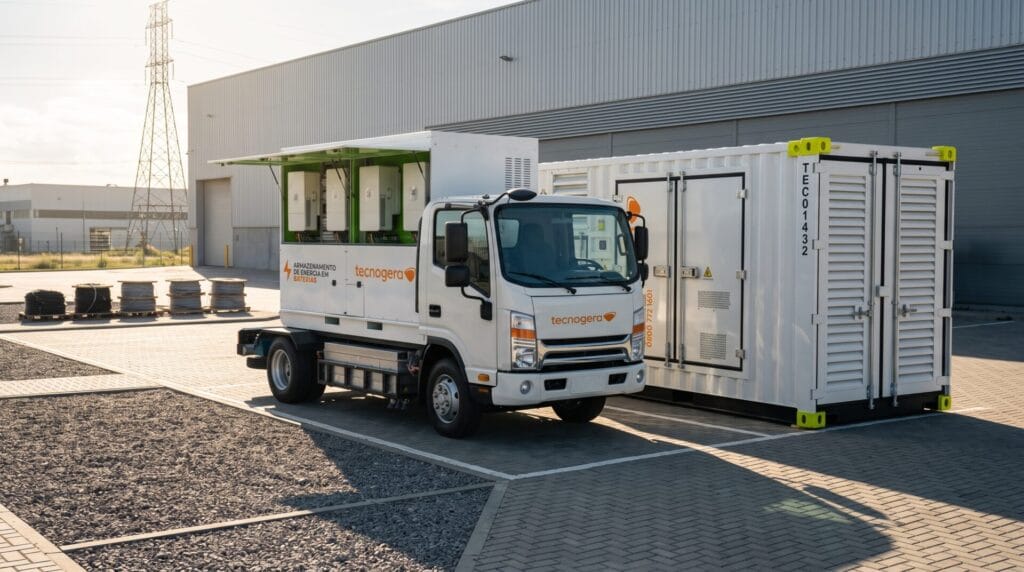
When an operation faces scheduled maintenance, expansion, contingency, or infrastructure failure, the first need that usually arises is the search for temporary power.
In many projects, however, ensuring power supply is only part of the challenge.
An industry may need to keep equipment cooled. A Data Center may require temporary cooling capacity. A construction site may need lighting, compressed air, and height access. During maintenance shutdowns, different systems may depend on temporary infrastructure to keep activities going.
It is in this context that the need arises to think about an integrated solution.
More than hiring equipment in isolation, an operation may need to analyze how different systems work together and what resources are needed to maintain the activity, support an intervention, or ensure the continuity of a critical process.
What is an integrated temporary solution?
An integrated temporary solution brings together different equipment and services to meet the specific needs of an operation.
Instead of analyzing just one demand — such as the lack of power — the project considers all the infrastructure necessary for a particular activity to be carried out.
Depending on the application, an integrated solution may involve:
- Temporary power generation;
- Energy storage systems, such as BESS;
- Cooling and temperature control with chillers and fan coils;
- Electrical system testing with load banks;
- Compressed air supply;
- Temporary lighting;
- Elevating platforms for working at heights.
The combination of these solutions depends on the characteristics, risks, and objectives of each project.
Why might temporary power alone not solve the problem?
Imagine a maintenance shutdown in an industrial plant.
A generator can supply power to certain equipment and systems. But if the operation also depends on compressed air, temperature control, or lighting in temporary areas, just generating power doesn’t meet all the activity’s needs.
The same happens in other segments.
A Data Center, for example, may need contingency power, but also relies on the proper functioning of cooling systems to maintain the necessary operational conditions for the equipment.
In a construction site, on the other hand, the demand may involve power, lighting, and equipment for access at heights.
What situations might require an integrated solution?
There are different scenarios where a single solution may not be sufficient.
Maintenance shutdowns
During a scheduled shutdown, different areas of an operation may undergo maintenance simultaneously.
This can create temporary demands related to:
- Power;
- Lighting;
- Compressed air;
- Air conditioning;
- Height access;
- Equipment and systems testing.
Integrated planning allows these needs to be assessed before the intervention begins.
Capacity expansion
Companies that are expanding a plant, building a new area, or temporarily increasing their capacity may need additional infrastructure before the permanent facility is ready.
During this period, temporary solutions can support the operation without requiring the immediate deployment of all permanent infrastructure.
Contingencies and infrastructure failures
When a critical system fails, the goal is not just to replace the unavailable equipment.
It is necessary to assess which other areas will be impacted by the interruption.
A failure in an air conditioning system, for example, may require a temporary cooling solution. Depending on the project configuration, this solution may also require adequate electrical infrastructure to operate.
Thinking about these systems in an integrated way helps to understand the dependencies between them.
Temporary works and projects
Construction and infrastructure projects often need different resources at the same time.
The same work front may require:
- Power for equipment;
- Lighting for nighttime operations;
- Platforms for activities at height;
- Compressors for tools and processes;
- Temporary climate control for specific areas.
In this case, planning each need separately can increase the complexity of the operation.
How does an integrated solution work in practice?
An integrated solution begins with the analysis of the operation.
Before defining the equipment, it is necessary to understand:
1. What is the objective of the operation?
Is the need related to operational continuity, maintenance, expansion, construction, or contingency?
The answer influences all subsequent steps.
2. Which systems are critical?
It is important to identify which equipment and processes cannot be interrupted or which are necessary for the activity to be carried out.
An operation may depend on energy, climate control, compressed air, or a combination of these resources.
3. What are the dependencies between the systems?
Not all equipment operates independently.
A temporary climate control system, for example, may depend on an adequate energy infrastructure. Similarly, a nighttime operation may require both energy and lighting equipment.
Mapping these relationships helps create a more coherent project.
4. How long will the solution be needed?
The duration of the need influences the sizing, logistics, and choice of equipment.
A contingency of a few hours has different characteristics from a scheduled shutdown of several weeks.
5. How will the installation and operation be carried out?
It is also necessary to evaluate factors such as:
- Available space;
- Access to the site;
- Ground conditions;
- Existing infrastructure;
- Operation schedule;
- Transportation and mobilization needs;
- Technical and operational requirements.
Energy, climate control, and infrastructure: systems that need to work together
In more complex operations, the infrastructure functions as a set of interdependent systems.
The energy allows powering equipment and processes.
The climate control helps maintain the necessary thermal conditions for certain operations.
The compressed air can be essential for tools, equipment, and industrial processes.
The load bank can be used in testing and validation of electrical systems.
As for aerial work platforms and light towers can support the execution of field activities.
When these needs are analyzed together, it is possible to have a more complete view of the necessary temporary infrastructure.
An example: maintenance in an industrial operation
Imagine that an industry needs to carry out scheduled maintenance on part of its infrastructure.
During this period, different teams may work simultaneously. Some activities may occur at height. Others may require pneumatic tools. Certain areas may need additional lighting.
Additionally, critical systems may need to continue operating.
In this scenario, the project may involve:
- Generators for temporary power supply;
- Air compressors to support activities and processes;
- Aerial work platforms for access at height;
- Light towers for outdoor areas or nighttime operations;
- Chillers or fan coils, when temperature control is needed;
- Load banks for specific electrical infrastructure tests.
The main point is not to use all these devices in every project.
It is to identify which solutions are necessary for that specific operation and how they should be planned together.
Integrated solutions for Data Centers
The integration between different systems is also especially relevant in critical operations, such as Data Centers.
The availability of the infrastructure depends on different elements working in a coordinated manner.
Among them may be:
- Power systems;
- Energy storage solutions;
- Cooling systems;
- Temporary infrastructure during maintenance;
- Testing and validation of electrical equipment.
During an expansion, retrofit, maintenance, or contingency, a temporary solution may need to meet more than one of these needs.
For example, the unavailability of part of a cooling system may require temporary cooling capacity. For this solution to come into operation, it may also be necessary to assess the available electrical infrastructure.
Therefore, planning needs to consider the operation as a system — not just isolated equipment.
What are the benefits of planning solutions in an integrated way?
Integration does not simply mean hiring multiple pieces of equipment from the same supplier.
The main objective is to plan the different needs in a coordinated manner.
Among the benefits of this type of approach are:
More comprehensive view of the operation
Instead of analyzing only the immediate problem, planning considers the systems that may be impacted.
Better coordination between solutions
Equipment and services can be scaled considering the relationships between the different demands of the operation.
Reduction of operational complexity
An integrated view can facilitate the planning of logistics, mobilization, installation, and project monitoring.
Greater predictability
When needs are identified in advance, the operation can be planned more clearly.
Flexibility for different scenarios
Temporary projects can be adapted according to changes in operation, schedule, or infrastructure needs.
How to choose an integrated temporary solution?
The choice should be based on the needs of the operation, not just the available equipment.
Some questions can help in this process:
- Which activity needs to continue functioning?
- Which systems are essential?
- Is there any infrastructure unavailable?
- Which equipment depends on each other?
- What is the expected duration of the need?
- Is there space for equipment installation?
- What are the access and mobilization conditions?
- Is the demand planned or emergency?
- Does the solution need to be scalable?
Based on this information, it is possible to define a more suitable combination of solutions for each project.
The future of temporary infrastructure lies in integration
Operations are becoming increasingly complex.
Industries, construction sites, Data Centers, and infrastructure projects do not rely on just one system to function. Power, climate control, storage, testing, and support equipment are part of an infrastructure that needs to respond to the characteristics of each operation.
Therefore, the planning of temporary solutions tends to go beyond the simple rental of equipment.
The question is no longer just:
“Which equipment do I need to rent?”
And becomes:
“What does my operation need to continue functioning?”
This change in perspective allows for a broader analysis of the project and the identification of solutions that meet the different needs of the operation.
Integrated solutions for temporary operations with Tecnogera
The Tecnogera operates with different solutions that can support temporary projects and critical operations, including power generation, storage with BESS, climate control, load banks, air compressors, aerial platforms, and lighting towers.
Each project has its own characteristics. Therefore, the infrastructure sizing must consider factors such as demand, duration, operating environment, critical systems, and client objectives.
By analyzing these needs in an integrated manner, it is possible to structure solutions more aligned with the reality of each operation.
FAQ: integrated temporary solutions
What is an integrated temporary solution?
An integrated temporary solution combines different equipment and resources to meet the needs of an operation. Depending on the project, it may involve power, climate control, storage, compressed air, lighting, testing, and support equipment.
When is temporary power not enough?
Temporary power may not be enough when the operation also depends on other systems, such as climate control, compressed air, lighting, or infrastructure for activities at height.
What solutions can be used during a maintenance shutdown?
Depending on the activity, a maintenance shutdown may require generators, air compressors, aerial platforms, lighting towers, climate control systems, and load banks.
How can an integrated solution support a Data Center?
An integrated solution can consider different needs of a critical operation, such as power, storage, climate control, temporary infrastructure, and system testing.
How to choose a temporary solution for an operation?
The first step is to identify which systems need to continue operating, which resources are unavailable, how long the solution will be needed, and what the technical and operational conditions of the site are.Read also: how to protect the operation against interruptions caused by storms