

Wind Power to Become the Second Largest Energy Source in 2019
Wind energy is set to become Brazil’s second largest energy source in 2019, reaching 15 GW by March (surpassing biomass at 14.7 GW). The sector boasts 568 wind farms and 7,000 wind turbines across 12 states, with Rio Grande do Norte leading at 3.9 GW. Brazil climbed from 15th in the world in 2012 to 8th in 2017. Power generators and load banks are crucial during commissioning, simulating real-world scenarios to detect instabilities before the commercial operation of the farms.
Rain and High Temperatures Drive Temporary Energy Market
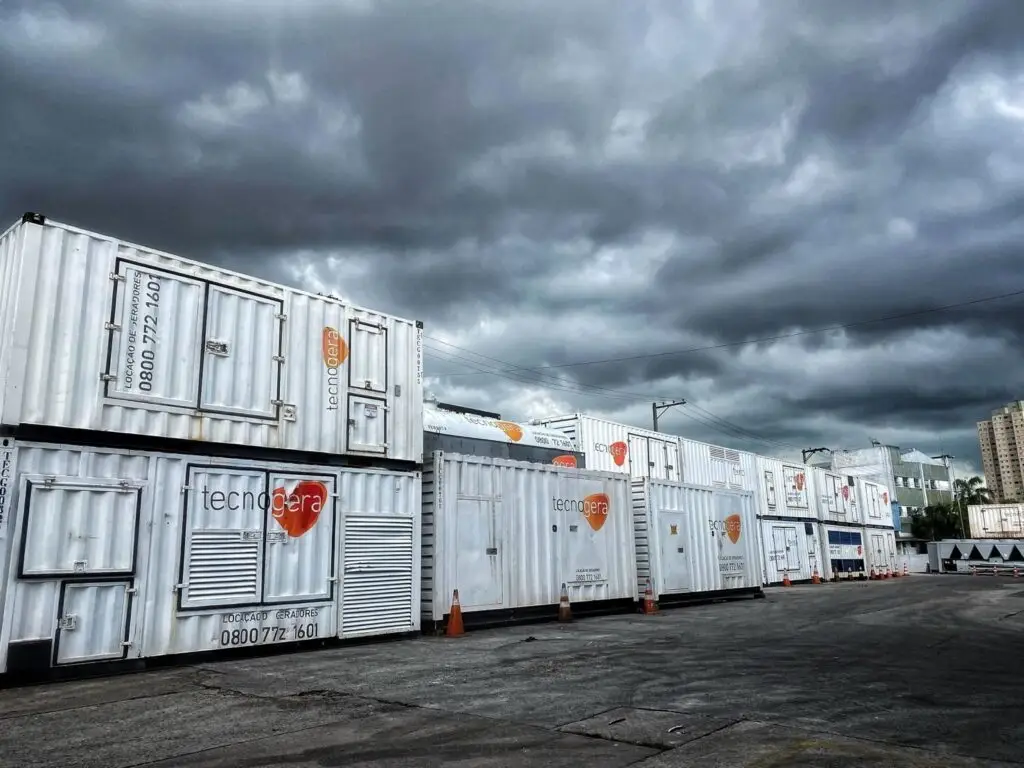
The International Research Institute for Climate predicts a 70% chance of El Niño in 2019, leading to dry weather in the Central-North and wet conditions in the South/Southeast with high temperatures and heavy rains. Storms cause power outages disrupting business operations. In retail, demand for temporary energy is expected to grow by 50% at the end of 2018 and the beginning of 2019. Rental becomes a viable alternative including generators, accessories, and 24-hour service, avoiding high acquisition costs.
Temporary Power Solutions for Retail
Brazilian retail grew by 3.2% in October 2018, with Black Friday sales increasing by 23% compared to the previous year (exceeding the 15% expectation). The event expanded from online to physical stores, raising concerns about power. Outages during key dates like Black Friday and Christmas can lead to sales losses and damage to reputation. High temperatures drive up demand for air conditioning. Tecnogera provides customized 24/7 solutions with a fleet of 800+ power generators for retail sector contingencies.
Tecnogera secures contract with Petrobras
Tecnogera has won a bid to supply temporary power to Petrobras for three years (extendable for an additional two), covering facilities in 15 states. The contract includes power generators, cables, transfer switches, and accessories to meet demands such as technical failures, shutdowns…
Oil Companies and the Demand for Temporary Power
Petrobras forecasts a 9.5% increase in oil production for 2019 (2.3 million barrels/day), with new facilities like P-74 and Cidade Campos dos Goytacazes. Platforms located up to 300 km offshore do not connect to the SIN due to economic infeasibility, relying on diesel generators for extraction at depths of up to 7,000 meters. Tecnogera offers compact and more fuel-efficient generators, reducing logistical costs and ensuring energy security for up to 150 workers per platform.
The use of power generators in football stadiums
Blackouts in stadiums cause significant disruptions, as seen at Centenário (Argentina, 2012) and Pacaembu (March 2018, Santos vs. Corinthians match interrupted for 49 minutes). Tecnogera implemented an energy solution at Pacaembu, providing power generators for all games. Stadiums overload the electrical grid due to high lighting demands. During the Rio 2016 Games, Maracanã and beach volleyball arenas used power generators as required by the IOC. Power generators are well-suited for high power demands and offer maximum energy security.
Asset Light: The Business Model Revolutionizing the Market
The asset-light model has proven to be an effective strategy for companies seeking greater flexibility and better return on investment. In this article, we explore how this model applies to the temporary power sector, comparing it with the traditional asset-heavy approach and presenting case studies of companies that have adopted this strategy.
Infrastructure investments will resume growth in 2019
Power generators have been essential to Brazilian infrastructure since the 1970s, supporting sectors like construction, mining, oil & gas, retail, sanitation, telecommunications, and renewables. After a decline in 2018 (1.65% of GDP), investments are expected to rise to 1.85% of GDP in 2019 and 2.03% by 2030. BNDES forecasts a 13% growth in infrastructure over the next three years. Industries such as mining and oil & gas require power generators around the clock. Tecnogera operates over 800 power generator units across 5 states.
Temporary Power in the Automotive and Auto Parts Industry
The vehicle and auto parts sector led the increase in energy consumption with a 13.99% growth in July. The automotive industry closed 2017 with 2.24 million vehicles sold (9.2% growth) after three negative years. With 24-hour production lines and critical processes like welding and post-paint cooling, power interruptions cause significant losses. The ISO TS 16949 standard requires plans against energy risks for export. Generator rental is a viable solution for energy security.
Low reservoir levels and demands for temporary energy
The reservoirs of hydroelectric plants maintain critical levels: Northeast at 34.5% (historical average 50.9%) and Southeast/Central-West at 33.57% (historical average 57.5%). In Bahia, 180 municipalities are in emergency due to drought, affecting 4 million people. Aneel maintains red flag level 2 (R$ 5.00 per 100kWh). This increases demand for temporary energy. Tecnogera provided generators to pump water from the dead volume of Cantareira in 2015, ensuring the supply of millions of homes.