Distributed Generation (DG) is the production of electricity conducted at or near the consumer’s location. Unlike the traditional model, which is centralized in large plants or production sources, DG decentralizes this generation, using renewable or high-efficiency sources directly at the consumption site or nearby, connected to the distribution network.
Index
- How distributed generation works
- What are the advantages of distributed generation?
- What is the importance of distributed generation in the electrical sector?
- What legislation governs distributed generation
- What are the challenges in implementing distributed generation?
- Difference between centralized and distributed generation
- What is the efficiency of a distributed generation system?
- Applications of distributed generation in Brazil
How does Tecnogera support clients engaged in distributed generation?
How distributed generation works
The operation of distributed generation begins with the installation of a generating system, such as photovoltaic solar panels. After installation, the system is connected to the local utility’s electrical grid, following technical and safety standards. The energy generated is primarily consumed at the production site.
If production exceeds the immediate and necessary consumption of the site, the surplus is injected into the utility’s grid. This added and injected energy volume generates energy credits, which can be used to offset consumption in subsequent months or at other consumer units, provided they are under the same ownership.
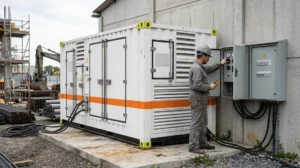
In some scenarios, Tecnogera can provide complementary solutions, ensuring stability and continuity of supply even during the intermittency of the main source.
What are the advantages of distributed generation?
Distributed generation offers several benefits, transforming the consumer’s relationship with energy. From financial savings to environmental contributions, the advantages are significant and cover various aspects of the energy chain.
Reduction in energy bills
One of the most attractive advantages is the reduction in electricity bills. By generating their own energy, consumers reduce the amount purchased from the utility. The surplus injected into the grid becomes credits, which can offset consumption by up to 95%, depending on the system and usage profile.
For companies with a high consumption profile, these savings can be even greater. Imagine an industry that, by installing a photovoltaic system, reduces its monthly bill from R$ 20,000 to R$ 2,000.
This is a practical example of the direct impact of DG on operational costs, with percentages varying according to the type of consumption and the business’s relationship with the input.
Enables companies and industries to participate in energy production
DG empowers companies and industries to become key players in the energy matrix. In this format, they cease to be mere consumers and become producers, or “prosumers” – a term that combines producing and consuming, referring to consumers who generate energy.
This not only reduces costs but can also add value to the brand by demonstrating a commitment to sustainability and energy generation from renewable sources.
Businesses, industries, and agribusiness can install micro or mini-generation systems to meet their own demand.
With its expertise in energy solutions, Tecnogera can assist from sizing to integrating DG systems, ensuring that production meets the specific needs of each operation safely and in compliance with regulatory rules.
Reduces pressure on energy operation and transmission
Another advantage is that generation close to the consumption site eases the load on extensive transmission and distribution networks. This happens because energy does not have to travel long distances from large plants to end consumers, who are usually in urban centers.
With fewer losses along the way, the overall efficiency of the electrical system improves and operational costs are also reduced.
This relief can delay or reduce the need for large investments in transmission infrastructure expansion. Locally generated energy helps stabilize the grid at specific points, especially in areas with higher demand or more sensitive infrastructure.
Enables energy autonomy
And the advantages don’t stop there. Distributed generation provides greater energy autonomy to consumers.
By producing part or all of the energy they consume, they become less dependent on tariff fluctuations and the availability of the public grid. This independence is an important step towards energy security.
In remote locations or with unstable supply, DG can be the main energy source. Tecnogera’s solutions, like backup generators, can complement DG systems, ensuring continuous and reliable supply even during grid failures or renewable source intermittency.
What is the importance of distributed generation in the electrical sector?
The main importance of distributed generation in the electrical sector lies in its ability to democratize access to energy. It also diversifies the energy matrix, promotes sustainability, and increases system resilience.
By decentralizing generation, dependence on large energy-producing plants and transmission lines is reduced, positively impacting the entire supply system.
This contributes to a more robust system, less susceptible to widespread blackouts. DG also drives technological innovation and the creation of new business models in the sector, fostering a more dynamic and competitive market.
What legislation governs distributed generation
The regulation of distributed generation in Brazil is fundamental to its development. ANEEL’s Normative Resolution No. 482/2012 was the initial milestone, establishing the conditions for micro and mini-distributed generation to connect to the grid and the electricity compensation system.
Subsequently, Normative Resolution No. 687/2015 brought improvements, such as the possibility of shared generation. More recently, Law No. 14.300/2022 established the legal framework for DG, providing greater legal certainty and predictability for the sector.
Understand Law 14.300
Law 14.300/2022, enacted in January 2022, is known as the Legal Framework for Distributed Generation. It established clear rules for microgeneration – up to 75 kW and minigeneration – above 75 kW and up to 5 MW for dispatchable sources, or 3 MW for non-dispatchable distributed sources.
Dispatchable sources are, by definition, those that can be controlled to generate energy on demand.
Law 14.300 was very important for providing legal certainty, consolidating the electricity compensation system (SCEE).
What are the challenges in implementing distributed generation?
Despite advances, especially regulatory ones, the implementation of DG still faces challenges. The initial cost of acquiring and installing systems, although decreasing, can still be a barrier for some consumers.
The regulatory and bureaucratic complexity, even with the new law, also discourages investors with less financial capacity.
In Brazil, mainly due to its continental dimensions, there are specific challenges such as the need to adapt distribution networks to accommodate a bidirectional energy flow and manage the intermittency of renewable sources.
Tecnogera contributes by offering solutions that mitigate intermittency, such as backup and stabilization systems.
Difference between centralized and distributed generation
Centralized generation involves large plants like hydroelectric, thermoelectric, and nuclear, usually located far from consumption centers.
In this format, energy is transported through extensive transmission and distribution lines, with significant energy losses in the process. The energy flow is predominantly unidirectional.
Distributed generation, on the other hand, occurs near consumers, with small or medium-sized generating plants. It mainly uses renewable sources, like solar, reducing transmission losses and environmental impact.
It allows a bidirectional energy flow, with consumers also injecting surpluses into the transmission network, generating scale savings for users and reducing operational costs for the entire system.
See the main differences between the two types of generation:
| Centralized Generation | Distributed Generation (DG) |
Generation | Large-scale plants generate energy that is transmitted over long distances to consumers | Energy is generated by small or medium sources at the consumption site or nearby |
Where it is generated | In hydrographic basins and areas with mineral resources | At the consumption site itself. Like, in the case of solar, on rooftops, farms, and industries |
| Power | High power (hundreds of Megawatts to Gigawatts – MW to GW). | Low to medium (from a few Kilowatts to some Megawatts – kW to MW). |
Transmission | Requires long and expensive transmission lines and can have losses during the process | Uses short distribution networks or none, resulting in lower electrical losses |
| Energy Flow | Unidirectional: from the plant to the consumer. | Bidirectional: the consumer can also produce and inject excess energy into the grid. |
Reliability Level | Vulnerable to large-scale failures. A problem in a plant or main line can cause mass blackouts | More resilient and stable. A local failure does not affect the entire system, and the grid becomes more robust |
Environmental Impact | Usually high and concentrated in a single region (large dams, thermoelectric emissions). | Lower and dispersed. Often associated with clean renewable sources (solar, wind, biogas |
Investments | High initial investment, usually owned by the state or large energy corporations. | Lower and more accessible investment, potentially owned by the consumer, companies, or communities |
| Examples | Hydroelectric Plants, like Itaipu and Belo Monte) and Thermoelectric Plants, | Solar panels on rooftops, diesel/gas generators in industries, small hydroelectric plants (SHPs), wind turbines on farms |
What is the efficiency of a distributed generation system?
The efficiency of a distributed generation system should be analyzed from two perspectives. The first is the efficiency of the equipment, such as solar panels converting light into electricity. The second, more comprehensive, is the efficiency of the system as a whole, including the drastic reduction of losses.
Compared to centralized generation, which can have transmission and distribution losses exceeding 10-15%, DG is more efficient. By generating energy close to the consumption point, these losses are minimized, optimizing energy utilization overall.
Applications of distributed generation in Brazil
Brazil, with its vast territorial extension and high solar irradiation, presents an ideal scenario for DG. The most common application is photovoltaic solar on the roofs of homes, businesses, warehouses, and industries, reducing electricity bills and promoting scale savings while contributing to sustainability.
In agribusiness, DG is used for irrigation and rural operations, often in locations without easy access to the grid. Isolated communities also benefit, gaining access to reliable energy.
With its experience in executing different projects, Tecnogera has supported various clients, from data centers to hospitals, that integrate DG to optimize costs and ensure the continuity and security of their critical operations.
How does Tecnogera support clients engaged in distributed generation?
Tecnogera plays a crucial role in the distributed generation ecosystem, offering solutions that ensure system reliability and optimization.
For clients investing in DG, especially with intermittent sources like solar, continuity of supply is vital.
Our solutions include high-performance power generators, uninterruptible power supply (UPS) systems, and load banks, ensuring energy supply during grid failures or periods of low self-generation.
Tecnogera offers specialized consulting to efficiently integrate these solutions, maximizing the benefits of DG and protecting critical operations from interruptions, strengthening our clients’ energy autonomy and security.