Choosing between renting or buying an aerial platform is a strategic decision that directly impacts the performance, costs, and safety of operations at height.
Finding the best cost-effectiveness does not depend solely on price, but rather on the relationship between investment, efficiency, time frame, and productivity.
Work at height is characterized by any activity performed above two meters from the lower level, with a risk of falling.
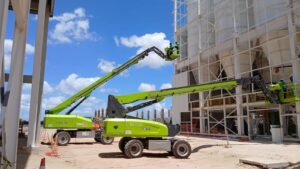
To ensure safety and productivity, it is essential to have appropriate equipment such as Mobile Elevating Work Platforms (MEWPs). They replace scaffolding, increase mobility, and reduce accident risks, facilitating tasks in building maintenance, electrical installations, and painting, among others.
However, the question arises: what is the best option, buy or rent?
When to rent or buy a platform
Renting an aerial platform is a good choice for temporary projects, with specific or short-term demands.
Renting avoids high initial investments, eliminates maintenance and storage costs, and allows access to modern and updated equipment for each type of project. In construction, scheduled maintenance, or services in different locations, renting is advantageous for offering flexibility and time savings.
Another important point of renting is the included technical assistance and the possibility of choosing the type of platform according to the need: scissor, articulated, vertical or telescopic mast.
The rental company is also responsible for inspections, regulation according to standards and transportation to the site. Thus, the company avoids concerns about repairs and increases operational efficiency.
On the other hand, purchasing an aerial work platform may be more appealing for companies that use the MEWP continuously, in recurring operations or in industrial production sectors with high demand.
Despite the high initial outlay, the acquisition ensures immediate availability of the equipment, full control of maintenance, and customization according to the operational routine.
Purchasing also avoids recurring rental expenses in the long term and may be more economical for those who constantly use the machinery. The decision should also consider storage capacity, maintenance team, and whether the investment will fit within the company’s budget without compromising other areas.
Factors influencing the decision
Mobile Elevating Work Platforms (MEWPs) are essential for activities at height in various sectors, such as construction, industries, warehouse maintenance, and industrial installations.
They provide safety, agility, and efficiency in operations, replacing scaffolding and optimizing resources on the construction site or plant.
Check out the main factors influencing the decision between renting or buying:
- Type and duration of the project
- Frequency of use
- Available budget
- Maintenance and storage cost
- Project location and logistics
- Need for technical assistance
- Types of platforms required (articulated, scissor, telescopic, vertical mast)
- Regulatory requirements
- Sustainability and energy efficiency of equipment
- Own operation and fleet management capability
Risks and limitations of each option
Every decision has advantages, risks, and limitations. Carefully evaluating scenarios avoids unnecessary expenses and increases operational safety.
In rental
- Time limitation: the use of the platform is restricted to the contracted period, which may incur additional costs in case of delays;
- Availability: there may be unavailability of the ideal model on the desired date, especially during periods of high demand;
- Recurring costs: in the long run, the rental value may exceed the acquisition cost;
- Dependence on third parties: the efficiency of the operation depends on the agility and support of the rental company.
In purchase
- High initial investment: can compromise cash flow, especially in small and medium-sized businesses;
- Maintenance costs: it is necessary to anticipate expenses with parts, inspections, and specialized labor;
- Storage and logistics: requires physical space and adequate structure to store and transport the equipment;
- Obsolescence: the equipment may become outdated over time, losing efficiency and market value.
How to calculate the best cost-benefit
To make an assertive choice in the cost-benefit relationship, it is necessary to follow some steps:
- Evaluate the project demand: analyze the duration, type of activity, and frequency of use of the MEWP;
- Compare the costs: put on paper the rental and purchase values, including maintenance, storage, and support;
- Consider the location: evaluate the logistics of transportation, delivery, and pickup of the equipment;
- Study the necessary models: identify if it will be necessary to use more than one type of platform;
- Check regulatory requirements: be aware of the regulations governing work at height and the required certifications;
- Consult specialists: relying on an experienced supplier like Tecnogera helps find the most efficient solution.
Tecnogera’s flexible solution
Tecnogera is a reference in solutions for operations at height, offering a complete portfolio of aerial platforms modern and safe.
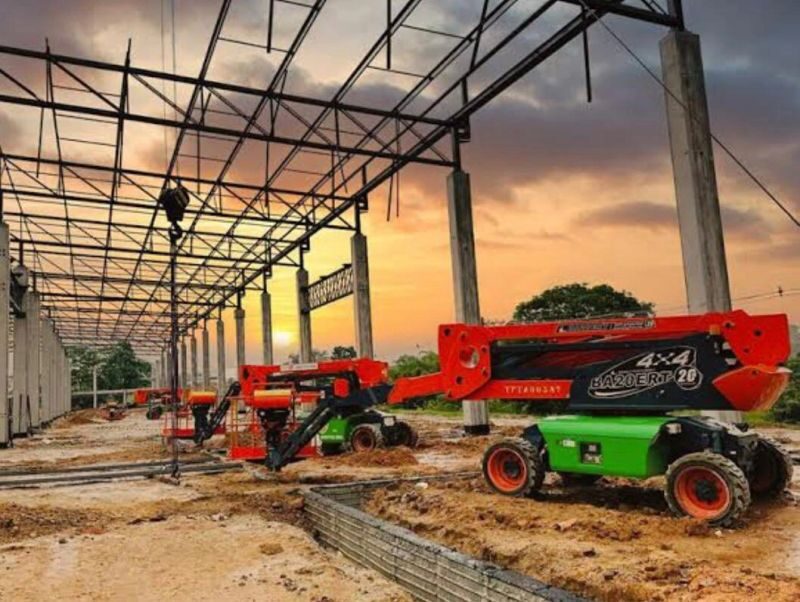
With models that reach up to 51 meters in height, Tecnogera’s MEWPs have power and 4×4 traction, anti-crush sensors, silent operation (ideal for sensitive areas) and high performance on any terrain.
Efficient logistics and fast delivery ensure agility even in urgent projects. And for total peace of mind, Tecnogera’s team is available 24 hours a day, providing full support before, during, and after delivery.
Request a quote and elevate your operation with efficiency and safety!