Replacing scaffolding with aerial work platforms is revolutionizing safety and efficiency in construction, industrial maintenance, and logistics operations. With technological advancements, these machines offer superior agility and significantly reduce risks, playing a crucial role in meeting project timelines. Tecnogera leads this movement with a 100% electric fleet, combining high performance and sustainability.
Selecting the right model is not just a technical decision but a strategic one that impacts budget and team safety.
Why Choosing the Right Aerial Work Platform Makes a Difference
Understanding the importance of choosing the right aerial work platform is the first step to ensuring that the investment in rental yields the expected return in efficiency and protection.
Impacts on Productivity, Safety, and Operational Cost
Choosing the right equipment eliminates downtime and unnecessary costs. Electric platforms powered by lithium batteries, for example, offer up to 12 hours of autonomy and quick recharging. This allows for continuous work shifts without the frequent stops of older models, significantly optimizing team productivity in the field.
In terms of safety, the right equipment ensures stability and reduces accident risks, complying with NR-18 and NR-35 requirements. Working with the right platform avoids improvisation, protecting operators’ physical integrity and preventing project stoppages that could cause financial and legal setbacks for the company.
Operational costs are also reduced by opting for modern machine rentals. Electric equipment eliminates fossil fuel expenses and has simplified maintenance.
Companies transitioning to this solution report cleaner and quieter operations, ideal for environments that restrict noise and emissions, such as hospitals, shopping malls, logistics centers, and airports.
Common Mistakes When Selecting Platforms Without Prior Analysis
A common mistake is renting equipment based solely on price, ignoring load capacity and necessary reach. This can result in a machine arriving that cannot reach the work site or that halts operations due to excess weight, incurring extra costs with freight for emergency asset replacement.
Another mistake is overlooking the machine’s dimensions in relation to the access location. Often, the platform is suitable for height but cannot pass through the establishment’s doors or corridors. It’s necessary to check the chassis width and turning radius to ensure the equipment reaches the point of use without damaging infrastructure.
Ignoring the work environment is also problematic and risky. Using an indoor platform on uneven outdoor terrain can cause bogging and instability. Similarly, using inappropriate tires on finished floors can incur repair costs on the client’s flooring, compromising the service provider’s reputation.
Essential Factors in Choosing an Aerial Work Platform
To define the exact equipment, it’s necessary to analyze three fundamental technical pillars: actual operating height, ground conditions, and available physical space.
Working Height: How to Calculate the Ideal Reach
“Working height” is the most important data in the technical specification and differs from the platform height. To calculate it, add the maximum basket floor height to the average reach of the operator’s arms (approximately 2 meters). This calculation prevents renting a machine that leaves the operator far from the repair point.
If the task is 10 meters above ground, a platform with an 8-meter lift is sufficient, as it provides the 10 meters of working height. However, it’s always recommended to consider a safety margin to ensure the operator works ergonomically comfortably, without needing to overextend during the task.
Tecnogera offers models ranging from 6 to over 40 meters in reach. Validating this measurement accurately before contracting is essential. Our technical consultants are ready to assist in this calculation, ensuring the machine delivered has the exact elevation for your project’s demand.
Type of Ground and Terrain: What Changes in Operation
The ground determines the traction and tires needed for machine stability. In indoor environments with leveled and finished floors, platforms with non-marking tires should be used, which do not leave marks and preserve the location’s aesthetics, ideal for retail and logistics warehouses.
For outdoor, rugged, or earth-moving phase terrains, the requirement changes completely. In these cases, platforms with robust traction, higher ground clearance, and suitable tires are needed to overcome unevenness. Stability on these terrains is vital to prevent tipping, especially when the platform is elevated.
The versatility of new fleets allows for interesting hybrid applications. A successful case study was the use at the International Mountain Bike Cup in Araxá (MG). Even being an event on open terrain, choosing the right equipment ensured operation without damaging the sensitive soil, proving the importance of aligning the machine with the terrain.
Available Space and Equipment Mobility
Before renting, it’s necessary to measure the passage areas and the operation site. Platforms vary greatly in width and length; compact models are designed to pass through standard doors and operate in narrow warehouse aisles, while larger models require ample spaces for maneuvering and stabilization.
Mobility also involves the machine’s turning radius. In industries with dense layouts and many obstacles, platforms with “zero tail swing” allow the base to rotate without colliding with nearby structures. This is essential to ensure the machine can position itself correctly without causing damage to property or other equipment.
Modern electric platforms have an advantage in this aspect, as they tend to be more compact than older diesel models. Evaluating the delivery route to the point of use ensures the machine won’t get “stuck” before even starting to lift workers, avoiding schedule delays.
Types of Platforms and Their Applications
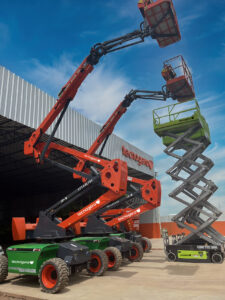
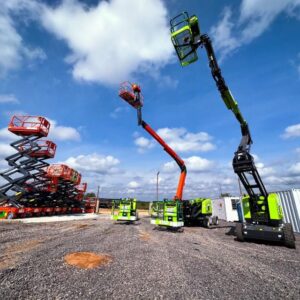
Knowing the specific characteristics of each model: scissor, articulating, and telescopic, is crucial to applying the correct solution in each phase of construction or maintenance.
Scissor Lift: Stability and Load Capacity
The scissor lift is designed for direct vertical elevation and stands out for its stability. It offers a wide working area in the basket, allowing more than one operator and heavy tools to be lifted safely. It’s the standard choice for electricians, painters, and drywall and fire system installers.
This model supports a higher load capacity than most articulating lifts, generally ranging between 230 kg and 450 kg. Its application is perfect for environments where the ground is firm and access to the work point is free of floor obstacles, such as in inventory stock or maintenance of lighting fixtures in warehouse ceilings.
Market data indicates that scissor lifts represent the majority of rentals for indoor environments due to their efficiency. At Tecnogera, we offer scissor models with lithium batteries, ensuring silent and emission-free operation, essential for work in enclosed spaces or with high foot traffic.
Articulating Boom Lift: Versatility and Height Reach
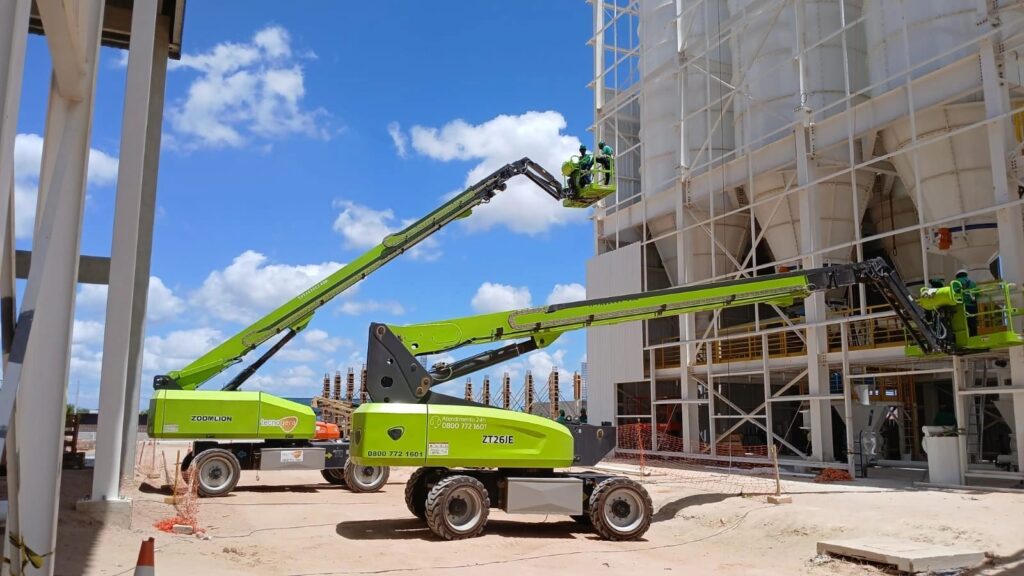
The articulating boom lift has a boom with folds (articulations) that allow horizontal and vertical reach. It is the necessary solution to overcome physical obstacles, such as shelves, pipes, or floor machines, positioning the operator exactly where they need to be, even in hard-to-reach places.
Its geometry allows for “negative reach” and the ability to rotate the base, offering total flexibility. It is widely used in complex industrial maintenance, event assembly, and projects where the platform base cannot be directly below the work point due to physical barriers or unevenness.
The versatility of this equipment makes it indispensable in infrastructure projects and external building maintenance. Tecnogera constantly invests in these electric models, as they combine the reach of large machines with sustainability to operate in any environment, without noise or atmospheric pollution.
Telescopic Boom Lift: Maximum Height and Horizontal Reach
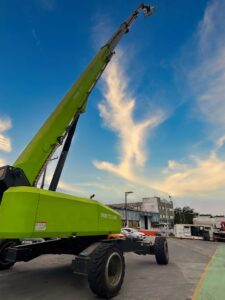
The telescopic boom lift, or straight boom lift, has a straight arm that extends to offer the greatest reach in the market. It is indicated for large-scale projects, such as high warehouse construction, bridge maintenance, and building facade work, where vertical or horizontal distance is the biggest challenge to overcome.
Unlike the articulating lift, its focus is direct reach and straight-line elevation speed. It is ideal for open areas where it’s necessary to reach very high or distant points from the machine base. Its robust structure allows operation on rougher terrains, being a powerful tool for the structural phases of civil construction.
Choosing the telescopic lift requires considering that it needs more space for maneuvering than other models. It’s crucial to evaluate the construction site to ensure there is free area for its safe operation and for the extended arm’s movement without collision risks with adjacent structures.
Tips for Choosing the Right Model for Each Type of Project
Besides the machine specifications, it’s necessary to consider the project environment and safety protocols to ensure a successful and unforeseen-free rental.
How to Define the Ideal Platform for Internal and External Projects
For internal projects, the priority is: zero gas emissions, low noise, and floor protection. Electric or hybrid platforms with non-marking tires are the only viable option. They preserve air quality in enclosed environments and prevent damage to finishes, being mandatory in shopping malls, hospitals, and food industries.
In external projects, weather and terrain conditions should be evaluated. If the floor is paved, electric platforms remain excellent; if it’s dirt or gravel, models with greater traction capacity are needed. Wind resistance is also a safety factor that should be checked in the manufacturer’s manual for outdoor use.
The sustainability trend has led to the use of electric platforms in external areas as well. Tecnogera innovates by offering a fleet that serves both scenarios with the same efficiency. The lithium battery allows the same machine to operate in the external structural phase and internal finishing, optimizing the client’s logistics.
Safety and Maintenance Checklist Before Rental
Safety starts before operation. When renting, check if the rental company performs rigorous preventive maintenance and if the equipment has an up-to-date inspection seal. Items like brakes, level sensors, audible alarms, and emergency stop buttons should be tested during technical delivery.
Renting with Tecnogera includes full responsibility for maintenance, ensuring you receive equipment in perfect condition. This eliminates the need for your company to maintain a team of mechanics or a stock of parts, transforming a fixed and complex cost into a practical and safe solution.
Besides the machine, operator training is legally required. Ensure the team is trained according to NR-35 and NR-18. The use of PPE, such as a safety harness anchored to the basket, is indispensable. A daily visual checklist performed by the operator before the shift helps identify risks and maintain continuous safety.
With over 2,000 machines in our portfolio, Tecnogera offers options for every scenario.
Conclusion — The Right Choice Increases Productivity and Reduces Risks
Selecting the ideal aerial work platform goes far beyond comparing rental prices; it’s about ensuring operational efficiency and team integrity.
It’s about aligning the project’s technical needs with employee safety and the project’s energy efficiency. The right choice prevents accidents, reduces task execution time, and minimizes unforeseen operational costs from idle or inadequate machines.
With the evolution of lithium batteries and the availability of modern fleets, companies across all sectors can benefit from quiet, powerful, and sustainable equipment. Tecnogera positions itself as a strategic partner, offering specialized support to size the perfect solution for your challenge.