Working at heights requires different solutions, and articulated and scissor lifts are great resources for performing these activities. Ensuring safety, productivity, and efficient access to operation points is part of the delivery process.
Choosing the right equipment directly impacts operational performance, reduces risks, and avoids unnecessary costs. Therefore, understanding the differences between these models is essential to make the best decision.
In this guide, we explain when to use an articulated or scissor lift, their advantages, and which applications are best suited for each equipment.
What is the difference between an articulated lift and a scissor lift?
The main difference between the two pieces of equipment is the way they access the work area and the reach associated with each of them.
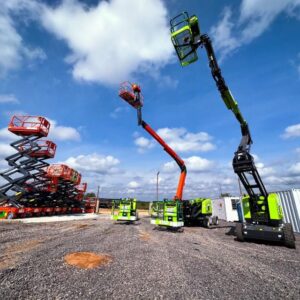
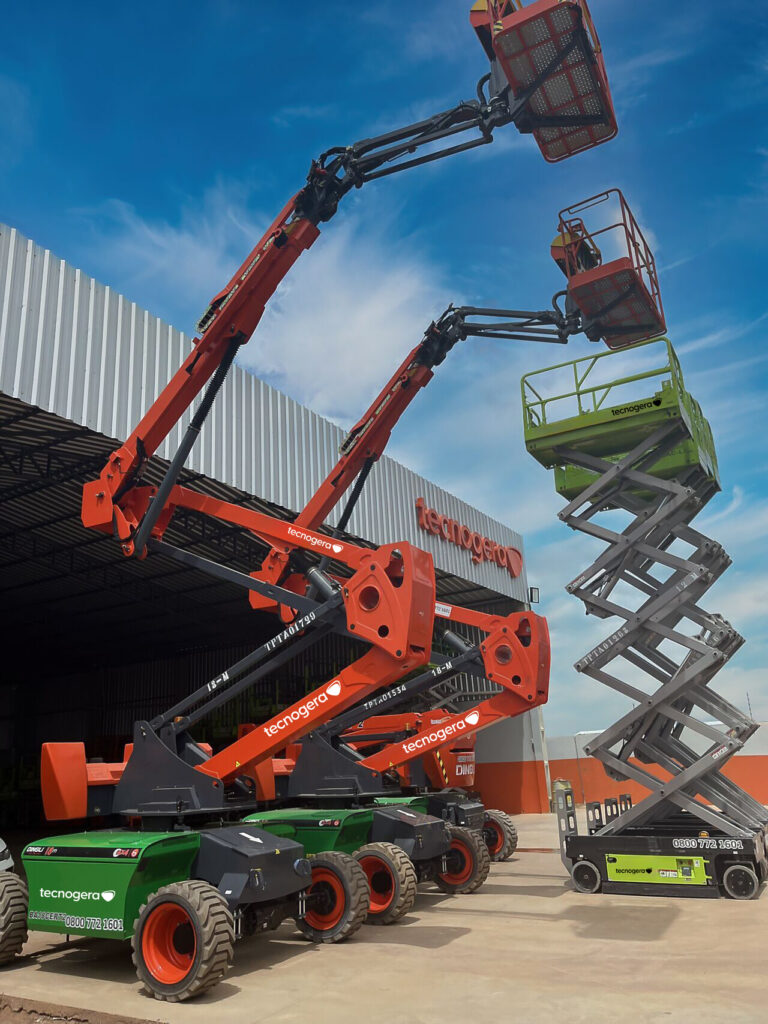
The scissor lift performs exclusively vertical movements, raising operators and tools in a straight line. The articulated lift, on the other hand, has articulated arms that allow reaching elevated areas with obstacles, performing both vertical and horizontal movements.
In practice, this means that each model meets specific operational scenarios.
| Feature | Scissor Lift | Articulated Lift |
| Vertical movement | Yes | Yes |
| Horizontal reach | No | Yes |
| Work with obstacles | Limited | Excellent |
| Workspace | Large surface | Smaller basket |
| Applications | Construction, maintenance, and logistics | Installations, maintenance, and complex access |
| Productivity at height | High | High |
When to use a scissor lift?
The scissor lift is suitable for activities that require working at height with predominantly vertical movement.
Its main advantage is offering a large platform, allowing operators to work with tools, materials, and equipment comfortably and safely.
Main applications include simpler building maintenance, such as painting and restoring small facades, cleaning internal environments, and those with vertical structures.
Construction and civil engineering
On construction sites, the scissor lift is widely used for installations, finishes, and activities on facades and internal structures.
As it allows transporting operators and materials simultaneously, it helps increase team productivity.
Logistics centers and warehouses
In logistics operations, the scissor lift facilitates maintenance of structures, inventories, and access to elevated areas.
Electric models are especially suitable for indoor environments as they do not emit gases and operate with low noise.
Additionally, these models can also serve indoor environments under low temperatures. The electric models have a structure to operate in this type of environment.
Industrial maintenance
Industries use scissor lifts in preventive and corrective maintenance activities that require safe and stable vertical access.
When to use an articulated platform?
The articulated platform is the best choice when the work point is located behind obstacles or in hard-to-reach places.
Its articulated arm system allows access to areas that would not be reachable with conventional vertical lifting equipment.
Building maintenance
On facades, roofs, and complex structures, the articulated platform allows reaching elevated points without the need for assembling auxiliary structures.
Electrical and industrial installations
The installation of electrical systems, piping, and industrial structures often requires access to areas located behind machines or obstacles.
In these cases, the articulated platform offers greater operational flexibility.
Events and special assemblies
Assembly of temporary structures, LED panels, lighting, and scenography often demand equipment with greater horizontal reach.
Therefore, the articulated platform is widely used in events and special projects.
Articulated or scissor platform: which offers more productivity?
The answer depends on the application.
If the operation requires simple vertical access and material movement, the scissor lift tends to offer better productivity.
On the other hand, when there are obstacles, complex structures, or the need for horizontal reach, the articulated platform reduces movements and makes the operation more efficient.
The ideal is to analyze the work environment and the activity objectives before defining the equipment.
Which is safer for working at heights?
Both articulated and scissor lifts are designed to meet safety standards and provide suitable conditions for working at height.
The correct choice depends on the operational scenario.
Using an inappropriate platform for a specific activity can lead to productivity loss and increase operational risks.
Therefore, in addition to the appropriate equipment, it is important to have trained operators and follow the manufacturer’s safety guidelines.
Is it more worthwhile to buy or rent aerial platforms?
Many companies opt for rental to access the ideal equipment without the need for a high investment in acquisition.
Renting allows you to choose the most suitable model for each project, as well as reduce costs related to maintenance, storage, and fleet updates.
This flexibility is especially important in temporary operations, construction, and projects with variable demands.
How Tecnogera helps choose the ideal platform
Tecnogera offers complete solutions for working at height, with one of the largest fleets of aerial platforms in the country.
The company provides articulated and scissor models for different applications, as well as specialized technical support to assist in choosing the most suitable solution.
Modern and diverse fleet
Equipment prepared to serve construction sites, industries, logistics centers, events, and special projects.
Electric and sustainable platforms
Tecnogera has a 100% electric fleet for various applications, contributing to more efficient operations aligned with sustainability practices.
National service
Structure prepared to serve projects in different regions of Brazil.
Specialized support
Technical team trained to guide the correct sizing of equipment.
How to choose the best platform for your operation
The choice between an articulated platform and a scissor lift depends on factors such as working height, presence of obstacles, available space, and the need for horizontal movement.
In general:
Choose a scissor lift when:
- Access is predominantly vertical.
- There is a need to transport materials.
- The environment has ample space for movement.
Choose an articulated platform when:
- There are obstacles between the equipment and the work point.
- Horizontal reach is necessary.
- Access to the location is more complex.
A technical analysis of the operation is the best way to ensure productivity, safety, and efficiency.
FAQ – Frequently Asked Questions about Articulated and Scissor Lifts
What is the difference between an articulated platform and a scissor lift?
A scissor lift performs vertical movements, while an articulated platform allows for vertical and horizontal reach through articulated arms.
Which is more suitable for construction?
It depends on the activity. Construction with vertical access generally uses scissor lifts, while complex structures may require articulated platforms.
Can an articulated platform reach areas with obstacles?
Yes. This is one of the main differentiators of the equipment.
Is it worth renting an aerial platform?
Yes. Renting offers more flexibility, reduces initial investment, and allows you to use the most suitable equipment for each project.
H2: How to choose the best platform for your operation
The choice between an articulated and scissor platform depends on factors such as working height, presence of obstacles, available space, and the need for horizontal movement.
In general:
Choose a scissor platform when:
- Access is predominantly vertical.
- There is a need to transport materials.
- The environment has ample space for movement.
Choose an articulated platform when:
- There are obstacles between the equipment and the work point.
- Horizontal reach is necessary.
- Access to the location is more complex.
A technical analysis of the operation is the best way to ensure productivity, safety, and efficiency.
FAQ – Frequently asked questions about articulated and scissor platforms
What is the difference between an articulated and scissor platform?
The scissor platform performs vertical movements, while the articulated one allows for vertical and horizontal reach through articulated arms.
Which is more suitable for construction?
It depends on the activity. Constructions with vertical access generally use scissor platforms, while complex structures may require articulated platforms.
Can an articulated platform reach places with obstacles?
Yes. This is one of the main differentiators of the equipment.
Is it worth renting an aerial platform?
Yes. Renting offers more flexibility, reduces initial investment, and allows you to use the most suitable equipment for each project.