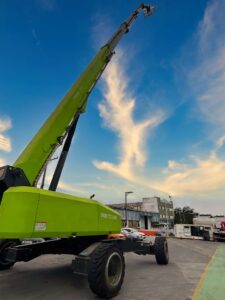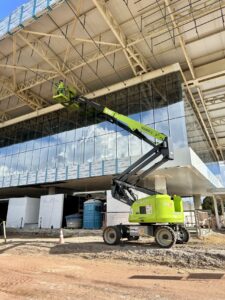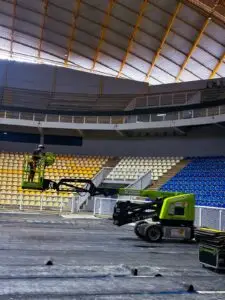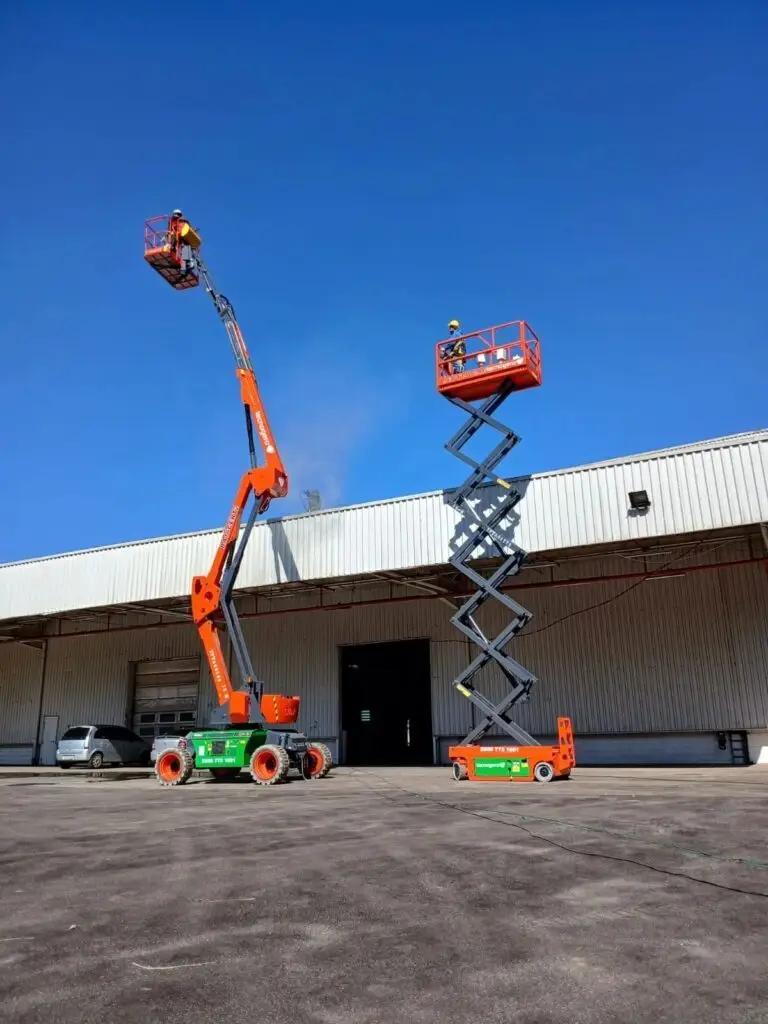
The Regulatory Standard No. 18 (NR 18) is the document that establishes safety guidelines in the construction industry, and its requirements are the gold standard for any serious operation.
Requiring compliance with NR 18 when renting aerial platforms is the main guarantee of safety and productivity for any operation involving work at height. More than hiring a machine, hiring an aerial platform is selecting a partner responsible for the legal and operational safety of your construction site, industry, or event.
NR 18 and workplace safety: what the legislation says about aerial platforms
The NR 18 dedicates a specific section to Mobile Elevating Work Platforms (MEWP), detailing the minimum requirements for their safe use. The legislation is clear in defining the conditions that the equipment and operation must meet.
According to the standard, every platform must have safety devices, such as guardrails, fall protection systems, emergency controls, and audible alarms.
Additionally, the equipment must be able to ensure stability in all working positions, considering the weight of workers, materials, and tools.
The legislation also requires that the equipment undergo periodic inspections and maintenance, carried out by qualified professionals. These procedures must be documented and available for inspection at the workplace.
The goal of NR 18 is to create a safe working environment, establishing that accident prevention is a shared responsibility between those who hire and those who supply the equipment.
What are the supplier’s obligations when renting aerial platforms?
When renting an aerial platform, the supplier has a series of legal obligations, stipulated by NR 18, to ensure that the delivered equipment is safe and compliant.
- Provide the equipment in perfect condition and working order:deliver the platform with all its safety devices operational and with up-to-date preventive maintenance.
- Provide all machine documentation:this includes the operations manual in Portuguese, maintenance records, and inspection reports. The absence of these documents is a major red flag.
- Provide technical support: a serious company offers guidance on the ideal model for each type of service and understands the complete context of the client’s operation, including the demands of electrical power for industrial equipment.
Choosing a specialized supplier means having a team capable of supporting everything from platform sizing to operational support.
This support is especially important in short-term projects, industrial shutdowns, electromechanical assemblies, and large constructions, where each stage depends on the availability of the correct equipment.
More than providing an aerial platform, a technical partner helps reduce operational risks and increases execution efficiency. These obligations ensure that the contractor receives equipment that not only works but is fundamentally safe and legally compliant for operation.
NR 18 Checklist in 4 steps
Upon receiving a rented aerial platform, use this practical checklist to verify the most critical compliance points before releasing the equipment for use:
- Complete and accessible documentation: demand the manufacturer’s manual in Portuguese and maintenance and inspection records, checking if the dates of the last maintenance are up to date.
- Visual inspection of the equipment: look for oil leaks, structural damage, excessive rust, and check the condition of the tires and traction systems. All safety and load capacity stickers must be legible.
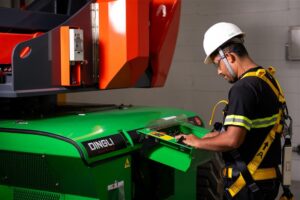
- Testing of safety devices: before first use, test the operation of the emergency stop button, movement sound alarms, safety locks, and the stability of the guardrail.
- Operator qualification: NR 18 requires the operator to be properly trained, with specific training for the model of equipment used. Request and verify the training certificate before starting operation.
Differences between NR 18 and NR 35: what changes in rental
NR 18 is the document that establishes safety guidelines in the construction industry, addressing the conditions of the equipment and the construction site.
NR 35, on the other hand, deals with the planning of any activity carried out above two meters in height, providing for the Preliminary Risk Analysis (PRA) and the use of specific Personal Protective Equipment (PPE), such as the safety harness anchored to the basket.
The level of rigor in safety planning is an indicator of professionalism, applicable to any operation, from a construction site to power generation for event organization.
Checking these items is the way to ensure that your operation is protected. A serious supplier encourages this: at Tecnogera, transparency and compliance are the foundation of our work.
Tecnogera’s Commitment to NR 18
At Tecnogera, compliance with NR 18 is part of every stage of aerial platform rental.
The equipment undergoes inspections and preventive maintenance, is delivered with the documentation required by law, and has fully functional safety devices, ensuring more reliability for operations in construction, industries, events, and other activities at height.
In addition to the quality of the equipment, Tecnogera offers specialized technical support to assist in choosing the most suitable platform for each application. In this way, companies have a solution that combines safety, compliance, and operational efficiency, reducing risks during the execution of activities and contributing to the continuity of the operation.
To rent equipment in full compliance with NR 18 and have a partner that treats your safety as a priority, talk to Tecnogera’s specialists.