Defining the electrical power to climate control industrial environments goes beyond ensuring thermal comfort. A well-sized system directly impacts energy efficiency, productivity, and equipment durability.
Climate control projects should consider humidity, air renewal and quality, particle control, even distribution, and other aspects.
Industrial environments with thermal, chemical processes, or high concentrations of people and machinery require customized solutions, considering volume, internal thermal load, activity, materials, and external climate.
The choice of system (direct, indirect, or hybrid expansion) depends on these variables. Splits and VRF are common in smaller spaces, while CAGs (chilled water plants) and systems with chillers and fan coils are more efficient in large areas.
The Relationship Between Industrial Climate Control and Energy Consumption
Proper sizing of the electrical power of industrial climate control systems is crucial for energy efficiency. Equipment with inadequate power (under or oversized) increases energy consumption and can reduce component lifespan.
Moreover, a poorly sized system compromises thermal comfort, causing uneven temperature and humidity distribution, which affects production and worker health in the environment.
The relationship between cooling capacity (BTU, British Thermal Unit) and electrical power (kW) must be precisely determined for climate control calculations.
This advanced calculation considers factors like thermal insulation, solar heat gain, number of people, and heat generated by equipment.
Risks of Undersizing or Oversizing Equipment
The impacts of improper sizing range from increased energy bills to significant operational losses.
Undersized equipment operates under strain, consuming more energy per hour of operation. Oversized equipment tends to operate with short cycles, causing consumption spikes and reducing compressor lifespan.
Key risks include:
- low equipment performance: the unit cannot reach the reference temperature, requiring longer operation time and compressor effort;
- increased energy consumption: inefficient systems operate longer and at higher power;
- premature wear: extra effort or short cycles accelerate wear of components like compressors and motors;
- air quality issues: in environments with high particle, gas, or vapor generation, a poorly designed system may fail in air renewal and humidity control;
- production impacts: thermal variations can compromise the stability of production processes sensitive to heat or humidity.
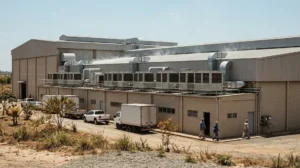
A common example is warehouses with high heat generation from machines or welding. If air exchange is not properly designed, the environment becomes stuffy, with thermal overload affecting operators and machinery.
In refrigerated logistics centers, temperature variations directly impact product preservation. In the case of agribusiness, proper climate control helps maintain good productivity year-round.
How to Choose Climate Control Systems
When selecting an industrial climate control system, the decision should not be guided solely by price or the nominal capacity of the equipment. Various factors must be analyzed.
- thermal profile of the operation: is there heat generation? What is the thermal load of the machines?
- operating hours: will the system be used continuously?
- construction characteristics of the space: what is the thermal insulation and type of coverage?
- air quality: is there a need for filtration, exhaust, or constant renewal?
- seasonality and geographic location: areas with intense summer require reinforced cooling;
- energy efficiency: check the Procel seal, the coefficient of performance (COP), and the system’s automation capability.
Additionally, it is advisable to evaluate complementary systems, such as industrial air curtains, which create invisible barriers to reduce heat exchange between environments; industrial fans and exhausters, which improve air circulation and quality; and humidifiers, especially useful in processes requiring fine control of relative humidity.
Practical Climate Control Calculation: Volume x Air Changes Per Hour
A widely applied methodology for initial sizing and knowing how to calculate climate control for environments is based on air changes per hour:
Environment volume (m³) x Number of air changes per hour (ACH)
For example, in a factory of 250 m² with a ceiling height of 6 m, the total volume is 1,500 m³. If 45 changes per hour are needed, the required airflow will be:
1,500 m³ x 45 = 67,500 m³/h
This value indicates the airflow capacity that the climate control equipment (or set of equipment) needs to meet to ensure efficient climate control.
The number of air changes per hour varies according to the activity: light assembly areas require about 20 changes/hour; heavy industries, 40 to 60 changes/hour or more.
Tecnogera: Technical Support for Industrial Energy Efficiency
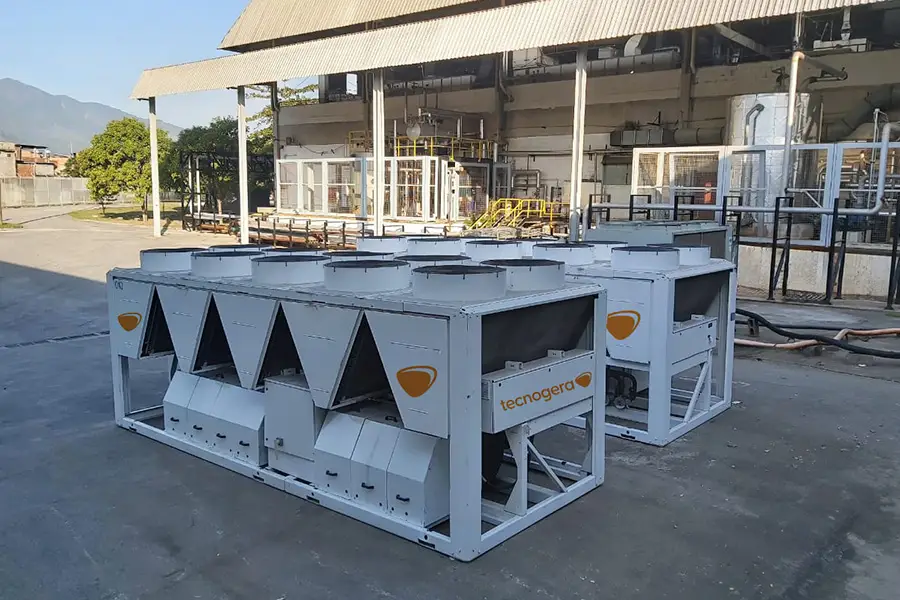
Tecnogera focuses on smart temporary energy and industrial climate control solutions, combining technical robustness, energy efficiency, and 24-hour specialized support.
Our systems are custom-designed, with comprehensive thermal studies and evaluation of the industrial plant’s electrical profile.
We have high-performance equipment and technical teams prepared to accurately size your needs, based on real operation indicators, seasonality, and production process requirements.
Additionally, we offer continuous monitoring and maintenance services, ensuring that the performance of climate control systems remains within ideal parameters throughout the entire operation – whether for temporary, seasonal, or permanent demands.
Learn more about our temperature control solutions.