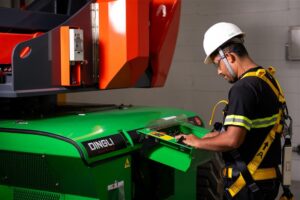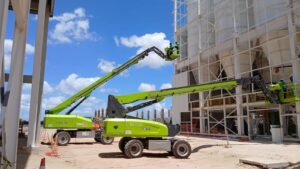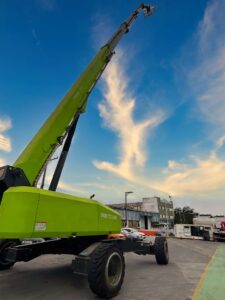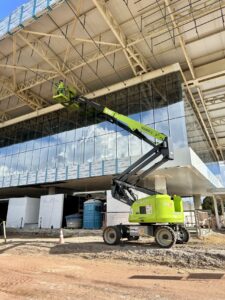
The system anti-crush in Mobile Elevating Work Platforms (MEWP) is a safety device that automatically stops the machine’s movements when it detects pressure or proximity to obstacles.
It protects the operator’s life by preventing the risk of entrapment between the basket and overhead structures, such as beams or ceilings. The advantage of Tecnogera’s solutions is the immediate response technology, which combines high sensitivity with robustness for harsh industrial environments.
What is MEWP and its importance for work at height?
The Mobile Elevating Work Platform (MEWP) is equipment designed to lift people to the work site, ensuring stability and technical safety according to ABNT NBR 16776. The current nomenclature replaced the old term AWP (Aerial Work Platform) to align Brazilian legislation with international work safety.
Tecnogera offers a complete portfolio of aerial platforms that strictly comply with current standards, raising the level of productivity and protection in construction sites, retail, agribusiness, and industries in general.
How does the anti-crushing system work in Mobile Elevating Work Platforms (MEWPs)?
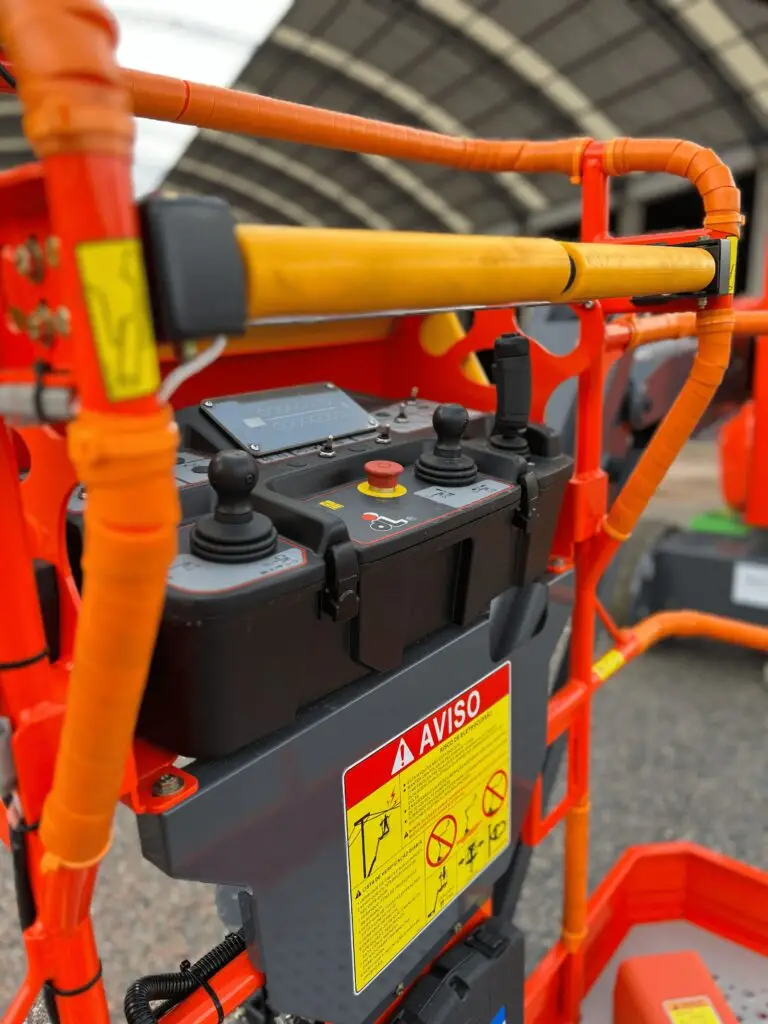
The effectiveness of this device lies in the speed between detection and the complete stop of the machine, minimizing any physical impact on the worker. There are models that use ultrasonic (electronic) sensors or physical protection bars located above the equipment’s control panel.
The operating steps follow this flow:
- Pressure or presence detection: physical or electronic sensors identify an obstacle in the basket’s path.
- Immediate movement interruption: the system cuts the hydraulic or electric flow to instantly stop the ascent.
- Audible/visual alarm: an alert is issued to notify the operator and ground crew about the incident.
- Automatic reversal: in advanced models, the platform retracts a few centimeters to relieve pressure on the operator.
What are the most common applications of MEWPs?
Aerial platforms are versatile and essential in various sectors, especially where anti-crushing safety in critical industrial environments is an operational requirement.
- Industrial maintenance: repairs on pipelines and electrical systems in warehouses with low roofs.
- Tree pruning and landscaping: safe access to canopies in urban areas with nearby wiring.
- Painting and facades: agility in finishing large external and internal surfaces.
- Logistics installations: stock organization and maintenance of lighting fixtures in distribution centers.
Safety in aerial work platforms
The use of protection technologies is vital to reduce the number of accidents related to falls and entrapments. Compliance with NR-18 and NR-35 ensures that the operation occurs under strict guidelines, preventing fatalities against fixed structures.
Tecnogera emphasizes that the stability of the equipment, combined with the use of sensors, is what allows the schedule to continue without interruptions due to accidents and with maximum safety for operators.
What are the main benefits of the anti-crush sensor in MEWPs?
The implementation of active protection devices transforms the construction site into a much more controlled, productive, and safe environment for everyone.
- Preservation of operator integrity: prevents workers from being crushed against beams, ceilings, or overhead pipes.
- Active detection: the system identifies the obstacle and stops the movement even before the impact occurs.
- Regulatory compliance: ensures full adherence to the requirements of NR-18 and NR-12, avoiding fines and shutdowns.
- Reduction of material damage: prevents collisions that could damage both the platform and the client’s structure.
Rent AWP with maximum technological safety. Talk to our consultants!
Why use aerial work platforms with anti-crush sensors?
Using modern equipment with anti-crush system is a differentiator that demonstrates the company’s commitment to life and technical excellence.
Tecnogera provides high-performance platforms that undergo constant reviews, ensuring that all sensors are ready to act in fractions of a second.
Market data indicates that companies investing in cutting-edge safety drastically reduce costs associated with leave and insurance. Opting for platforms with this technology is a strategic decision that protects human capital and reinforces the brand’s authority in the face of the challenges of working at height.
What are the types of AWP with anti-crush system?
Different platform models can be equipped with this technology to meet the particularities of each terrain and required height.
- Scissor Lifts: ideal for vertical ascent, the sensor protects against crushing on warehouse ceilings.
- Articulated Platforms: the system is vital for maneuvering in locations with overlapping obstacles, such as complex piping.
- Telescopic Platforms: ensure protection at great heights where the operator’s vision may be limited by distance.
Find out which model is ideal for your project. See our complete catalog!
How to perform maintenance and inspection of the anti-crushing system in MEWP?
Preventive maintenance is the only way to ensure that the device will work in the event of a real emergency during operation.
- Check the physical integrity of the guard bar or the lenses of the optical sensors.
- Test the sensor activation at the beginning of each shift, as required by NR-35.
- Clean the electronic components to prevent dust or construction debris from causing false positives or failures.
- Contact specialized technical support if the audible alarm shows any irregularities.
Tecnogera performs rigorous inspections and offers 24-hour support, seven days a week so that your leased fleet never compromises work safety.
What are the advantages of renting platforms with anti-crush sensors?
Renting allows your company to have immediate access to cutting-edge technologies, such as the crush protection system, without the high acquisition cost. Tecnogera’s differential is delivering ready-to-use machines, with up-to-date maintenance and full specialized technical support.
In addition to financial savings, you eliminate concerns about depreciation, storage, and constant regulatory updates required by the market. Renting aerial platforms with anti-crush systems at Tecnogera is the best choice to ensure modern, safe equipment that fully complies with labor inspection requirements.
Optimize your costs and increase operational safety. Request a rental quote now!
Frequently asked questions about anti-crush systems in MEWPs
What is the purpose of the anti-crush sensor?
The sensor is designed to automatically stop platform movements when detecting an obstacle, preventing the operator from being crushed against fixed structures.
Which item of NR-18 addresses MEWPs?
NR-18 covers the specifications for MEWPs in its item 18.14.24, establishing safety, operation, and maintenance standards for these equipments.
Is an anti-crush sensor mandatory in MEWPs?
Although regulations require efficient safety devices, the anti-crush sensor is widely recommended as a best practice to mitigate the risk of entrapment in areas with overhead obstructions.