

How does the fan coil unit system work?
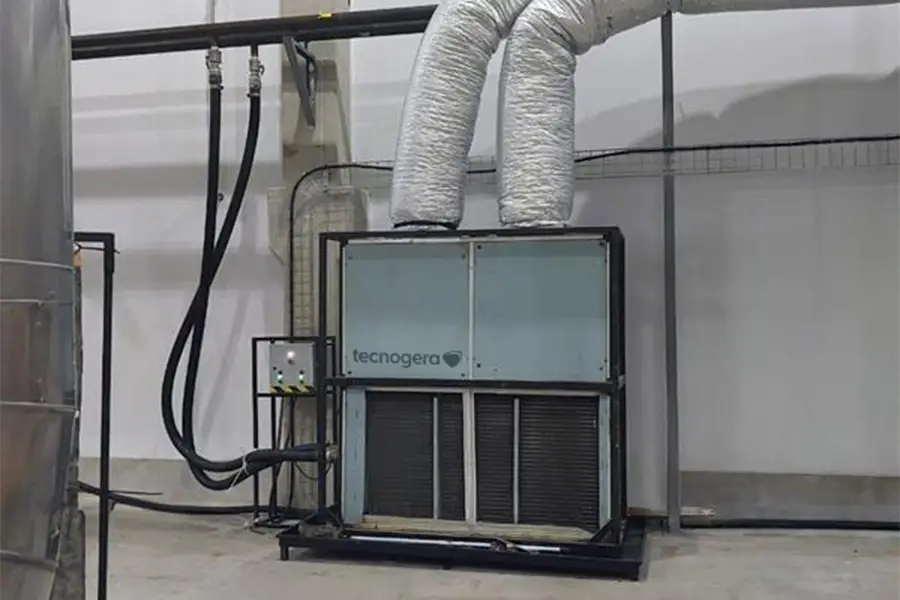
The Fan Coil Unit system functions as a ventilation coil that uses chilled water (not refrigerant gas) for climate control. Components: fan + coil with circulating cold water. Capacity measured in TR (1 TR = 12,000 BTU). Works integrated with Chiller (water cooler). Advantages vs traditional air conditioning: up to 2x greater energy efficiency, ideal for large spaces (hypermarkets, industries, malls, airports), precise temperature control, operational costs shared among users, flexible adaptation to environmental needs. Applications: large spaces with high ceilings, high foot traffic, strict thermal control requirements. Tecnogera offers complete industrial/commercial climate control solutions.
Guaranteed climate control at the airport
Rio de Janeiro Airport conducted maintenance on two Central Chilled Water Plants during peak season (December-March). Tecnogera provided an emergency turnkey solution: 2 Chillers 300TR (Support CAG), 3 Chillers 170TR (Cargo Terminal 17,000m³). The complexity of 24-hour operation required adjustments: customized headers for hydraulic connection, 1000A distribution panels with individual breakers, extra panel protection. Complete supply: 300m 6″ 150psi water hoses, 2000m 240mm² cables, transport, installation, preventive/corrective maintenance. Specialized service included rigorous documentation: ASO, NR 10/20/35, APR, PPRA, Federal Police accreditation. Tecnogera is ISO 9001 certified, with a 4-hour corrective service SLA, 24-hour support.
7 Solutions for Construction Companies
A growing sector with 9.7% more contracts in Q1 2019 according to CBIC. Seven key solutions: drones for mapping (239% annual growth), management software, LEED-certified eco-design, dry construction, IoT (127 new devices/second), power generators for construction sites, and smart safety equipment. Generators ensure power in locations without an electrical grid.
Renewable Market on the Rise
Solar energy is expected to grow by 44% in 2019, reaching 3.3 GW with investments of R$ 5.5 billion. Distributed generation facilitates supply to homes and businesses. Wind energy is projected to produce 15,000 MW in the first quarter, becoming the second largest energy source (10% of the electricity matrix). There are over 500 wind farms in Brazil. Power generators are essential on construction sites, and load banks are crucial during commissioning to test and integrate systems. Tecnogera has commissioned over 2,500 wind turbines with teams available 24/7.
Oil Companies and the Demand for Temporary Power
Petrobras forecasts a 9.5% increase in oil production for 2019 (2.3 million barrels/day), with new facilities like P-74 and Cidade Campos dos Goytacazes. Platforms located up to 300 km offshore do not connect to the SIN due to economic infeasibility, relying on diesel generators for extraction at depths of up to 7,000 meters. Tecnogera offers compact and more fuel-efficient generators, reducing logistical costs and ensuring energy security for up to 150 workers per platform.
Infrastructure investments will resume growth in 2019
Power generators have been essential to Brazilian infrastructure since the 1970s, supporting sectors like construction, mining, oil & gas, retail, sanitation, telecommunications, and renewables. After a decline in 2018 (1.65% of GDP), investments are expected to rise to 1.85% of GDP in 2019 and 2.03% by 2030. BNDES forecasts a 13% growth in infrastructure over the next three years. Industries such as mining and oil & gas require power generators around the clock. Tecnogera operates over 800 power generator units across 5 states.
Temporary Power in the Automotive and Auto Parts Industry
The vehicle and auto parts sector led the increase in energy consumption with a 13.99% growth in July. The automotive industry closed 2017 with 2.24 million vehicles sold (9.2% growth) after three negative years. With 24-hour production lines and critical processes like welding and post-paint cooling, power interruptions cause significant losses. The ISO TS 16949 standard requires plans against energy risks for export. Generator rental is a viable solution for energy security.
Low reservoir levels and demands for temporary energy
The reservoirs of hydroelectric plants maintain critical levels: Northeast at 34.5% (historical average 50.9%) and Southeast/Central-West at 33.57% (historical average 57.5%). In Bahia, 180 municipalities are in emergency due to drought, affecting 4 million people. Aneel maintains red flag level 2 (R$ 5.00 per 100kWh). This increases demand for temporary energy. Tecnogera provided generators to pump water from the dead volume of Cantareira in 2015, ensuring the supply of millions of homes.
Reservoir levels improve in the Northeast, but Cantareira is a concern
ONS forecasts improvement in Brazilian reservoirs for 2018, with expected levels of 30% versus 18.7% in the Southeast/Central-West and 5.5% in the Northeast in 2017. Cantareira System is a concern with 48.1% (without dead volume), below the 61.5% of 2013 before the crisis. Generators were crucial in water crises: Sabesp used them for pumping dead volume in 2014-2015 and in the Sobradinho Reservoir (BA) in 2017 when it reached 5.1%. Tecnogera has expertise in sanitation, providing a 14.5 MVA gas-powered mini power plant for Sabesp to pump 4,000 liters/second in the Rio Grande-Alto Tietê project.
Booming Supermarket Sector Drives Demand for Temporary Power
The Brazilian supermarket sector is showing strong growth, with March sales 17.23% higher than February 2018 and 12.12% above 2017, according to Abras. This marked the best first quarter since 2013. The retail boom is increasing demand for power for lighting, air conditioning, and refrigeration. The March 2018 blackout highlighted the risks for supermarkets, especially in preserving perishables, making temporary power essential for operational security.