The demand for electricity is growing exponentially, driven by technological innovation and industrial development.
However, with this expansion come significant challenges, such as the need to manage consumption more efficiently and integrate renewable energy sources. To address this complexity, smart energy grids, or smart grids, emerge as the ideal solution.
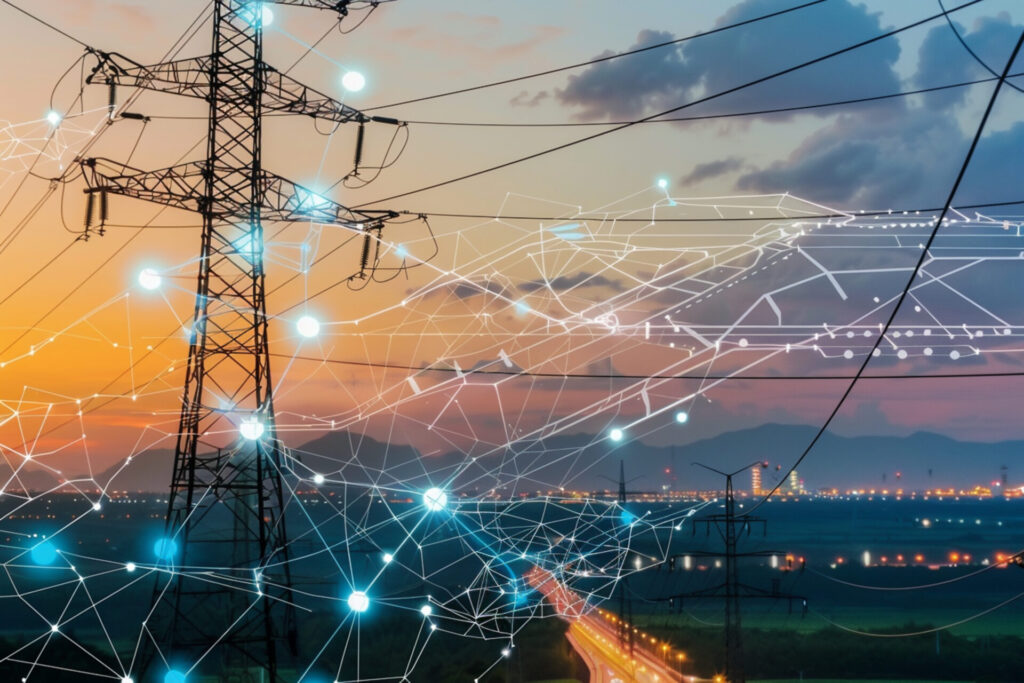
Smart grids are not just a technological advancement; they represent a new philosophy of energy management. By digitizing the electrical grid, these energy automation solutions enable a bidirectional flow of data, allowing the grid to “communicate” with consumers and generation sources.
It’s an evolution that opens doors to more dynamic, adaptable, and, above all, more sustainable management.
The application of a smart grid can go far beyond large cities. It proves essential for projects requiring flexibility and precise control, such as those relying on hybrid energy solutions.
Therefore, understanding the operation and benefits of these networks is crucial for any sector looking to optimize costs and environmental footprint.
What smart grids are and how they work
Smart grids are electrical networks that use information and communication technology (ICT) to operate intelligently and automatically.
Unlike traditional grids, which are unidirectional, smart grids allow real-time information exchange between the utility, generators, and consumers, creating a more dynamic and responsive ecosystem.
At the heart of a smart grid are smart meters. These devices go far beyond simply measuring consumption. They collect detailed data on electricity usage patterns and automatically send it to the grid’s control center.
This information is vital for identifying demand peaks, optimizing energy distribution, and even proactively detecting faults before they cause significant interruptions.
The intelligence of the grid also manifests in its ability to manage energy flow from diverse sources, such as solar, wind, and biomass.
With the integration of hybrid solutions, the system can prioritize the most efficient and sustainable source available at any given time, ensuring maximum energy efficiency. This granular control is what makes smart grids a powerful tool for the global energy transition.
Benefits of smart electrical networks for hybrid projects
Implementing smart networks offers significant advantages, especially for projects that combine different energy generation sources. In a scenario where sustainability is increasingly valued, the ability to effectively integrate and manage renewable sources is a competitive and environmental differentiator.
The first major advantage is increased energy efficiency. A smart grid allows for automatic load balancing and distribution optimization.
This way, energy losses during transport are reduced, and electricity is used more rationally, avoiding waste and lowering the final cost for the consumer.
Another crucial benefit is greater network reliability. The ability to quickly detect and isolate faults minimizes downtime.
For industries and events that cannot afford operational interruptions, this stability is invaluable. The energy automation provided by the smart grid ensures a continuous and secure supply.
Moreover, the integration of renewable sources is facilitated. The intermittent nature of sources like solar and wind is a challenge for traditional grids.
However, a smart grid manages this variability by storing excess energy in batteries and releasing it when demand is higher.
Examples of applications in temporary energy
Large-scale projects, such as construction sites, temporary events, and music festivals, are perfect, among others, for the application of smart grid solutions. In these scenarios, energy demand is variable and unpredictable.
On a construction site, for example, a smart grid can be used to monitor equipment consumption in real-time.
Thus, project managers can identify machines consuming more than expected and adjust operations to optimize energy use.
Additionally, if the site uses diesel generators and solar panels, the smart grid can decide which source to use for each type of equipment, ensuring a more sustainable and economical mix.
In events like festivals, the ability to dynamically manage energy load is crucial. Electricity demand can vary drastically between day (with natural light) and night, and between different stages.
A smart grid can balance this demand, activating auxiliary generators only when necessary and optimizing the use of available renewable sources.
The future of smart grids in Brazil and the world
The future of smart electrical networks is promising. Countries worldwide are heavily investing in modernizing their electrical infrastructures.
In Europe and North America, smart grids are already a reality in many cities. In Brazil, although the implementation process is underway, it represents a crucial step towards a more sustainable and efficient energy future.
The electrification of vehicles, the expansion of smart cities, and the growing number of homes with solar panels are factors driving the need for a smart grid in Brazil.
The transition to a low-carbon economy requires infrastructure capable of supporting a distributed generation scenario, where each consumer can also become a small energy producer.
The expansion of the smart grid in Brazil is not limited to large cities. Its potential is enormous in rural areas, allowing energy management in isolated communities and more effective integration of renewable sources.
It is an essential step to ensure not only sustainability but also the democratization of energy access.
In conclusion, smart energy networks are no longer a futuristic vision. They are a reality already transforming how we consume and manage electricity.
For companies and projects seeking efficiency, reliability, and sustainability, investing in smart grids is the way forward.