The choice between access equipment directly impacts the safety and schedule of the project.
The aerial platform is superior to scaffolding in various industrial scenarios due to its agility, regulatory safety (NR-18 and NR-35), and mobility. By opting for this technology, companies achieve significant gains in deadlines and a drastic reduction in risks.
Working at heights requires equipment that can support weight and movement demands with absolute stability. Although there are old manual methods, they fail to provide the necessary protection against falls and severe structural failures.
What is scaffolding?
Scaffolding is a static and temporary access structure, assembled to support workers and materials during construction or repairs. It is a rigid framework that requires considerable assembly time and a stable base.
Unlike technological solutions, this option is considered unsafe and obsolete for most industrial applications. Its fixed nature limits movement and increases the physical effort of workers, hindering the overall productivity of the operation.
What are the types of scaffolding and where are they used?
Knowing the types of scaffolding helps to understand the most common applications and the operational limitations and challenges of each model.
- Tubular Scaffolding: composed of interlocking metal panels, is used in simple renovations but requires a perfectly level floor and slow manual assembly.
- Facade Scaffold: covers large facade areas for painting, but its complex assembly poses a high risk of falling for the assemblers.
- Suspended Scaffold: known as a swing stage, is supported by steel cables and is typically used for external cleaning, being a structure that is difficult to stabilize.
- Mobile Scaffold: metal structure on casters, used for brief services in indoor areas, but offers low safety compared to mechanized equipment.
Technological advancements have allowed the creation of machines that replace manual structures with total efficiency and no pollutant emissions.
What is an aerial work platform?
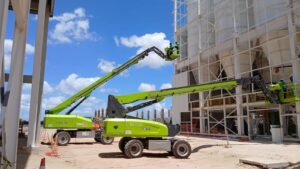
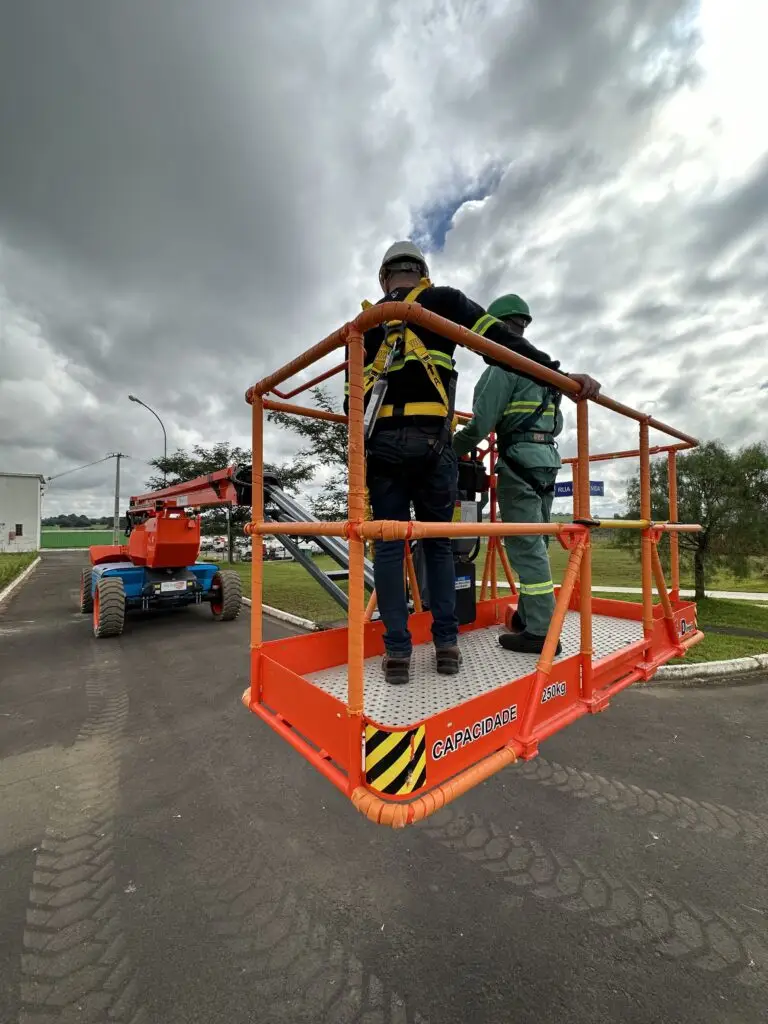
The aerial work platform, or AWP, is a mechanized mobile equipment designed to lift people and tools with millimeter precision. Tecnogera’s fleet is the only 100% electric and lithium battery-powered in Brazil, ensuring safe and sustainable operations.
Unlike old methods, these machines are ready for immediate use, eliminating idle assembly time. They represent maximum operational safety, being ideal for enclosed environments as they are silent and do not emit harmful gases.
What is the function of an aerial work platform?
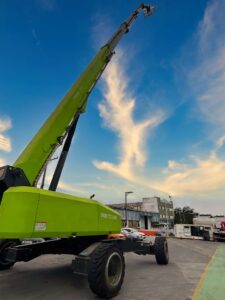
The main function of this equipment is to facilitate safe access to elevated locations, optimizing task execution time. This model allows reaches of up to 51 meters, ensuring versatility in large projects.
In addition to elevation, the platform provides superior stability for the professional, reducing fatigue and physical effort. This results in increased productivity, allowing the team to focus exclusively on the quality of technical delivery and agility.
What are the types of aerial work platforms and their applications?
Knowing the characteristics and being able to select the best model of aerial work platform for each phase of construction or maintenance is essential, as it impacts the budget and team safety.
Scissor Lift: ideal for vertical elevation in locations that require more space on the deck, excellent for stockrooms and warehouses with flat floors.
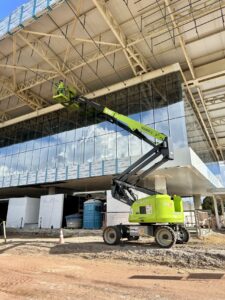
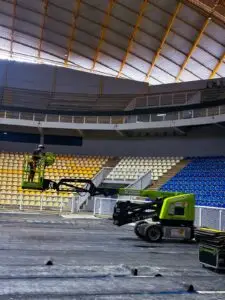
Articulating Boom Lift: has arms that navigate around aerial obstacles, making it perfect for complex industrial maintenance in indoor or outdoor environments.
Telescopic Boom Lift: offers the greatest horizontal and vertical reach quickly, suitable for large construction sites and energy infrastructures.
Electric Models: recommended for enclosed areas, as they have zero gas emissions, preserving the health of employees and the local environment.
Vertical Mast Lift: with a compact base, allows easy positioning and is ideal for tight spaces, offering safe vertical elevation for quick maintenance.
The choice of equipment should be based on technical data and the need for agility in the schedule. Considering the impact on productivity is essential to ensure that the investment brings the expected return for the company.
What criteria should be considered when choosing between scaffolding and an aerial work platform?
Electric solutions for working at heights stand out for offering precise controls and being ready for immediate use . Below, we detail the differences that make the aerial work platform the only viable strategic choice for high performance.
| Criteria | Traditional Scaffolding | Elevating Platforms |
| Assembly Time | High (requires manual assembly) | Immediate (equipment ready to use) |
| Mobility | Fixed (difficult to reposition) | High (moved with operator in the basket) |
| Reach and Height | Limited to lower heights | Maximum (sensors and guardrails) |
| Ground Space | Requires a wide and fixed base | Compact, operate in confined spaces |
| Safety | Unsafe (high risk of falling) | Maximum (sensors and guardrails) |
| Cost-effectiveness | Low initial investment | High return by reducing time and personnel |
The agility in changing work positions drastically reduces the total operation time in any industrial sector. While old structures cause delays, Tecnogera’s modern equipment ensures deadlines are met with zero environmental impact.
Is it better to use scaffolding or a lift platform?
It is better to use lift platforms in all cases, as they ensure immediate agility, enhanced safety, and superior mobility compared to scaffolding. Lithium battery technology ensures a quiet, clean, and highly productive operation.
The search for operational efficiency necessarily involves choosing partners that offer top-notch technical support. Market-leading companies prioritize equipment that does not require complex assemblies and eliminates the risk of serious accidents.
Where to find the best lift platform rental service?
To find the best service, it is essential to look for a company with a modern fleet, rigorous maintenance and specialized technical support. Tecnogera is a leader in lift platform rental in Brazil , offering state-of-the-art equipment that ensures the continuity and safety of your operation.Our team is prepared to recommend the ideal model for each type of terrain, ensuring maximum productivity. We offer agile, specialized technical assistance and 100% electric equipment that
meet all safety requirements To learn more details and request a quote for your operation,.
talk to our specialists.
Frequently Asked Questions About Scaffolding or Aerial Work Platforms
When to choose an aerial work platform instead of scaffolding?
Choose the platform whenever the project requires speed, frequent mobility, or when employee safety is the company’s top priority.
What are the advantages of aerial work platforms?
Advantages include drastically reduced setup time, high operational safety against falls, and versatility to operate on various terrains with precision.
Do you need a driver’s license to operate an aerial work platform?
A driver’s license is not required, but the operator must have mandatory training certification according to NR-18 and NR-35 standards to operate the equipment.
What are the advantages of renting an aerial work platform?
Renting from Tecnogera eliminates maintenance and storage costs, ensuring access to a modern fleet with lithium batteries and full support.
What is included in the aerial work platform rental service?
Rental at Tecnogera includes delivery of the inspected equipment, specialized technical support, and the guarantee of quick replacement to keep your project moving.