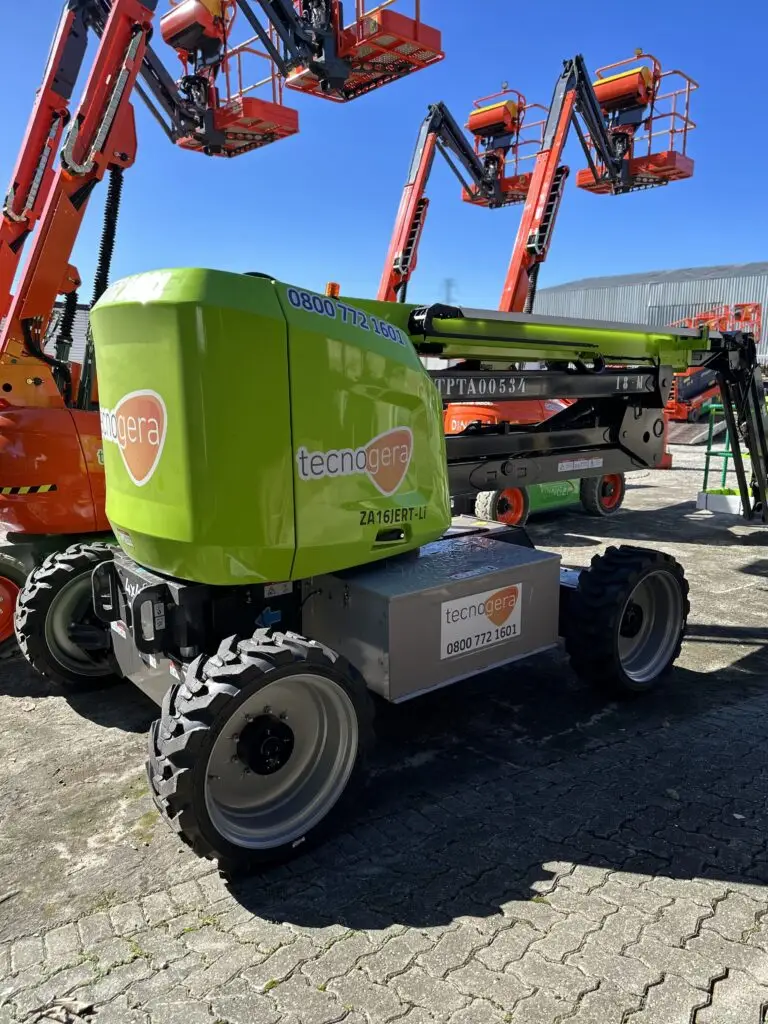
Mobile Elevating Work Platforms (MEWPs) are increasingly strategic allies for performing tasks at height. Powered by lithium batteries, they stand out by enabling workers to operate more safely.
More modern compared to diesel models, they lift workers to heights over 50 meters and can be used in both outdoor and indoor environments.
What is an aerial platform?
An aerial platform is a mobile piece of equipment designed to lift workers, tools, and materials to various heights with maximum safety. Its primary purpose is to facilitate work in elevated areas, replacing scaffolding or ladders, offering greater stability, mobility, and enhancing productivity.
This equipment provides stable access, allowing operators to perform their tasks with precision. The use of aerial platforms aims to optimize time and ensure worker safety, minimizing the inherent risks of working at height.
There are various models, each adapted to specific height, reach, and environmental requirements, crucial in sectors such as construction, maintenance, logistics, agribusiness, and retail.
What are the types of aerial platforms?
In the market, there are several types of aerial platforms, each designed with distinct features to meet a wide range of aerial work needs.
Understanding the specifics of each model is essential for making an informed choice, directly impacting the efficiency and safety of the operation. Below are the main models, their operation, features, and applications.
Articulated Platform
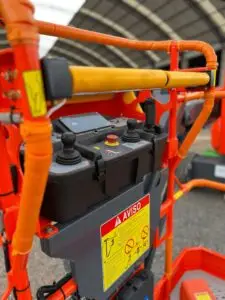
The articulated platform operates with a multi-section arm connected by joints, allowing it to reach elevated points while overcoming obstacles. Control is managed via a panel in the basket for precise positioning.
Its features include excellent lateral reach and great maneuverability, with models varying in height up to 40 meters and a load capacity of up to 250kg.
It is recommended for sectors such as construction, industrial, and building maintenance. Its benefits include versatility, and in electric models powered by lithium batteries, silent operation allows use in small or noise-restricted areas. Another advantage is its multi-directional reach.
Scissor Platform
The scissor platform is elevated by crossed metal arms that expand and retract vertically. This system ensures strictly up-and-down movement, offering a wide and stable base.
Its features are vertical elevation and a spacious platform, ideal for heights below 20 meters, with excellent load capacity, exceeding 450kg in some models.
It is used in maintenance, construction, logistics, and events. Benefits include safety, efficiency, and sustainability of electric models, distinguished by purely vertical elevation.
Telescopic Platform
The telescopic platform operates with a straight boom that extends linearly to reach the work point, ideal for maximum vertical and horizontal reach.
Its operation is simple, with controls in the basket. Its main features are impressive reach, with some models exceeding 50 meters in height, robust structure, and often 4×4 traction.
Telescopic platforms are common in large constructions and maintenance of bridges, viaducts, and central spans, such as shopping centers. The main benefit is quick access to very high or distant points, differentiating from the articulated by superior linear reach.
Mast Platform
The mast platform elevates along a single mast, ideal for confined spaces.
Additionally, its features include moderate height reach, generally up to 14 meters, with a smaller platform for one operator. Its compact base allows for easy positioning and movement.
It applies to light maintenance in warehouses and retail. The benefit is access to restricted areas, distinguished by being compact and offering only vertical elevation, without significant horizontal reach.
How to choose the ideal type of aerial platform?
Selecting the correct platform is crucial for the safety and efficiency of an operation. Various criteria must be analyzed to ensure the equipment meets specific demands, optimizing investment. Below are the main aspects to be evaluated.
Height
Working height is the first factor to consider. Scissors are for lower heights, up to 18m, and direct vertical access. For greater heights or to overcome obstacles, articulated or telescopic – for heights above 40m are more suitable. Masts are for moderate heights in confined spaces.
Load
Load capacity must be compatible with the weight of operators, tools, and materials. Scissors usually have higher capacity. Articulated and telescopic generally have lower capacities, which must be strictly adhered to for greater safety.
Terrain
The type of ground at the worksite influences the choice of a platform.
Flat surfaces are ideal for electric scissor and mast platforms. For uneven or unpaved terrain, articulated and telescopic models with four-wheel drive and suitable tires are most recommended.
Environment
The operating environment, indoor or outdoor, is decisive. For indoor work or with noise and emission restrictions, electric platforms are the best option. Modern electric models with lithium batteries also offer excellent outdoor performance, with the advantage of sustainability.
When to use an aerial platform?
An aerial platform is used whenever there is a need to perform work at height safely, efficiently, and productively. These machines are designed to replace more traditional and often less safe methods, such as conventional scaffolding and long ladders, especially in tasks requiring mobility, precise reach, and a stable work base.
Platforms are recommended for a wide range of activities, such as industrial and building maintenance, installations, painting, facade cleaning, structure assembly, warehouse stock organization, and event production.
They allow operators to quickly reach elevated locations, increasing productivity and reducing accident risks.
What are the requirements to operate an aerial platform?
To operate an aerial platform safely and in compliance with regulations, it is essential that the operator is properly qualified and trained.
In Brazil, Regulatory Standard NR-18 sets clear guidelines for the safe use of these machines, including the requirement for specific operator training.
Additionally, NR-35 (Work at Height) also applies, requiring Risk Analysis and the use of appropriate Personal Protective Equipment (PPE), such as a full-body harness attached to the platform’s anchor point.
Before each shift begins, the operator must conduct daily equipment inspections.
Comparisons between types of aerial platforms
Choosing the ideal type of aerial platform depends on a comparative analysis of their features. Scissor platforms offer great stability and load capacity for vertical elevation, ideal for internal maintenance and installations up to about 18 meters.
Articulated platforms provide versatility with vertical and horizontal reach, overcoming obstacles, suitable for construction and industrial maintenance up to more than 40 meters.
Telescopic platforms guarantee maximum linear, vertical, and horizontal reach, for large constructions and inspections at elevated heights, potentially exceeding 50 meters.
Mast platforms are compact, perfect for vertical access in confined spaces such as warehouse aisles or retail, with heights up to 14 meters. Each has its specific advantages and challenges in terms of maneuverability, terrain type, and capacity.
What are the advantages of renting aerial platforms with Tecnogera?
Renting aerial platforms with Tecnogera represents a smart strategic decision, offering a robust set of advantages that positively impact the efficiency, costs, and safety of your project.
With over 18 years in the market, we stand out by offering a modern and highly diversified fleet, with a significant differentiator: we are pioneers in offering 100% electric aerial platforms equipped with lithium batteries in Brazil.
This commitment reflects our forward-looking vision, aligned with sustainability and energy efficiency. One of the main advantages is the significant cost reduction, eliminating the high initial investment in acquisition and ongoing expenses with maintenance and storage.
Flexibility allows access to the right platform, for the necessary time, with easy model exchange. Tecnogera ensures equipment is always ready for use and compliant with safety standards, with specialized technical support.
By renting from us, you gain a complete solution and a partner committed to the success of your operation.