Temperature control in industrial processes is one of the most important stages of production processes. Equipment in operation must remain within the temperature range specified by manufacturers, or they risk malfunctioning. Issues with these machines, resulting from excessively high or low temperatures, can lead to a chain of losses.
Impacts of Inadequate Temperature
Processed products may fall outside quality standards, production lines may be halted, or, in the worst-case scenario, the machine could cause an accident with casualties. The benefits gained by industries go beyond controlling the temperatures of machines.
Additional Benefits of Climate Control Systems
Climate control systems can also refresh the air, bringing in external air and extracting internal air. This is a significant advantage for environments with limited air outlets or where the air becomes polluted due to the emission of gases from industrial machines.
Climate control systems can also manage air humidity (some chillers have a humidification efficiency of 80%), a very important function for certain industrial processes, such as beverage manufacturing.
Impact on Productivity
There are also impacts on the workforce. Professionals working in excessively high temperatures experience reduced productivity. Additionally, research shows that the risk of accidents increases when machine operators work in uncomfortable temperatures.
Solutions for Temperature Control
Fortunately, the market offers various solutions for temperature control in industrial processes. Discover some of them now and learn how to maintain the ideal temperature for your equipment.
Chillers
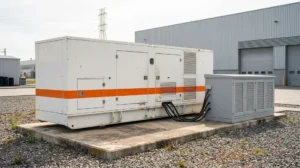
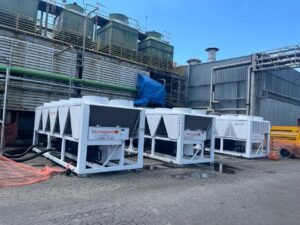
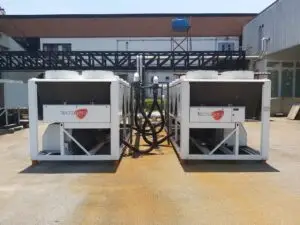
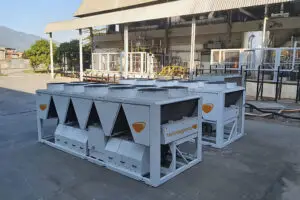
Chillers are large water coolers. This water cools the environment or industrial machines through indirect heat exchange. The chilled water flows through coils, cooling the ambient air or equipment that comes into contact with these structures. Chillers consist of evaporators, compressors, condensers, expansion devices, thermal accumulators, pumps, and control panels.
Fan Coil Unit
If you’re in a commercial building, look at the ceiling. If you see a grille where cold air comes out, you’re likely under a fan coil unit. Fan coil units are large boxes considered by many to be the air conditioner itself, although they operate in conjunction with a chiller.
Inside them are aluminum or copper coils through which chilled water circulates to cool an environment. That’s why fan coil units are also called “water condensation systems.” Other components include fans and belts that draw air from the environment.
Rooftop
Another solution for temperature control in industrial processes is the rooftop. This equipment combines the functionalities of chillers and fan coil units but with lower power. While chillers and fan coil units have a minimum capacity of 100 TR (tons of refrigeration), rooftops typically have a maximum capacity of 33 TR.
Rooftops are suitable for large, open spaces like banquet halls and warehouses. They are highly versatile and easy to install, requiring only one power point and can be placed outdoors.
Types of Temperature Control
Industrial process cooling equipment features sophisticated systems for temperature control. Chillers and other devices have sensors that constantly measure the ambient or machine temperature, ensuring everything operates within the ideal range.
On-Off Control
This is the simplest type of control, ideal for companies seeking low-cost solutions. These controls turn cooling equipment on or off whenever the temperature exceeds or falls below the ideal level.
Proportional Control
Proportional controls respond to temperature changes before they fall outside the desired range. They increase or decrease the energy used by the cooling equipment as the ambient or equipment temperature reaches its upper or lower limit.
Proportional Integral Derivative (PID) Control
PID controls can adjust cooling intensity with high precision by considering the ideal temperature to be achieved and the current process temperature. Through “proportional and integral” control, the power of climate control systems is used proportionally.
Industrial equipment can experience temperature changes due to numerous factors. The machine’s operating time, the intensity of operation, and sudden changes in ambient temperature can disrupt the calculation of the ideal operating temperature.
In such cases, using PID temperature controls is essential, as they can calculate the impact of variables on processes and determine new ideal temperatures. With this information, climate control systems make “course adjustments” in their power, ensuring that process temperatures always provide maximum efficiency.