The Brazilian market is experiencing simultaneous growth in two distinct sectors that both require absolute energy and thermal stability: events and IT infrastructure.
While the entertainment sector is regaining full strength with large festivals and fairs, digital expansion is driving the massive construction of data centers.
For both, climate control is not just a comfort item but a critical operational requirement. A failure in temperature control can mean the end of a live show or the interruption of banking and internet services for millions of users, resulting in incalculable losses and damage to the reputation of the companies involved.
In this scenario, chiller rental emerges as a smart strategy. It allows event organizers and data center managers to access cutting-edge technology and security redundancy without tying up capital in depreciating assets, ensuring operational continuity with specialized support.
Why Temperature Control is Critical in Events and Data Centers
Thermal management is the pillar that supports the operability of both sensitive electronic equipment and human experience in large gatherings. In data centers, data processing generates intense heat that, if not dissipated, causes automatic server shutdowns. In events, excessive heat affects the audience’s health and the functioning of audiovisual equipment.
Impacts of Climate Control Failures on Equipment and Comfort
In a data center, high temperatures are the main enemy of hardware. Servers operating above thermal limits suffer reduced lifespan and imminent risk of component burnout. Thermal instability can cause the loss of valuable data and the interruption of systems that support critical operations for businesses and governments.
In the events sector, thermal comfort is crucial for a successful experience. With a 60% increase in the number of events in São Paulo in the first half of 2025, as reported by Veja magazine, public demand for air-conditioned environments has grown. Failures in air conditioning in enclosed spaces or tents cause discomfort, complaints, and even medical risks to participants.
Moreover, sound, lighting, and LED panel equipment used in shows generate their own heat. Without adequate external cooling provided by powerful chillers, these systems can freeze in the middle of a performance, compromising the entire delivery of the spectacle and the organizers’ reputation.
Operational Costs and Losses Due to Overheating
The cost of energy inefficiency is extremely high. Data centers focused on Artificial Intelligence, for example, have much higher heat density. Recent projects indicate that these centers can consume the same energy as 16 million homes. An ineffective cooling system wastes energy and significantly increases the electricity bill.
For corporate events, which are expected to grow by 16% by the end of 2025, according to Panrotas, a failure in the climate control system can render business and networking opportunities unfeasible. The loss goes beyond ticket refunds; it involves contractual penalties and the loss of sponsors who associate their brands with the quality of the infrastructure offered.
On the other hand, unplanned downtime in data centers costs thousands of reais per minute. Overheating is one of the most common causes of these downtimes. Investing in robust cooling systems, often through rental to meet peak demand, is a form of insurance against these direct financial losses.
Advantages of Chiller Rental Over Purchase
Opting for the rental of cooling equipment offers agility that purchase cannot match. In a volatile and technological market, owning the equipment can become a logistical and financial burden, while renting delivers the exact solution to the problem, at the time and place needed.
Flexibility of Use According to Temporary Demand
Events are inherently temporary and itinerant. It makes no economic sense to purchase an industrial chiller to use it for only a few days or weeks. Rental allows you to size the exact power for each project, whether it’s a wedding in a tent or a music festival for thousands of people, paying only for the period of use.
For data centers, flexibility is vital during maintenance or expansions. If the main system fails or needs repair, a rented chiller can be quickly installed to take on the thermal load. Additionally, on extremely hot days, rental serves as reinforcement (peak shaving) to prevent the fixed system from collapsing.
This model also meets seasonal demands in industry and commerce. The ability to increase or decrease the cooling infrastructure according to the real needs of the business avoids the idleness of expensive machines and ensures that the company is always ready to meet peaks in production or audience.
Reduction of Operational and Maintenance Costs
By renting a chiller, the company transforms capital expenditures (CAPEX) into operational expenses (OPEX). This improves cash flow and frees up budget for investments in the “core business,” such as hiring attractions for the event or upgrading servers for the data center, instead of tying up money in infrastructure.
Maintenance is another point of significant savings. By opting for rental with Tecnogera, all preventive and corrective maintenance costs are included. The client does not need to maintain their own specialized technical team or worry about purchasing replacement parts, oils, or refrigerants.
This eliminates financial unpredictability. There are no surprises with sudden breakdowns that require unbudgeted emergency expenses. The responsibility for the equipment’s performance lies with the rental company, ensuring that the lessee has cost predictability from the start to the end of the contract.
Access to Modern Equipment Without Capital Investment
Refrigeration technology advances rapidly, with new compressors and more efficient fluids constantly emerging. Purchasing a chiller “ties” the company to a technology that may become obsolete in a few years, losing energy efficiency compared to newer models.
Through rental, the client has constant access to a renewed and modern fleet. This means using equipment with greater energy efficiency (better COP), lower noise levels, and more precise digital controls, without having to pay the full price of new equipment with each technological update.
For data centers seeking sustainability and efficiency certifications (PUE), using modern chillers is essential. Rental allows for periodic technological upgrades, keeping the cooling infrastructure at peak performance with controlled operational costs.
Practical Applications of Chiller Rental
The versatility of chillers allows their application in very different scenarios, but with similar performance requirements. The ability to control large thermal loads with precision makes these devices indispensable for both live entertainment and the digital infrastructure that drives the economy.
Events: Participant Comfort and Equipment Preservation
In large events, chillers are coupled with air handling units (fan coil units) to air-condition pavilions, tents, and VIP areas. The goal is to maintain a pleasant temperature, regardless of external heat, ensuring the audience’s stay and well-being during hours of exposure.
Besides human comfort, cooling is vital for the event’s industrial kitchen and technical areas. Video transmission equipment and audio processing servers in large shows generate a lot of heat and need air-conditioned rooms, a technique known as “cold room,” to avoid freezing during the presentation.
Rental allows the installation of quiet and aesthetically discreet systems that do not interfere with the scenography. With the sector’s growth, the demand for quick and efficient temporary climate solutions has become a mandatory quality standard for professional event organizers.
Data Centers: Redundancy and Critical Thermal Security
Brazil is expected to receive over R$ 60 billion in Data Center investments by 2029, according to XP report. With this growth, the need for redundancy (backup systems) becomes mandatory. Chiller rental is often used to create an extra layer of security (N+1 or 2N) without the immediate construction of new fixed infrastructure.
During scheduled maintenance shutdowns of the main cooling systems, rented chillers take on the full thermal load. This allows maintenance teams to work safely on the data center’s own equipment, without any interruption in the clients’ data processing service.
In emergency situations, such as catastrophic failures in the original system, the agility in delivering a rented chiller is the difference between a controlled crisis and an operational disaster. Specialized companies like Tecnogera offer 24/7 service to ensure cooling is restored as quickly as possible.
Technical Considerations for Choosing the Right Chiller
Choosing the right equipment should not be based solely on price, but on rigorous technical criteria. Incorrect sizing can lead to excessive energy consumption or the inability to reach the desired temperature, compromising the entire operation of the event or data center.
Cooling Capacity and Proper Sizing
The thermal load calculation must consider all heat sources: people, equipment, lighting, and solar incidence at the location. For data centers, power density per rack is the determining factor. Undersizing the chiller will result in cooling failure; oversizing will lead to energy waste and unnecessary costs.
It is also essential to analyze the available infrastructure on site. Electrical voltage, water availability (for models with cooling towers), and physical space for chiller placement and air circulation directly influence the choice of model, whether air or water-cooled.
Specialized professionals conduct technical visits to assess these variables. In events, seasonality and peak heat hours are also considered. Correct sizing ensures that the system operates at maximum efficiency, maintaining the thermal stability required by the project.
Energy Efficiency and Environmental Impacts
Energy efficiency is measured by the ratio of cooling capacity to electrical energy consumed. Modern chillers have frequency converters that adjust the compressor speed to the actual demand, saving energy during partial load moments, which is common in data centers and nighttime events.
The choice of refrigerant is also an important environmental aspect. Newer equipment uses eco-friendly gases that do not harm the ozone layer and have a lower global warming potential. This is essential for companies with ESG goals seeking to reduce their carbon footprint.
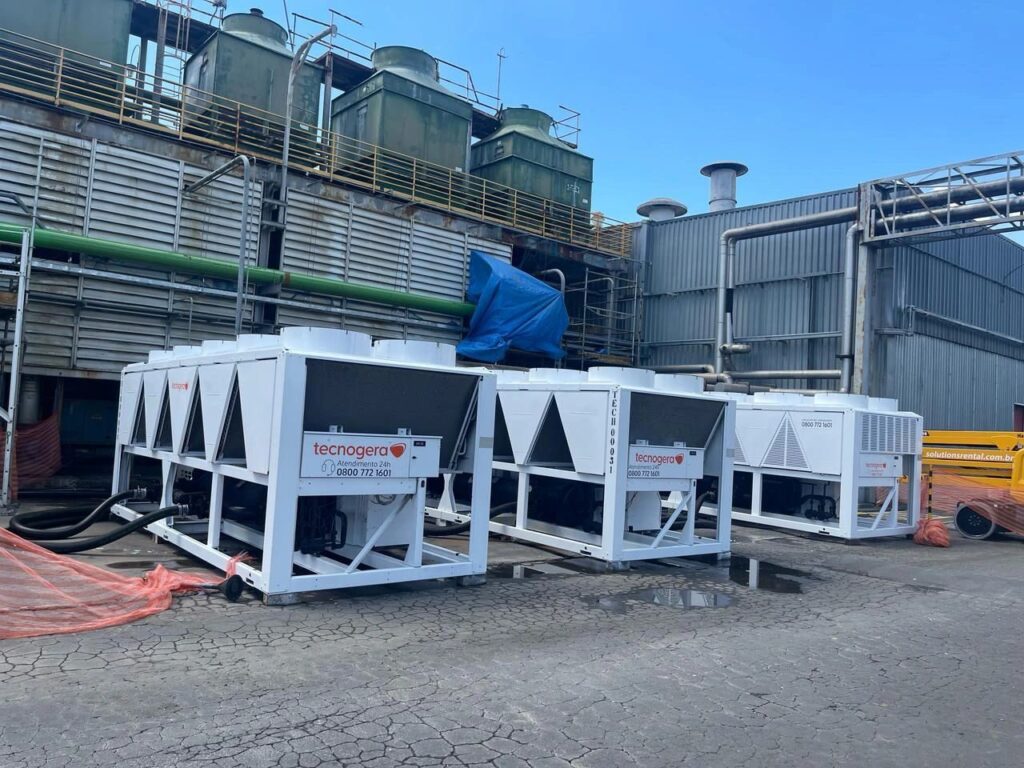
Water-cooled models tend to be more energy-efficient but consume water, which may not be viable in all locations. Air-cooled models are more practical for temporary installations and avoid water resource consumption, often being the preferred choice for rental in events.
Technical Support and Remote Monitoring
The technology embedded in chillers allows for remote performance monitoring. Sensors send real-time data on inlet and outlet temperature, pressure, and energy consumption. This enables the technical team to identify anomalies before they turn into system shutdowns.
When contracting rental, check if the company offers 24/7 technical support. In data centers and events, problems do not have a scheduled time to occur, and the support team’s response speed is crucial to minimize operational impacts.
Tecnogera, for example, combines modern equipment with a monitoring center. This ensures that any deviation from the norm is addressed immediately, often remotely or with proactive dispatch of technicians to the site, ensuring total peace of mind for the client.
Conclusion — Chiller Rental as a Strategic Solution
Chiller rental has established itself as an indispensable strategic solution for the events and data center sectors. It combines the flexibility needed to meet variable demands with the security of operating with high-performance equipment and guaranteed maintenance.
Given the rapid growth of investments in digital infrastructure and the vigorous recovery of the events market, having a specialized partner in energy and climate control is a competitive advantage. Tecnogera offers the expertise and technology needed to ensure your project operates at the ideal temperature, with efficiency and safety.