Cooling System refers to the set of processes and equipment that transfer heat from one environment to another. This technology ensures the operational continuity of industries and the preservation of sensitive inputs.
What are the basic principles of a cooling system?
Cooling is based on thermodynamics, specifically the ability of a fluid to absorb heat when changing state. Historically, we’ve evolved from using natural ice to complex mechanical systems that allow precise control of industrial temperatures.
Many believe that the system “creates cold,” but the correct concept is heat removal. The equipment extracts thermal energy from a body or space and dissipates it elsewhere. This process is essential for maintaining the integrity of production processes and critical environments.
How the cooling cycle works in practice
The vapor compression cycle is the most widely used method globally today. It employs a refrigerant that circulates continuously, alternating between liquid and gaseous states to transport heat efficiently.
The four main stages are:
- Compression (pressure increase);
- Condensation (heat release);
- Expansion (pressure reduction);
- Evaporation (heat absorption).
In a refrigerator or air conditioner, this cycle repeats to maintain controlled internal temperatures.
The physics behind this involves the relationship between gas pressure and temperature. When the refrigerant evaporates inside the device, it “steals” heat from the environment.
Essential components of a cooling system
For the thermal exchange cycle to occur without interruptions, four fundamental components work in total sync.
- Compressor: the heart of the system, responsible for circulating the fluid and increasing its pressure and temperature.
- Condenser: where the hot vapor releases heat to the external environment and turns into liquid.
- Expansion Device: sharply reduces the fluid’s pressure, preparing it for heat absorption.
- Evaporator: where the fluid absorbs heat from the internal environment, completing the cooling mission.
These components work together to ensure that thermal energy is moved efficiently. The quality of each item directly reflects on the system’s reliability and reduces operational failures in critical projects.
Types of cooling systems and their applications
There are various technologies available, each designed for specific demand and scale needs. The right model choice influences the economic viability and the ability to deliver the necessary thermal load for the operation.
Tecnogera assists in defining the best configuration, ensuring that the investment results in maximum productivity and lower electricity consumption.
Direct Expansion (DX) Systems
Direct expansion systems are very common in offices and small businesses due to their simplified installation. In these systems, the refrigerant cools the air directly, without the need for an intermediary fluid like water.
Models like Split and Multi-Split are practical examples of this technology in everyday life. Although limited over long distances, they offer a quick response for temperature control in smaller and specific areas.
Chilled Water Systems
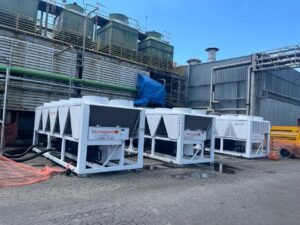
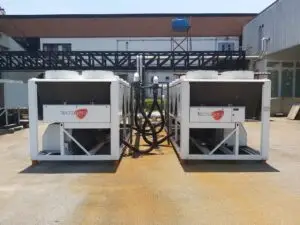
Chillers are the main players in large industrial installations and malls due to their high capacity. They cool the water, which is then pumped to units like the Fan Coil to air condition the environment.
There are chiller models cooled by air or water, adapting to different resource availabilities. To learn more about applying this technology, check out our guide on industrial refrigeration chillers.
Variable Refrigerant Flow Systems
The VRF (Variable Refrigerant Flow) or VRV (Variable Refrigerant Volume) system is an evolution that adjusts the refrigerant flow as needed. It allows individual control of several internal units connected to a single external condenser, ensuring operational flexibility.
This technology is ideal for buildings requiring thermal zoning, such as hotels and corporate offices with different temperature demands. The system regulates the compressor speed, reducing waste and optimizing energy consumption intelligently.
The great advantage of VRF/VRV is the precise control of each environment, allowing different sectors to operate with varied thermal loads simultaneously. Tecnogera offers technical consulting to integrate this technology into projects seeking high efficiency and low acoustic impact.
Difference between cooling and air conditioning
Although they use similar principles, cooling focuses on achieving low temperatures for product conservation or industrial processes. This is the case for Data Centers and cold storage rooms, where precision is a determining factor.
Meanwhile, air conditioning aims at human thermal comfort in environments like offices and events. Besides temperature, it controls humidity, air renewal, and filtration, ensuring a healthy environment for people.
The importance of energy efficiency in cooling systems
Cooling systems represent a significant portion of global electrical consumption across various sectors. Old or poorly sized equipment generates enormous financial waste and increases the company’s carbon footprint.
Using efficient systems can significantly reduce operational costs compared to obsolete models. Certifications like the Procel label and LEED certification validate environmental commitment and real savings.
Technologies to increase energy efficiency
Technology has revolutionized the market by allowing the compressor to operate at variable speeds. This avoids start-up peaks and maintains stable temperatures, resulting in much more economical and quieter operation.
Heat recovery systems take advantage of energy that would be discarded to heat water or other processes. Tecnogera offers state-of-the-art equipment that integrates these innovations to ensure the best energy performance on the market.
How much does a cooling system cost?
The cost of acquiring a proprietary system involves high purchase, installation, and civil works values. Additionally, the owner assumes full responsibility for corrective maintenance and accelerated depreciation of the fixed asset.
In this scenario, equipment rental emerges as the most cost-effective alternative. By renting, your company eliminates the risk of initial investment and enjoys total financial predictability for your project.
How to choose the ideal cooling system?
Making the right choice depends on a detailed technical analysis of the specific needs of each location and process.
- Thermal load: precise calculation of the heat to be removed to avoid undersizing or energy waste.
- Type of environment: assessment if the location is industrial, commercial, or a temporary event area.
- Space availability: verification of the area available for installing condenser and evaporator units.
- Technical support: importance of having qualified engineering for the project and 24/7 support.
A well-sized project avoids unplanned downtime and ensures operational safety. Tecnogera’s technical team conducts customized studies to identify the solution that best meets the particularities of your infrastructure.
Proper maintenance of cooling systems
Preventive maintenance is essential to maintain the system’s original efficiency and extend its lifespan. Cleaning filters and checking pressures prevent the equipment from working harder, consuming more energy.
Lack of technical care can cause fluid leaks and critical compressor failures. In Tecnogera’s rental model, maintenance is included, ensuring the customer focuses only on their core activity.
Tecnogera’s advantages in renting cooling systems
With 20 years of foundation, Tecnogera is a reference in equipment rental for air conditioning and stands out for having a modern and versatile fleet, ready to meet demands of any size. Our highly specialized engineering develops tailor-made projects, ensuring each client receives the exact solution for their need.
We offer an End-to-End solution, taking care of all stages, from the preliminary study to assisted operation. With Tecnogera, your company gains agility, cutting-edge technology, and technical support available throughout the national territory.
How does Tecnogera’s cooling system rental work?
Tecnogera’s air conditioning and cooling rental model is designed to ensure thermal efficiency and operational continuity through a consultative and technical approach. Check out the step-by-step:
- Thermal load sizing: our engineers perform a precise calculation of your project’s cooling needs, considering environmental variables and equipment requirements to avoid energy waste and ensure the ideal temperature.
- Agile logistics and mobilization: after the technical definition, we manage the specialized transport of equipment (such as Chillers and Fancoils) to the site, following strict safety protocols and delivery deadlines.
- Specialized installation and assembly: our own technical team executes the complete installation and integration of the cooling system into your infrastructure, ensuring that all connections follow current technical standards.
- Commissioning and performance testing: before final delivery, we conduct rigorous load and functionality tests to validate if the system meets the performance parameters required by the project under real operating conditions.
- Delivery with availability guarantee: the system is delivered ready for use, operating at maximum efficiency. Tecnogera maintains technical support and monitoring to ensure refrigeration uptime throughout the contract.
Rent cooling systems with support from Tecnogera!
As an authority in energy solutions, Tecnogera delivers more than equipment: we deliver operational reliability. We focus on reducing the complexity of asset management for our clients, offering comprehensive support.
The benefits of relying on our competitive advantages include constant technological updates without purchase costs. By choosing Tecnogera, you ensure that your cooling system is an ally of productivity and resource savings.
Check out our temperature control rental solutions!