Data centers, also known as Data Processing Centers, are considered the heart of any company, as they store highly sensitive information about the business.
A failure in the data center can mean millions in losses and even halt a corporation’s activities for weeks.
Therefore, it is imperative that Data Processing Centers have power generators to ensure supply even in blackout situations.
Data Processing Centers should use power generators that complement the operation of the UPS (Uninterruptible Power Supply) in case of a power outage.
The UPS can provide emergency power for up to 15 minutes, which is more than enough time for the power generators to kick in.
The use of power generators in data centers became imperative after Brazil went through an energy crisis in 2015.
The crisis dissipated partly due to the decline in economic activity.
But now, with growth prospects and a consequent increase in consumption, fears of new blackouts have resurfaced.
What to consider before installing generator sets
When planning your data center, consider the type of generator needed, the size of the equipment, the fuel that will power the generator, the location, and the operating regime.
Type of generator
The engineer responsible for the data center and the technician from the company selling or renting the equipment need to determine the operating regime of the generators.
The regimes can be:
- Standby/emergency: when the equipment takes over the load only when there is a failure in the utility supply
- Prime power: when the generator operates regularly at a predetermined schedule
- Base power/continuous: constant and uninterrupted operation
Type of fuel
The most common types are diesel and natural gas, each with its advantages and disadvantages.
Whatever the choice, fuel consumption needs to be sized at this point, considering the operating regime and the power of the equipment.
Location
The location where the generator will be installed makes all the difference in determining which equipment is most suitable for the data center.
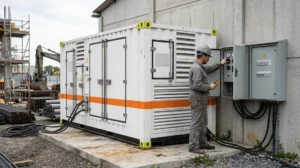
If the generator set is installed outside the processing center, a cabinet will be needed to protect the equipment from weather conditions.
For indoor installations, vibration isolation, sound dampeners, and exhaust systems for the gases emitted by the generator may be necessary.
Data center generators must be able to power non-linear loads without thermally compromising the windings, provide quick starts, have redundant filters and batteries, good monitoring and communication capabilities, and embedded electronic systems for voltage, speed, and parallelism control.
The most common generators used in data centers are from 750 kVA to 1000 kVA.
These are highly efficient in fuel consumption, have low maintenance costs, stable performance, and emissions compliant with relevant standards.
They can be used for up to 500 hours per year.
Precautions during installation
The main precaution during the installation of the generator set is to commission the system.
This essentially involves using load banks to test if all data center systems (including power generators) are functioning perfectly.
Generally, for a load bank test to be successful, generators need to operate at maximum capacity for at least 4 hours.
The test should also assess whether the generators can withstand a sudden load change, going from 25% of their nominal capacity to 100% capacity.
Generator commissioning is carried out with resistive and reactive load banks of low and medium voltage.
Load banks can also simulate thermal modeling with an airflow system; validate the connection with the utility; test transformers and protection transmissions, test the response time of UPS systems, and validate the cooling capacity of chillers, cooling towers, and chilled water providers.
A study by Emerson Network Power revealed the cost of not using load banks for data center commissioning.
Companies based in the US spend about 11 million dollars a day to fix problems that could have been identified with proper commissioning.
Precautions after installation
Now that everything is ready for your data processing center’s operation, it’s time to ensure your company is covered for any need.
Make a technical support contract with the generator supplier to have support in case of unforeseen events.
Perform preventive maintenance on the equipment periodically.
Ideally, maintenance should be done by professionals every six months.
Constantly monitor the generators.
If the devices operate in standby mode, manually start the device every week.
Additionally, ideally, generators should be tested with load banks every month.
This way, your company will be sure that, in case of a power outage, the backup system is 100% reliable.
Do not risk the information stored in your company’s data processing center.
Buy or rent power generators from trusted companies and always test the system with load banks.
The investments are low and provide your business with priceless security.
Have any questions about backup systems in data processing centers?
Leave your question below in the comments, and our team will respond soon.