

Hospitals must prepare for increased demand
The coronavirus pandemic requires hospitals to prepare for increased demand. The Ministry of Mines and Energy recommends measures to ensure the security of the power supply. Hospitals should adapt energy backup systems, monitor equipment usage, and keep power generators well-maintained. Tecnogera offers turnkey solutions with a modern fleet and 24/7 service to ensure operational continuity.
High Temperatures and the Importance of Chillers
With just over a month until summer arrives, high temperatures are already prevalent across much of the country. In this scenario, investing in equipment and solutions to keep environments climate-controlled is essential. Chillers are crucial for cooling large spaces, maintaining appropriate temperature and humidity levels, and enhancing the energy efficiency of air conditioning systems.
How does a power generator work?
A power generator is an essential piece of equipment that meets energy needs during power grid failures, serving as a primary or backup source. It offers advantages in security (ensuring operational continuity and alarm systems), agility (quick automatic response), and versatility (applicable in hospitals, industries, airports, events). To choose the right one, consider emergency or continuous use, available physical space, access to the power grid, and fuel type (diesel or gasoline). Tecnogera offers customized TurnKey solutions.
Do you know what power generators are?
An electric generator converts mechanical, chemical, solar, or other forms of energy into electrical energy. Composed of two poles (positive and negative), it maintains a potential difference, supplying energy to electrical loads. The simplest type is the dynamo, which converts mechanical energy using a magnet on a rotating shaft to create a magnetic field that generates electric current. Power generator sets, on the other hand, are large-scale equipment consisting of an engine, generator, and fuel tank, recommended for places that cannot afford power outages like hospitals, laboratories, and supermarkets.
100 kVA Power Generator – Where to Use It?
The 100 kVA generator offers immediate response during blackouts, making it widely used in construction and various sectors. Its applications include security cameras, alarms, electric gates, common area lighting, events, and industries that cannot afford productivity interruptions. It is also ideal for colleges, universities, and hospitals, ensuring continuous power supply.
What is an Enclosed Generator? Protection and Low Noise
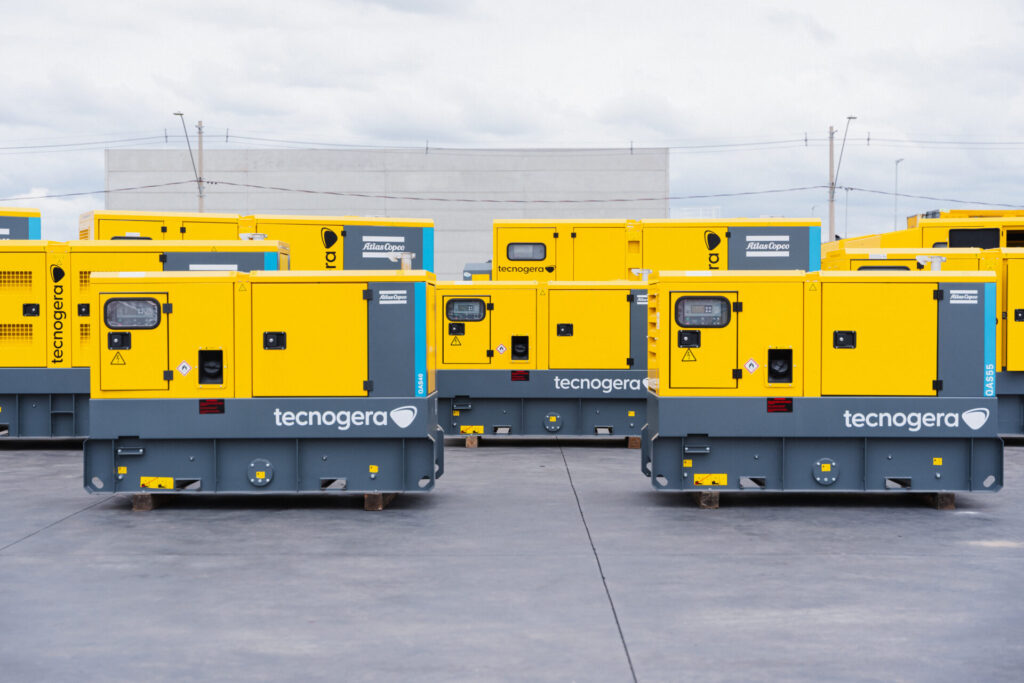
An enclosed generator is a power generation equipment featuring a metal structure internally lined with thermoacoustic foam, significantly reducing operational noise. Its features include weather protection, noise levels between 75-85 decibels, and easy maintenance through side doors. It’s ideal for hospitals, schools, libraries, hotels, and environments requiring low noise levels. Tecnogera offers modern and economical enclosed generator sets with comprehensive service.
Discover the key differences between industrial UPS and power generators
Generator sets are large-scale equipment offering high power as a primary or backup source, ideal for locations that cannot afford power outages, such as hospitals, laboratories, hotels, convention centers, and supermarkets. The UPS regulates voltage and energy purity, protecting against spikes and providing temporary power for safe equipment shutdown in case of supply failure.
What to do in case of a blackout in Brazil?
A blackout is a temporary or permanent loss of power caused by distribution accidents or insufficient supply capacity. During a water crisis with hydroelectric reservoirs below optimal levels, it’s a reality that can affect the country. Measures include staying calm, having flashlights and candles in safe places, contacting the utility company, unplugging devices, and gathering people…
What are the advantages and disadvantages of energy rationing?
Energy rationing linked to the water crisis is a concern for Brazilians. Most of the energy is produced by hydroelectric plants that rely on water flow, so a lack of water leads to energy shortages. Disadvantages include blackouts affecting the productivity of industries, businesses, and homes. Advantages involve raising awareness about sustainable consumption and conserving natural resources, benefiting the environment.
How Electrical Power Transmission Lines Work
The electrical power transmission system transports electricity from power plants to end consumers through high-voltage lines. In Brazil, 70% of the energy comes from hydroelectric plants like Itaipu. The system has three main components: towers that support the cables, insulators that prevent losses, and substations that adjust the voltage for safe use.