

Load bank for testing diesel turbo generators
The load bank for testing diesel turbo generators is a high-standard system that prevents issues related to the activation of the power generator equipment. This device can be reactive or resistive, capable of performing quality tests on power sources with complete safety and without compromising electrical voltage. The equipment is essential for verifying the safety and performance of turbo generators, conducting precise measurements of power, voltage, current, and other critical parameters.
What are the differences between a synchronous and asynchronous generator?
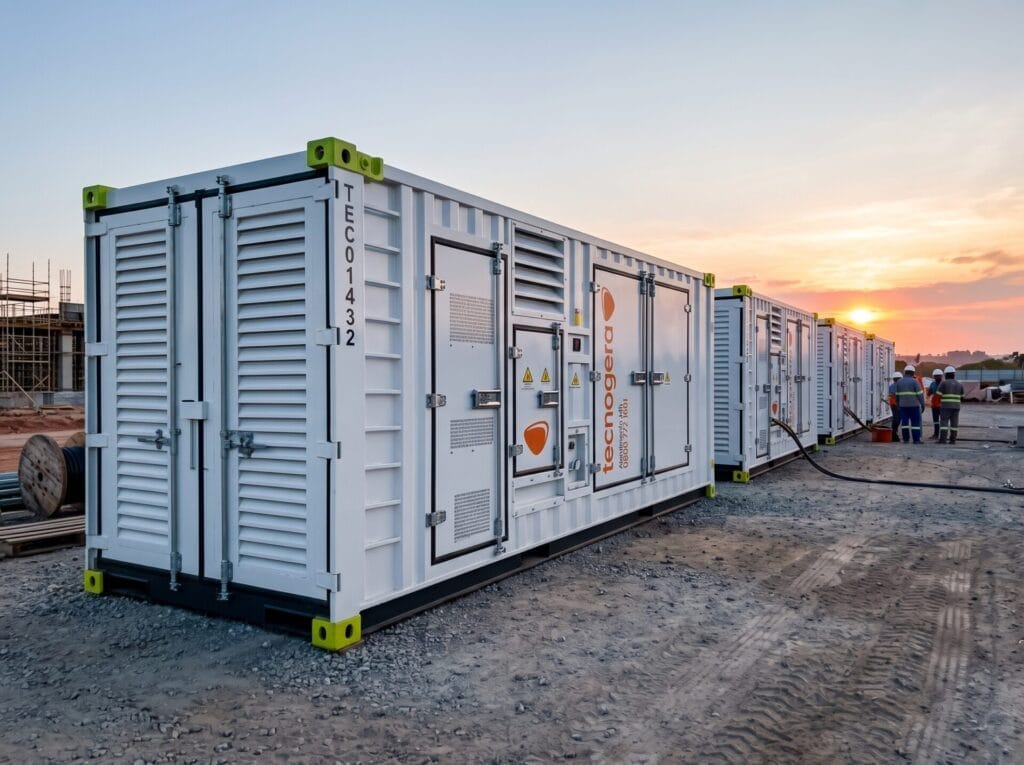
Power generators are classified as synchronous and asynchronous according to their operation. The synchronous generator maintains frequency synchronized with motor rotation, offers fixed frequency regardless of load, and is used in hydroelectric plants, but requires direct current and maintenance of mechanical contacts. The asynchronous generator has a simpler and more robust construction, without mechanical contacts in the rotor, used in wind turbines, but requires reactive power and stops if the load exceeds capacity. Both convert mechanical energy into electrical energy for hospitals, industries, and events.
Learn how to calculate ripple voltage and its usefulness
Ripple voltage represents minimal variations in DC voltage signals, crucial for sensitive electrical systems that cannot tolerate fluctuations. In a 12V system, variations from 11.99-12.01V (20 millivolts) can cause damage. Measured as a percentage, it detects variations in the millivolt range. The oscilloscope is the most commonly used equipment for measurement, identifying voltage peaks and effective values to pinpoint variations in electrical circuits.
What is electrical impedance? Learn about its calculation and applications!

Electrical impedance measures a circuit’s ability to resist the flow of electric current, defined as the total resistive load of alternating current circuits. Each material has a different impedance determined by its atoms. Expressed in Ohms, it is calculated by the relationship between voltage and current according to Ohm’s Law, essential for the correct sizing of electrical equipment.
Rainy Season and Power Supply Failures
After the 2015 water crisis, 2016 saw an increase in rainfall. Despite improvements in reservoir levels, some regions, like the Northeast, have accumulated volumes below expectations, and the supply crisis is not averted.
What does a power reactor do?
The reactor, also known as a ballast, is an essential device that limits electrical current in fluorescent lamps and other equipment. It functions as an inductor that adjusts the network voltage to the optimal power of the devices. Its dual role in fluorescent lamps includes generating the impulse to light them and maintaining the current at a safe level, preventing explosions. Available in traditional and high-performance versions for different applications.
What do you need to know about tariff flags?
In June 2015, Aneel implemented the tariff flag system with colors indicating power generation conditions. Green means favorable conditions with no extra charge, yellow adds R$ 0.015 per kWh, red level 1 charges R$ 0.030, and level 2 adds R$ 0.045. The system aims to pass on production costs based on reservoir levels and the use of thermal power plants. During 2015, the red flag predominated due to the water crisis, but in 2016, there was variation among the colors depending on rainfall and power generation conditions.
Understand what dielectric strength is and how it works in materials
Dielectric strength determines the maximum voltage insulating materials can withstand before failing, which is crucial for the safety of electrical installations. Tests expose materials to voltages from 5-400 kV to identify breakdown points. Insulating oils in transformers require special attention, as their strength varies with moisture and carbon contamination.
The role of temporary power in meeting Amazonas’ demands
Amazonas faces significant energy challenges, with 57 out of 62 municipalities relying on isolated power generation systems. In March 2016, 159 power generators were delivered to 91 locations, adding 124.8 MW to the existing 380 MW, with an investment of R$ 160 million. The government plans to invest R$ 6 billion by 2018 in improvements including new thermal power plants, integration into the SIN, and network expansion, creating opportunities for the temporary power sector.
Learn what electric potential difference is and how to calculate it
Electric potential difference, or voltage, is essential for the existence of electric current between two points. Charged particles in random motion align when exposed to an electric field. Electrified bodies have different potentials due to the gain or loss of electrons, creating a voltage that can be measured in Volts (V) using a voltmeter.