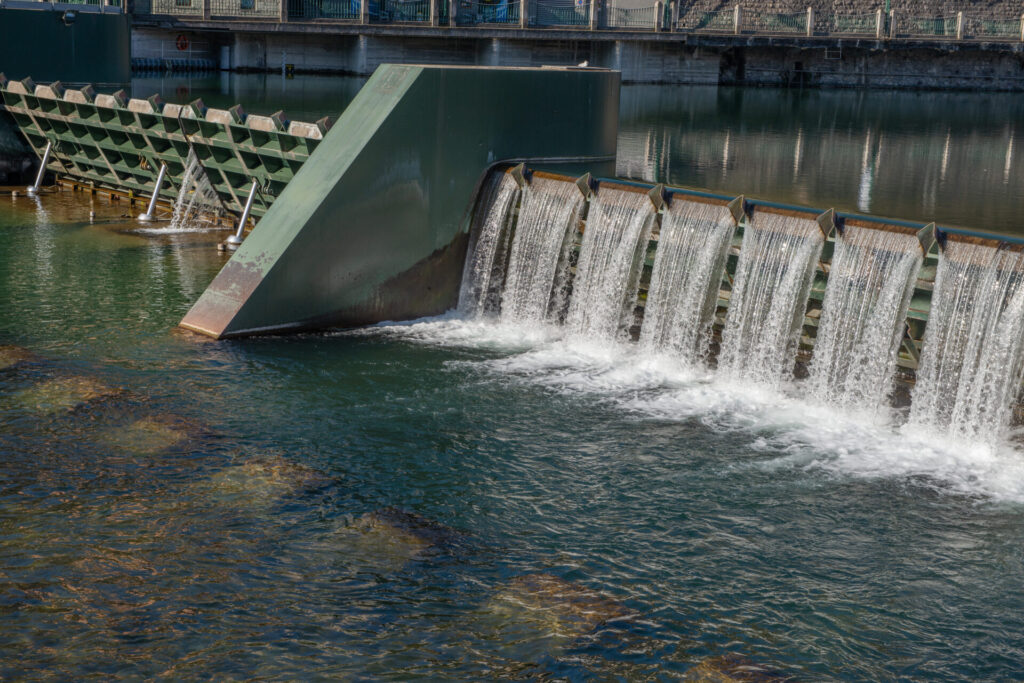
The largest hydroelectric power plant in the world currently is the Three Gorges Dam, in China, with an installed capacity of 22,500 MW on the Yangtze River.
Its structure, which includes 32 main generators, is essential for the supply of renewable hydroelectric energy on an industrial scale, harnessing the potential of strategic basins.
What are the largest hydroelectric power plants in the world?
The global ranking is mainly led by projects in Asia and South America, reflecting significant investments in energy infrastructure.
| Ranking | Power Plant Name | Location (Country/River) | Installed Capacity |
| 1 | Three Gorges Dam | China / Yangtze River | 22,500 MW |
| 2 | Itaipu Binational Dam | Brazil and Paraguay / Paraná River | 14,000 MW |
| 3 | Xiluodu Power Plant | China / Jinsha River | 13,860 MW |
| 4 | Belo Monte Power Plant | Brazil / Xingu River | 11,233 MW |
| 5 | Guri (Simón Bolívar) Power Plant | Venezuela / Caroni River | 10,235 MW |
| 6 | Wudongde Power Plant | China / Jinsha River | 10,200 MW |
| 7 | Tucuruí Power Plant | Brazil / Tocantins River | 8,370 MW |
| 8 | Grand Coulee Dam | United States / Columbia River | 6,809 MW |
| 9 | Xiangjiaba Dam | China / Jinsha River | 6,448 MW |
| 10 | Longtan Dam | China / Hongshui River | 6,426 MW |
| 11 | Sayano-Shushenskaya Dam | Russia / Yenisei River | 6,400 MW |
| 12 | Krasnoyarsk Dam | Russia / Yenisei River | 6,000 MW |
| 13 | Nuozhadu Plant | China / Lancang River | 5,850 MW |
| 14 | Robert-Bourassa Plant | Canada / La Grande River | 5,616 MW |
| 15 | Churchill Falls Plant | Canada / Churchill River | 5,428 MW |
1st Three Gorges Plant – China (22,500 MW)
This Chinese giant uses the flow of the Yangtze River to operate 34 generators, being one of the main power generation structures in the country. Its monumental structure helps control floods and facilitates commercial navigation within China.
2nd Itaipu Binational Plant – Brazil and Paraguay (14,000 MW)
Located on the border between Brazil and Paraguay, the Itaipu Binational Plant is a historical leader in accumulated productivity. Its 20 turbo generators provide a significant portion of the electricity consumed in both countries.
3rd Xiluodu Plant – China (13,860 MW)
Located on the Jinsha River, this plant stands out for its double-curvature arch dam, one of the highest in the world. It is an essential part of China’s west-to-east power transmission project for major industries in the east.
4th Belo Monte Plant – Brazil (11,233 MW)
Located in Pará, on the Xingu River, Belo Monte is the largest purely Brazilian plant. It operates under the run-of-the-river concept, with a smaller reservoir area compared to conventional plants, minimizing impacts on local biodiversity.
5th Guri Plant – Venezuela (10,235 MW)
The Simón Bolívar Hydroelectric Plant, known as Guri, is one of the main generation sources of the Venezuelan electric system. Its reservoir is one of the largest in the world in terms of water volume for generation purposes.
6th Wudongde Plant – China (10,200 MW)
Completed in 2021, this plant on the Jinsha River uses advanced smart monitoring technologies in its construction. It is part of the complex of large hydroelectric plants responsible for supplying China’s megacities with low-emission energy.
7th Tucuruí Plant – Brazil (8,370 MW)
The first large hydroelectric plant built in the Brazilian Amazon, Tucuruí harnesses the waters of the Tocantins River. Its energy is essential for the mining industry and for supplying the Northern region.
8th Grand Coulee Plant – USA (6,809 MW)
The main hydropower facility in the United States, it is located in the state of Washington. In addition to generating electricity, it plays a vital role in irrigating extensive agricultural areas in the American Northwest.
9th Xiangjiaba Plant – China (6,448 MW)
Located between the provinces of Yunnan and Sichuan, this plant focuses on providing stable energy to nearby urban centers. Its turbines are among the most efficient in China’s generating park.
10th Longtan Plant – China (6,426 MW)
Built with roller-compacted concrete, it has the highest dam in the world for this type of technique. It is an example of cost and time reduction in projects of this magnitude.
11th Sayano-Shushenskaya – Russia (6,400 MW)
It is the largest power plant in Russia, located on the Yenisei River in Siberia. After complete modernizations, it supplies energy to large aluminum smelting industrial complexes in the region.
12th Krasnoyarsk Power Plant – Russia (6,000 MW)
Also located on the Yenisei River, its dam is iconic and appears on the Russian ten-ruble banknote. The plant also has a unique ship lift to overcome the hydroelectric drop.
13th Nuozhadu Power Plant – China (5,850 MW)
This plant on the Lancang River has one of the largest storage capacities in southwest China. It contributes to grid stabilization and water flow control.
14th Robert-Bourassa Power Plant – Canada (5,616 MW)
Part of the La Grande complex in Quebec, it is the largest underground power plant in the world. The project is a milestone in cold climate engineering and the preservation of boreal ecosystems.
15th Churchill Falls Power Plant – Canada (5,428 MW)
Located in Labrador, this plant utilizes an impressive natural waterfall of over 300 meters. Almost all of its generation structure is in caverns excavated under solid rock.
How does large-scale power generation by hydroelectric plants work?
The process of large-scale power generation occurs by converting the gravitational potential energy of water into kinetic energy, which moves the turbines connected to generators.
Through electromagnetic induction, mechanical movement is transformed into electricity for high-voltage distribution.
What is the socio-environmental impact of large hydroelectric plants?
Large projects require population displacement and alter aquatic ecosystems, requiring rigorous wildlife and sediment management programs.
On the other hand, they offer a renewable source stable that reduces dependence on polluting fossil fuels.
Why doesn’t installed capacity guarantee continuous delivery?
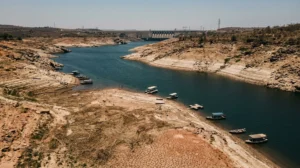
Installed capacity represents the maximum generation capacity of the plant, but actual production depends on water availability and hydrological conditions.
During drought periods, reduced reservoir levels can limit generation and reinforce the need for operational redundancy systems to ensure supply continuity.
The challenges of energy infrastructure and transmission
The distance between large plants and consumption centers poses logistical and technical challenges of high complexity.
The energy transmission over long distances requires extensive networks that are exposed to various operational risks, such as:
- Natural electrical losses that occur due to the resistance of conductors over thousands of kilometers.
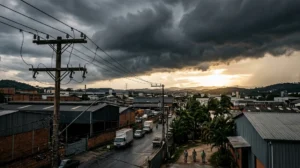
- Extreme weather events that can topple transmission towers, isolating entire cities from the main grid.
- The physical fragility of the lines which requires constant maintenance and teams prepared for work at heights.
The current and future scenario of hydroelectric energy
Hydropower remains the foundation of the energy matrix in countries like Brazil, but the trend points to the hybridization of sources. Integration with wind and solar systems allows for reservoir preservation, ensuring stability during periods of low rainfall.
What are sustainable and alternative energy sources?
The sector is evolving towards the use of alternative energy, such as biogas and photovoltaics, integrated into the free energy market.
Digital technologies enable intelligent management of this diversification, optimizing consumption and reducing operational costs for companies.
What is backup energy and why is it essential?
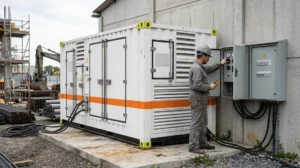
Backup energy protects operations against failures in the centralized grid, preventing financial losses and critical production stoppages.
Energy generator systems ensure business continuity, acting instantly when the main energy source presents instabilities.
How do hybrid systems and storage (BESS) work?
The Battery Energy Storage System (BESS) stores the surplus from renewable sources in high-density batteries for later use.
This technology is the necessary link for the energy transition, stabilizing the grid and ensuring clean energy even without sun or wind.
Ensure energy supply with Tecnogera!
As a national reference in temporary energy solutions, Tecnogera offers complete generator rental projects and high-performance backup systems for industries and large infrastructures.
With a focus on energy security and specialized technical support 24/7, we guarantee the continuity and efficiency of your operation.
Our differential is the agility in delivery and expertise in complex projects that require maximum reliability, protecting your business against supply interruptions and blackouts.
Frequently asked questions about hydroelectric plants
Is the Itaipu Plant the largest in the world?
No, the Itaipu Plant is currently the second largest in the world in installed capacity, surpassed by China’s Three Gorges.
However, Itaipu has held the world record for annual energy production several times due to its excellent productivity.
Who produces more energy, Itaipu or Three Gorges?
Although the Chinese plant has a higher installed capacity, actual production fluctuates annually according to the water availability of each basin.
Historically, both alternate the global leadership in effective TWh generation, depending on the climatic conditions in their regions.
What is the exact capacity of the Three Gorges plant?
The total installed capacity of the Three Gorges Plant is 22,500 MW, distributed in 32 main units of 700 MW each and 2 smaller generators of 50 MW, used for the installation’s own internal consumption.
When was the start of the plant on the Yarlung Zangbo announced?
The Chinese government announced plans for a new mega-hydroelectric plant on the Yarlung Zangbo River in Tibet at the end of 2020.
The project has the potential to surpass Three Gorges in capacity, generating debates about environmental and geopolitical impacts in the region.
Are hydroelectric plants the only sustainable energy alternative?
No, although they are fundamental, they are part of a mix of renewable energy sources that includes options like wind, solar, and biomass.
Diversifying the energy matrix is the best strategy to ensure security and sustainability in the face of climate change.