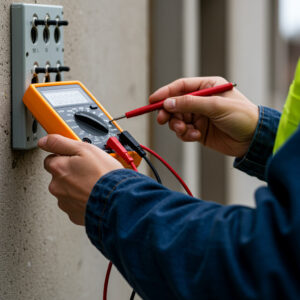
Used to turn on lights and other electrical appliances, the switch is a very common element in our lives. However, its mode of operation is not usually known. Do you know how a switch works?
How a Switch Works
Switches are extremely useful devices, having the function of turning electrical circuits on or off. They are used at network entrances, at intermediate points, and at the entrances of appliances and machines, in short: in all places where it is necessary to turn the electrical power on or off. The distribution of wires to these points requires a thorough study of the circuit’s needs to prevent them from becoming overloaded in the future.
The device is simple and basically works by opening or closing electrical circuits, thereby interrupting (reversibly) the passage of a signal in an electrical or electronic circuit. For this reason, the switches we use to turn lights on and off usually have two positions: open circuit and closed circuit. In the open position, energy circulates and is distributed; and in the closed position, this process is interrupted.
Let’s get to know the types of switches:
Simple Switch
The most common and well-known device, used to turn lights on and off. It has two terminals, with one terminal connected to the phase electrical conductor and the other terminal to the return conductor: the phase conductor is connected to the switch and the neutral and return conductors are connected to the lamp.
Double Switch
The double switch has two sections and follows the same principle as the simple switch, also only allowing a light or a set of lights to be operated from a single point. It is used in medium-sized environments. It is suitable for larger environments that have only one access door and can have separate lighting, for example, a classroom.
Parallel Switch (Three-Way)
The parallel switch, also called a three-way switch, is used when it is necessary to turn a light on or off from two different points in the same room. It is used to operate a light or a group of lights from two different points; for this, just install two three-way switches at different points according to your preference, usually used in corridors, stairs, and yards. The difference between the three-way switch and the simple switch is the existence of a third terminal, which communicates between the two three-way switches or between the three-way switch and the four-way switch.
How an Intermediate Switch (Four-Way) Works
The four-way switch, also known as an intermediate switch, is used when we want to turn a light on or off from more than 2 points in the same room.
It must be connected between two three-way switches to work correctly, thus expanding the activation points of the lights, allowing three or more activation points for a light or group of lights to be operated.
In this option, we have the connection of 1 phase wire to the central terminal of switch A.
From the end terminals, 2 return wires are connected to the terminals on the right of the intermediate connector. From the terminals on the left of the intermediate switch, 2 return wires are connected to the end terminals of switch B.
From the central terminal of switch B, we have a return wire that is connected to the lamp socket. From the second wire of the socket, a wire is connected to the neutral.