Electrical voltage is the electrical potential difference between two points, responsible for moving electrical charges in a circuit. In other words, it “pushes” the electric current, enabling devices and systems to operate.
Measured in volts (V) by a voltmeter, voltage is a fundamental concept in the Brazilian electrical grid.
Understanding electrical voltage is crucial for both electrical safety and energy efficiency. It is present in everyday situations, such as 1.5 V batteries, residential outlets of 127 V or 220 V, and also in high-voltage transmission systems.
In the following sections, we will explore its formulas, measurement methods, types, and main applications, from residential use to electric generators and industrial voltage.
Mastering this concept is the first step for any professional or consumer to use electricity safely and intelligently.
What is the difference between voltage and voltage?
Although the terms “voltage” and “voltage” are often used interchangeably, they both refer to the same phenomenon: the difference in electrical potential between two points in a circuit.
The difference lies in usage:
- Electrical voltage: is the preferred technical term and more formally used.
- Voltage: is a more colloquial and popular way to refer to the potential difference.
In professional contexts, such as technical manuals, standards, and in the industry, you will always find the term “voltage.” However, in everyday conversations or on some labels, “voltage” is widely understood. In both cases, it is the same measure expressed in volts.
Formulas and units of measurement for electrical voltage
The main formula for electrical voltage is described by Ohm’s Law, which states that voltage (V) is equal to the product of electrical resistance (R) and electrical current (I). Its unit of measurement is the volt (V).
Ohm’s Law formula is expressed as:
V = R × I
Where:
- V = voltage, measured in volts (V)
- R = electrical resistance, measured in ohms (Ω)
- I = electrical current, measured in amperes (A)
For example, if a device has 10 ohms of resistance and is traversed by 2 amperes of current, the applied voltage will be 20 volts.
This relationship is fundamental in electricity, as it allows the calculation of any one of the quantities if the other two are known. Ohm’s Law is the basis for the design and analysis of virtually all electrical circuits.
Ohm’s Law and its relationship with electrical voltage
Ohm’s Law, expressed by U = R × I (where U also represents voltage), describes the direct relationship between voltage, current, and electrical resistance. It shows that, in a circuit with constant resistance, the higher the voltage, the greater the electrical current flowing through the conductor, proportionally.
In practice, this means that for a certain electrical current to flow through a conductor, a certain potential difference, or voltage, is needed to overcome its electrical resistance. Materials with higher resistance require higher voltages to allow the same current flow.
For example, a high-resistance electric shower needs an adequate voltage for the current to be sufficient to heat the water. If the voltage is insufficient, the current will be lower and the shower will not heat properly.
Electrical voltage levels in Brazil
In Brazil, electrical voltage levels vary according to the application and region of the country. In residential networks, the most common voltage levels are 127V and 220V, varying by region and utility company.
Industrial and transmission voltage can reach thousands or even hundreds of thousands of volts, such as 13,800V in substations and 500,000V in transmission lines.
These regional variations require attention, especially when using equipment in different states, as many appliances are manufactured to operate at a specific voltage or in dual-voltage mode.
In the country, voltage levels are regulated by standards from the Brazilian Association of Technical Standards (ABNT) and the National Electric Energy Agency (ANEEL).
Below are the main voltage levels used in Brazil and their applications:
| Voltage Level | Main Application | Common Examples |
| Low Voltage | Residential and Commercial |
|
| Medium Voltage | Distribution for neighborhoods and industries |
(substations, large consumers) |
| High Voltage | Long-distance transmission |
(transmission lines)
|
| Extra-High Voltage | Long-distance transmission |
(large generators) |
How to measure electrical voltage?
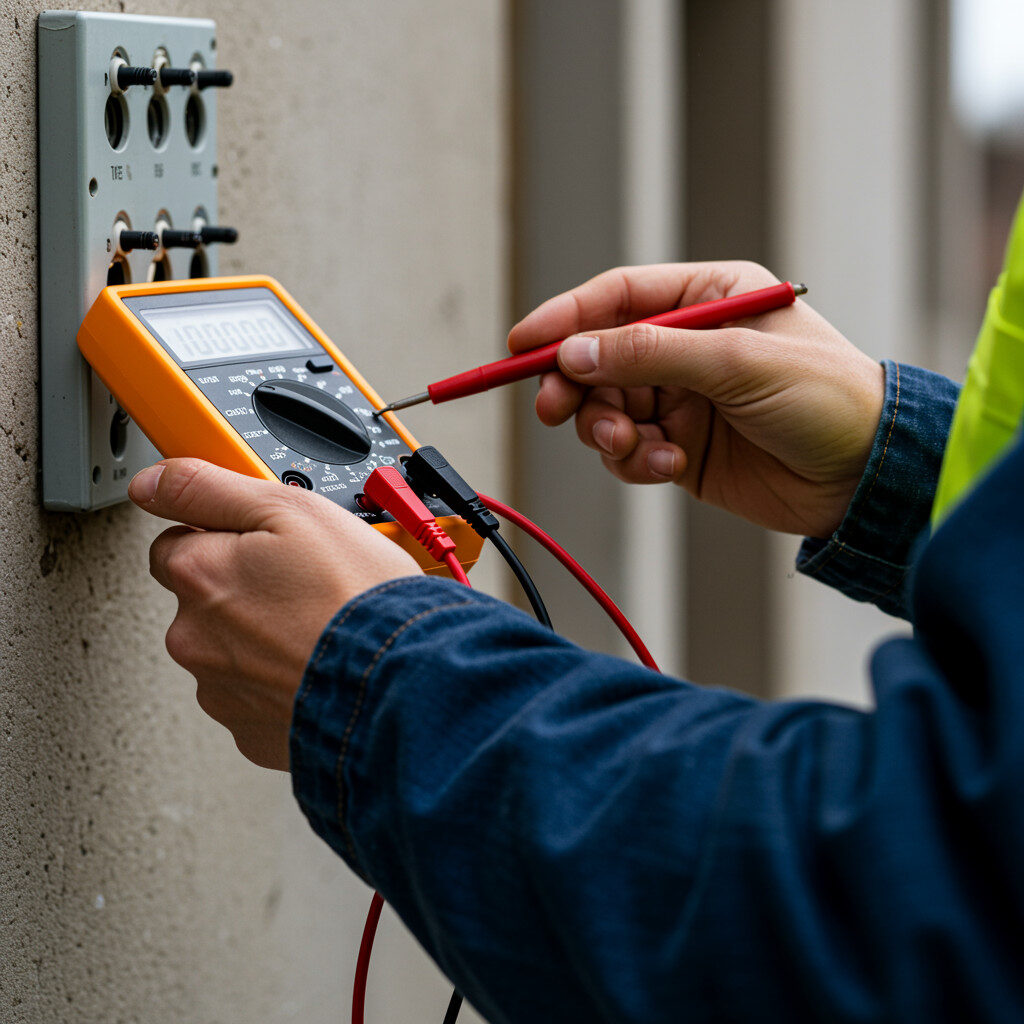
To measure electrical voltage, you use a voltmeter, an instrument specifically designed for this purpose. The measurement should be taken in parallel with the component or power source. It is a simple process but requires attention to electrical safety.
- Adjust the voltmeter: select the appropriate voltage scale (V~ for AC, V– for DC) and the maximum expected value.
- Connect the test leads: insert the red lead into the “V” or “Ω” terminal and the black one into the “COM” terminal.
- Touch the measurement points: position the test leads on the two points where you want to measure the potential difference. For example, on the terminals of a battery or the slots of an outlet.
Never touch the test leads while they are in contact with an active voltage source. The image below illustrates the correct way to use a voltmeter to measure the voltage of a battery.

Types of electrical voltage: direct (DC) and alternating (AC)
There are two main types of electrical voltage: direct current (DC) and alternating current (AC). Direct voltage maintains a constant flow of electrons in a single direction, while alternating voltage periodically reverses its direction.
Direct current is found in batteries, cells, and computer power supplies. Alternating current is used in the electrical grid of homes and industries because it is more efficient for long-distance transmission and has its voltage easily altered by transformers.
| Characteristic | Direct Current (DC) | Alternating Current (AC) |
| Flow | Unidirectional (constant) | Bidirectional (reverses direction) |
| Generation | Batteries, cells, solar cells | Electric generators, alternators |
| Applications | Electronics, automobiles | Homes, industries, transmission |
| Transmission | Not efficient over long distances | Very efficient over long distances |
Practical applications of electrical voltage
Electrical voltage is the driving force behind all modern technology.
In homes, it powers lights, appliances, and climate control systems, ensuring comfort and convenience in daily life. In industry, high voltages are used for powerful motors and large machinery, enhancing efficiency and productivity.
Long-distance energy transmission is possible thanks to voltage elevation by transformers, minimizing losses. Voltage is also crucial in the operation of electric generators, which convert mechanical energy into electrical energy.
Choosing the correct voltage for each equipment is vital for its performance and lifespan. Energy security systems, like those offered by Tecnogera, depend on the efficient and safe management of voltage levels.
Electrical voltage in generators and equipment
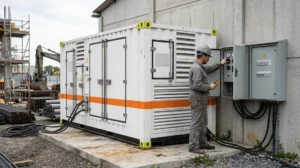
In electric generators, voltage is produced by converting mechanical energy (usually from a diesel or gas engine) into electrical energy through the principle of electromotive force. The generators produce voltage at specific levels, which can be adjusted.
The correct voltage is vital for the proper functioning of equipment. Too low a voltage can cause overheating and damage, while too high a voltage can burn components. Transformers are essential for converting voltage to the required level.
For example, a generator may produce 480V for industrial use, but a transformer can be used to supply 220V for smaller loads or residential voltage. This flexibility is crucial in various applications.
Safety related to electrical voltage
Handling electrical voltage requires extreme caution, as the risks are proportional to its magnitude. Even low voltages can cause a dangerous electric shock, resulting in burns or cardiac arrest. High voltages are lethal and require specific personal protective equipment (PPE).
It is essential to follow basic safety guidelines, such as:
- Never touch bare wires or energized circuits.
- Always turn off the power before performing any maintenance.
- Use protective devices, such as circuit breakers and RCDs, which prevent accidents caused by voltage variations or electrical faults.
In Brazil, the Regulatory Standard NR-10 establishes the minimum safety conditions for working with electricity. It is vital that all professionals and users are aware of and follow these guidelines to avoid electric shocks and other serious accidents.