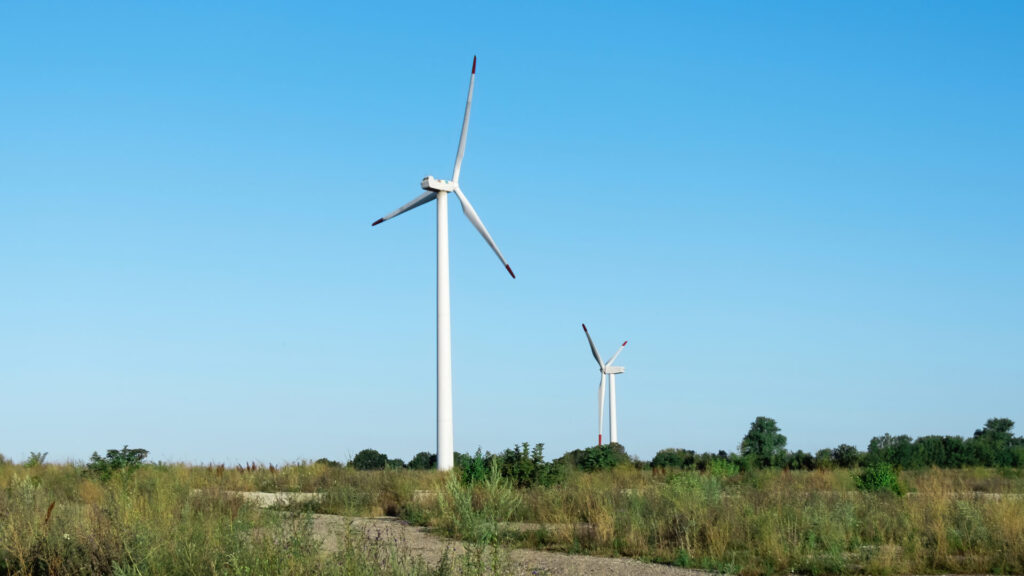
A wind turbine is a device that converts the kinetic energy of the wind into electrical energy. It works by capturing the wind’s force through its blades, which rotate a rotor. This movement is then transformed into electricity by an internal generator
The technology of wind turbines allows harnessing an abundant natural resource to produce electricity efficiently. With models ranging from small residential installations to large wind farms, wind energy has established itself as a crucial solution for energy security and the transition to a more sustainable future.
How does a wind turbine work?
The operation of a wind turbine is a process of energy conversion. It uses the wind’s force to generate electricity, following a series of well-defined steps:
Wind capture:
The wind turbine blades are designed to capture the wind’s energy, rotating around an axis. The aerodynamic shape of the blades is crucial for this efficient capture.
Transmission of movement:
The rotation of the blades drives a rotor, which is connected to a main shaft. This shaft transmits the movement to the nacelle, where the internal components are located.
Rotation multiplication:
Inside the nacelle, a gearbox (multiplier) increases the shaft’s rotational speed to a level suitable for the generator. This is essential to maximize energy production.
Electricity generation
The high-speed shaft connects to an electric generator, which transforms the mechanical energy of motion into electrical energy. This electricity is then sent to the distribution grid or used locally.
Advantages of a wind turbine
The use of wind turbines offers a range of significant benefits, both environmental and economic.
Clean and renewable energy:
The main advantage is the production of electricity without greenhouse gas emissions. Wind is an inexhaustible energy source, ensuring a continuous supply.
Reduction of fossil fuel dependence:
Wind turbines reduce the need to burn fossil fuels, contributing to energy security and reducing price volatility.
Reduced operational cost:
After installation, the operational cost of a wind turbine is relatively low, as the “fuel” (wind) is free. Preventive maintenance is the main expense.
Technological development and job creation:
The wind energy sector drives innovation and the development of new technologies. Construction and maintenance generate thousands of jobs.
Scale flexibility:
Wind turbines can be installed on various scales, from small residential systems to large offshore wind farms. This versatility adapts wind energy to different needs.
Wind turbine components
To understand how it works, it’s essential to know its main parts in converting wind energy into electricity.
Rotor blades:
These are the large “propellers” that capture the wind’s force. Made of lightweight and durable materials, they are aerodynamically designed to maximize capture of wind energy.
Hub:
The hub is the central piece that connects the blades to the low-speed shaft. It ensures that the blades rotate synchronously, transferring the motion to the nacelle.
Nacelle:
Located at the top of the tower, the nacelle is the box or structure where the main internal components of the wind turbine (shaft, gearbox, generator) are housed. It protects these components from the elements.
Imagine the nacelle as the “body” or “brain” of the wind turbine, where all the transformation of mechanical energy (from the rotation of the blades) into electrical energy takes place, and which also protects these sensitive components from weather conditions.
Low-speed shaft:
Connected to the hub, this shaft transfers the rotation of the blades to the gearbox. It rotates at the same speed as the rotor.
Gearbox (multiplier):
Increases the rotation speed of the low-speed shaft to the optimal speed for the generator, optimizing electricity production.
Generator:
The heart of the wind turbine, it converts the mechanical energy of rotation into electrical energy.
Anemometer and wind vane:
The anemometer measures wind speed, and the wind vane indicates its direction. This data optimizes the operation of the wind turbine.
Control system:
An electronic “brain” that monitors and controls the operation, adjusting the orientation of the nacelle (yaw) and the angle of the blades (pitch).
Tower:
The structure that supports the nacelle and rotor at height. The taller it is, the stronger and more constant the wind.
Yaw system:
Allows the nacelle to rotate 360 degrees so that the blades are always facing the wind, maximizing capture.
What are the types of wind turbines?
There are two main types of wind turbines, classified according to the orientation of their rotation axis: horizontal axis (HAWT) and vertical axis (VAWT). Each has specific characteristics and applications.
Horizontal axis
Horizontal axis wind turbines (HAWT) are the most common, with blades that rotate perpendicular to the ground. They are highly efficient for large-scale wind farms, taking advantage of constant winds at high altitudes. Their main feature is the ability to orient themselves in the direction of the wind to maximize capture.
Vertical axis
Vertical axis wind turbines (VAWT) have the rotation axis perpendicular to the ground. They are more suitable for urban areas or with turbulent winds, as they do not need to be oriented and operate well at low speeds. They are visually less intrusive and occupy less horizontal space.
Disadvantages of wind turbines
Although they are a clean energy source, wind turbines present challenges, as described below.
- Wind intermittency: wind power generation depends on the availability of wind, which is intermittent. This causes fluctuations and requires storage systems or complementary sources.
- Visual and noise impact: large wind farms can have a significant visual impact on the landscape and generate noise, a concern for nearby residents.
- Accidents and bird deaths: wind turbine blades pose a risk to birds. Mitigation technologies are constantly being developed to minimize this impact.
- High initial cost: the initial investment for installation can be considerable. However, low operational costs and incentives help in the long run.
- Need for large areas: parks wind require large tracts of land, potentially conflicting with other uses. Offshore solutions minimize this problem, as in this modality the wind turbines are installed at sea and away from the coast.
This way, it is possible to take advantage of the greater consistency and intensity of ocean winds, as well as free up land spaces that would be contested by agriculture, housing, or other human activities. In other words, instead of occupying vast land areas with wind towers, offshore solutions take these structures to the marine environment.
The research focuses on improving efficiency, reducing environmental impact, and better integrating wind energy. Tecnogera offers solutions to optimize energy integration, minimizing the challenges of intermittency.
What is the value of a wind turbine?
The cost of a wind turbine varies significantly depending on its size, technology, power, manufacturer, purpose, and whether the application will be residential or for use in wind farms.
Thus, discussing values is extremely complex. It is worth noting that, in addition to the price of the wind turbine itself, it is essential to account for additional costs such as the support tower, the inverter (converts energy for use or grid), storage batteries (if off-grid), and installation and cabling costs.
Even with the investments involved, the long-term cost-benefit is generally favorable due to savings on the electricity bill and return on investment.
Is it possible to have wind energy at home?
Yes, it is possible to have wind energy at home using residential wind turbines. With the advancement of technology and the pursuit of sustainable energy, small-scale models have become accessible and efficient for domestic consumption.
These devices allow homes, farms, and small businesses to generate their own electricity, reducing dependence on the conventional power grid.
The residential wind turbine is the central component for wind generation at home. It captures the wind and converts it into electricity, which can be used directly in the home or, in grid-connected systems (on-grid), injected into the utility’s system, generating energy credits.
The choice of the ideal model depends on the local wind conditions and energy demand.
How can I generate electricity in my home?
Generating your own electricity at home, focusing on wind solutions, involves some essential steps:
- Wind potential assessment: it is very important to assess the speed and consistency of the wind on your property. Companies like Tecnogera can conduct feasibility studies to determine the ideal location.
- System sizing: based on your consumption and wind potential, the ideal wind turbine will be sized. This includes choosing the power, tower height, and battery needs.
- Choice of wind turbine: opt for a suitable residential wind turbine. Tecnogera can assist in selecting the equipment that best fits your profile and local conditions.
- Installation of components: the installation involves assembling the tower, securing the nacelle and blades, as well as connecting the generator to the inverter and, if applicable, to the battery bank. Installation by qualified professionals is essential.
- Grid connection (On-grid) or Isolated system (Off-grid): decide if your system will be connected to the electrical grid (on-grid) or an isolated system (off-grid), which depends on batteries.
Ensure energy support for wind turbines with Tecnogera!
Wind energy is a fundamental pillar for energy security and sustainability. For your wind turbines to operate at maximum efficiency, it is essential to have a robust and specialized energy support. Tecnogera is the ideal partner to ensure the performance and longevity of your investments.
We offer solutions complete and customized solutions for wind turbines, from feasibility analysis and sizing, to installation, maintenance, and system monitoring.
With Tecnogera’s experience and technology, you will be assured of a continuous and optimized energy supply, maximizing your return on investment and contributing to a cleaner future. Contact us and find out how we can boost your wind project!