Brazil boasts over seven thousand kilometers of coastline from North to South, a fact that favors the production of wind energy. Generated from wind power, it is a clean and renewable energy source that is gaining increasing momentum in the country.
Currently, wind energy accounts for 3% of Brazil’s energy matrix, a percentage expected to grow in the coming years. According to the Brazilian Wind Energy Association – ABEEólica, Brazil has 360 wind farms. This represents 8.98 GW of installed capacity, nearly equivalent to what will be produced by the Belo Monte plant under construction in Pará.
Forecasts for the Brazilian Wind Sector
The forecasts for this sector are even more promising. In the next four years, an additional 10 GW will be installed, which will represent 10% of the total national electricity matrix. By 2024, the expectation is to reach 24 GW, with 21 GW in the northeast region alone.
Global Scenario: Japan and Norway
If the advances in wind energy production in Brazil are noteworthy, the numbers in countries like Japan and Norway are even more optimistic. Recently, the Japanese government announced plans to triple wind energy production by 2020, increasing from the current 3 GW to 10 GW. To achieve this, they plan to invest 478 million euros in new installations. The expectation is that by 2030, the proportion of wind energy generated in that country will increase from the current 3% to 15%. Despite such favorable numbers, wind energy currently meets only 0.5% of Japan’s energy needs.
Another country that recently announced investments in wind energy is Norway. The country plans to build the world’s largest wind farm and will invest over 1 billion euros. The park is expected to be completed in 2020 and produce 1 GW.
Brazilian Investments and Opportunities
Here, the announced investment for 2016 is R$ 28 billion, which will be used to implement 164 new wind farms and will generate a total of 4 GW.
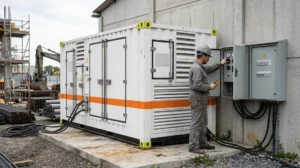
With the number of new wind farms and investments planned for the sector, the scenario is also very favorable for other segments. One of them is temporary energy, essential for the implementation process of a wind farm. The construction of a new plant, usually in locations without a transmission network, requires temporary power generation during construction and until full operation. In this scenario, the rental of load banks for commissioning wind turbines and temporary power generators is necessary.
In other words, with the wind energy market on the rise, other markets also benefit.