What is a refrigeration ton (RT) and thermal capacity
The Refrigeration Ton (RT) is the unit of measurement that defines the cooling capacity of a system. One RT equals the amount of heat needed to melt one ton of ice in 24 hours (approximately 12,000 BTU/h or 3,024 kcal/h).
On the other hand, thermal capacity of the chiller refers to the total volume of heat the equipment can remove from the fluid (water or air) per unit of time, being the decisive factor for the correct sizing of the project.
To cool water in processes, or generate cold air to air-condition environments, the chiller is the best option
Whether in industrial processes that require thermal precision or in large commercial buildings, the chiller stands out for its versatility.
It allows for strict control of the water temperature, which can be transported over long distances to supply different consumption points, ensuring superior energy efficiency compared to conventional direct expansion systems.
Main applications of the chiller by sector
- Pharmaceutical and food industry: Temperature control in production lines and preservation of inputs.
- Hospitals and hotels: Air conditioning of large areas with low noise levels.
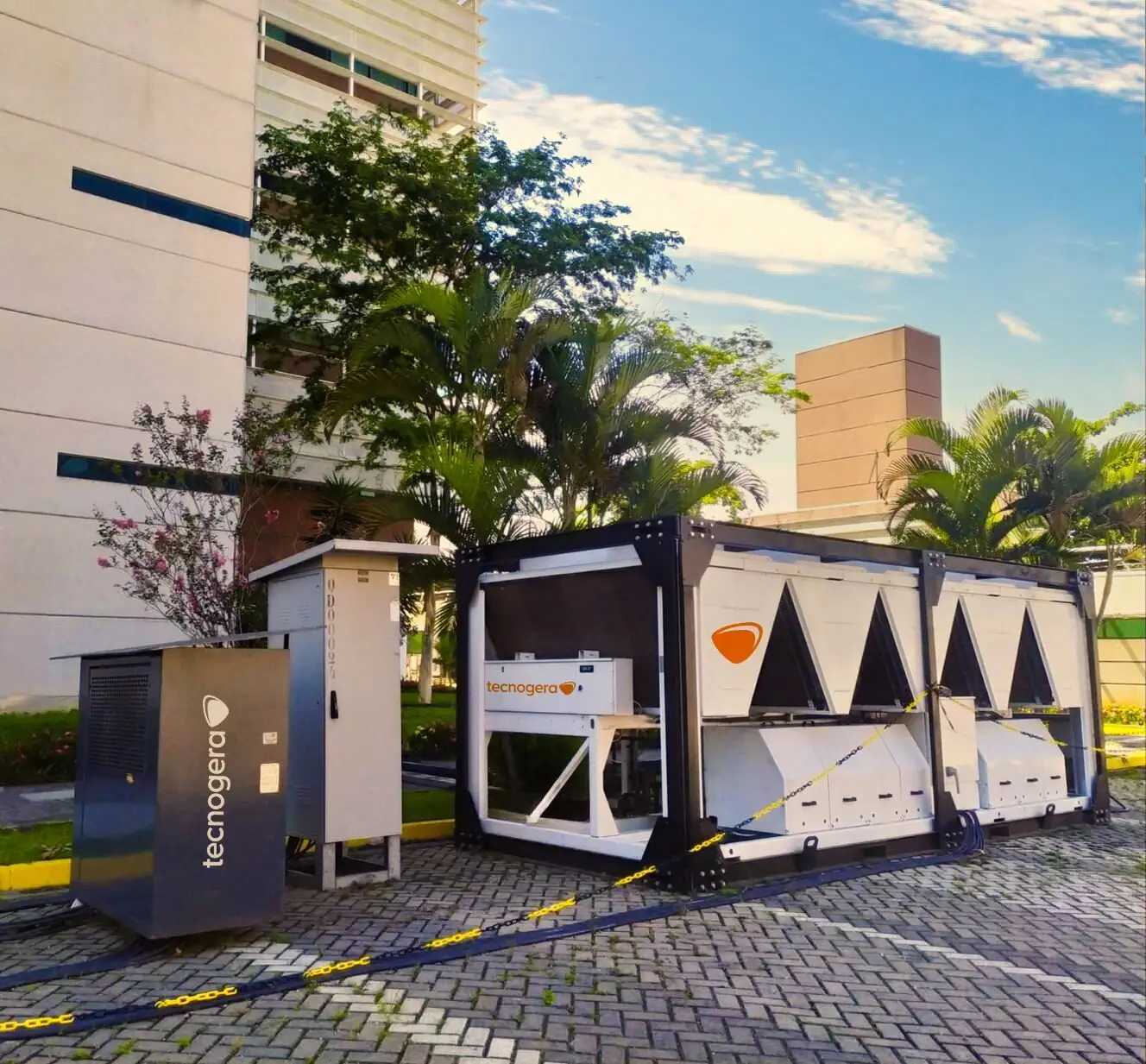
- Events: Use of rental chillers for temporary cooling of large pavilions.
- Plastics: Cooling of molds in injection and extrusion machines.
How Does a Chiller Work?
The Chiller consists of 4 basic components of a refrigeration system: Compressor, Condenser, Expansion Device, and Evaporator. The functions of each of these basic components are explained below.
Compressor
Taking refrigerant gas R-22 as an example, if we were to condense the refrigerant at atmospheric pressure, we would need to reduce its temperature to -41ºC. In other words, its condensation temperature would not be feasible at atmospheric pressure.
The function of the compressor is precisely to increase the pressure of the refrigerant, raise its temperature, and change its condensation point. In this case, condensation occurs at high pressures and temperatures.
The Compressor sucks in the refrigerant in vapor form at low pressure and temperature and compresses it, increasing its pressure and temperature. This pressure is also important for the circulation of the refrigerant throughout the entire refrigeration circuit.
It is important to note that the Compressor is built to pump only the refrigerant vapor. Otherwise, if the refrigerant were in a liquid state in the compressor, there would be a valve breakage or dilution of the lubrication oil, damaging the bearings.
Condenser
The hot refrigerant vapor at high pressure and temperature is discharged into the condenser. The Condenser is nothing more than a heat exchanger, which can be Air or Water. As heat is propagated from a substance with a higher temperature to one with a lower temperature, the latent heat absorbed by the vapor in the evaporation process plus the sensible heat absorbed by the vapor in the compression process is transferred to the air (air condensation) or water (water condensation).
Once the heat is removed from the refrigerant, it condenses and returns to the liquid state. The Condenser subcools the liquid before it exits and goes to the Expansion Valve.
Expansion Device
When the liquid leaves the condenser and passes through the expansion device, the pressure is reduced to the evaporator pressure. At this low pressure, a small portion of the liquid evaporates immediately, cooling the temperature of the remaining liquid to the evaporation temperature. Since this temperature is lower than the temperature of the Air or Water we want to cool, the heat removed by the evaporation of the refrigerant liquid in the Evaporator cools the Air or Water in question.
Evaporator
The function of the evaporator is to cool the ambient air or the Chiller water. The liquid refrigerant absorbs the heat from the air or water, causing the refrigerant to evaporate. The refrigerant, now in vapor form, completes the refrigeration circuit by being sucked in again by the compressor.
Types of Chillers and Their Advantages
Chillers have high technology, providing performance and safety. The main types of Chillers are water-cooled and air-cooled. Both offer advantages such as low energy consumption and a wide range of temperature variation. Additionally, the devices are efficient and have great durability.
Chiller by mechanical compression
This is the most common model on the market, using mechanical energy (usually via an electric motor) to drive the compressor. The refrigeration cycle is based on the physical alteration of the refrigerant fluid between liquid and gaseous states through pressure variation.
Absorption chiller
Unlike the mechanical model, the absorption chiller uses a heat source (such as steam, hot water, or gas combustion) to perform the refrigeration cycle. It is ideal for locations with cogeneration of energy or thermal surplus, as it uses substances like lithium bromide and water instead of electric compressors.
Modular chiller
The modular system allows the connection of several smaller units that work together. The main advantage is redundancy and scalability: if one module needs maintenance, the others continue operating, and the system’s capacity can be expanded as demand grows.
Portable chiller
Designed for applications that require mobility or localized cooling, the portable chiller is compact and has all components (including tanks and pumps) integrated into a single structure on wheels. It is widely used in laboratories and small-scale industrial processes.
Water-Cooled Chiller
Water-cooled chillers are extremely versatile and economical equipment. They operate quietly and, for this reason, are widely used in sectors where noise level is an important criterion. The most commonly used compressors are centrifugal (300TR to 2,000TR) and screw (100TR to 600TR). Centrifugal compressors can achieve efficiencies over 20% compared to screw compressors, but they have a higher initial investment cost.
Advantages and disadvantages of Water-Cooled Chiller
The main advantages include high energy efficiency and the reduced size of the equipment. As disadvantages, the need for cooling towers and constant water consumption stands out, requiring rigorous chemical treatment to prevent scaling in the pipes.
Air-Cooled Chiller
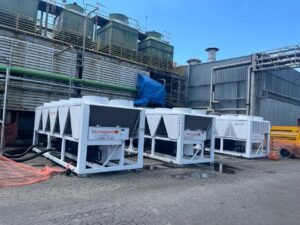
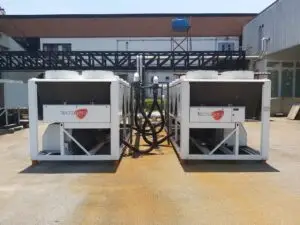
These are robust and highly durable equipment, widely used in large-scale industrial refrigeration systems. Their maintenance is more centralized and simple. The compressors are usually Scroll (12TR to 150TR) and Screw (100TR to 350TR). Screw compressors are more robust, have fewer moving parts, resulting in greater system reliability, but have a higher initial investment cost.
Advantages and disadvantages of Air-Cooled Chiller
The main advantage is the simplicity of installation, as it does not require cooling towers or condensation pumps. On the other hand, the disadvantage lies in the larger physical space occupation and slightly lower efficiency compared to water systems in very hot climates.
Difference Between Chiller and Fan Coil
The Chiller and the Fan Coil are two parts of the same cooling system. The Chiller is the equipment responsible for producing chilled water.
The Fan Coil, on the other hand, is the equipment that receives this chilled water from the Chiller, which circulates in its internal coil, and through an internal ventilation system, forces air through the coil, reducing the air temperature and air conditioning the environment.
Chillers for data centers and critical industrial applications
In critical mission environments, such as data centers, the chiller needs to operate 24/7 with maximum reliability. In these cases, systems are often used free-cooling, which take advantage of low external temperatures to cool the water without turning on the compressors, in addition to redundancy systems (N+1) to ensure that cooling is never interrupted.
How to Choose the Ideal Chiller?
The choice depends on the required thermal load, available space, and utility infrastructure (availability of water or electricity). It is essential to analyze the life cycle cost (initial investment vs. energy consumption) and the installation environment to decide between air or water condensation.
Preventive maintenance and Chiller lifespan
To ensure a lifespan of over 20 years, preventive maintenance is essential. This includes periodic analysis of compressor oil, checking the refrigerant charge, cleaning heat exchangers, and monitoring electrical panels. A well-executed maintenance plan prevents unscheduled downtime and maintains original energy efficiency.
Chiller brands and types
Carrier, Trane, Hitachi, Komeco, Johnson Controls, and Daikin are the main brands that currently manufacture various models of Chillers. The products feature high technology, providing performance and safety from an economic and ecological perspective.
There are also Absorption Chillers, rarely used in Brazil, which are powered by heat (direct fuel combustion, steam, hot water, or exhaust gases). They are widely used in energy cogeneration systems, divided into direct and indirect combustion types.
Thinking about renting a Chiller, contact us!