Electrical cable color code
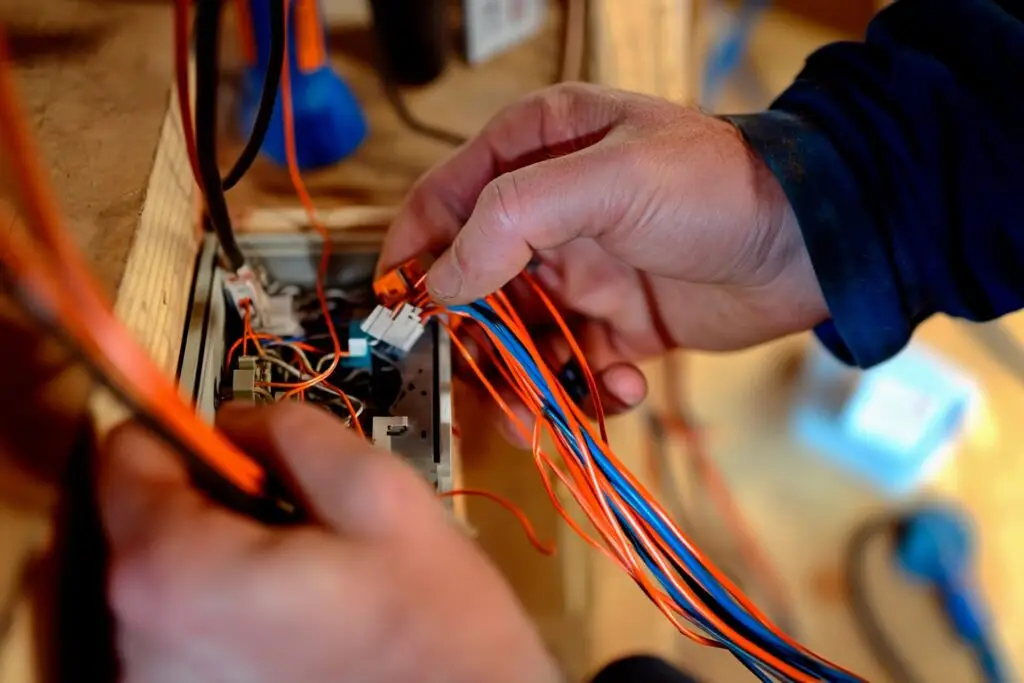
The electrical cable color code ensures safety in installations and maintenance.
The NBR 5410 standard establishes:
- light blue for neutrals (0V)
- green or green-yellow for protection (ground)
- red/black/brown for phase (127V/220V)
Wires are single, more rigid conductors, cables have multiple intertwined, more flexible conductors.
Classes:
- 1 (solid wire)
- 3 (7 rigid conductors)
- 4 (45 flexible)
- 5 (75 extra flexible)
It’s important to always check voltage and consult diagrams, as not all installations follow the standard, especially in older constructions.
What is the difference between wires and cables?
Wires and cables are electrical conductors that have different names only because they have distinctions in their internal composition, but with the same purpose, which is conducting electrical current. They are classified according to the NBR NM 280:2011 standard, which defines their category as electrical conductors: wires contain only one solid conductor while cables are composed of several smaller conductors according to their class, made of copper, and also aluminum.
Characteristics of electrical wires
The electrical wire is formed by a single wire, with a constant metallic section where there is no difference in terms of current conduction capacity in residential installations. Due to its rigidity, it is easier to break if bent several times. Therefore, they are only used in situations where they will not be subjected to bending. They are classified as Class 1: Solid Wire composed of only one conductor.
Characteristics of electrical cables
The electrical cable is made up of several intertwined conductive wires, which makes it flexible and able to withstand many bends without ever breaking. They are used in the connection between two parts of a circuit that can change position and are therefore subject to bending stresses. The section, or “thickness” of a conductor cable, depends on the amount of electricity it will have to support. It can be said that there are conductors with various sections and multiple configurations.
Classification of the main classes of conductor cables
- Class 3: Composed of 7 conductors (Rigid)
- Class 4: Composed of 45 conductors (Flexible)
- Class 5: Composed of 75 conductors (Extra flexible)
NBR-5410 Standard
In Brazil, the NBR 5410 standard determines the colors of electrical cables and wires that must be used for identification. It applies to low voltage electrical installations in buildings. In addition to specifying cable color rules, it also establishes their identification and function, residential grounding, lighting, sockets and switches, distribution panel location, load survey, and other items. According to the standard, it is not mandatory to use the color table to identify cables, but if color is used as a form of function identification, these colors must follow the standard.
Light blue cable
For insulated neutral conductors. Any insulated conductor, single-core cable, or multipolar cable core used as a neutral conductor, if identified by color, must be light blue, on the insulation of the insulated conductor or the core of the multipolar cable, or on the cover of the single-core cable. The conductor that has no voltage (0V) is not charged, but should not be called “negative,” using this concept is completely wrong.
Green or green with yellow cable
For protective conductors, popularly known as “ground wire.” Any insulated conductor, single-core cable, or multipolar cable core used as a protective conductor (PE), if identified by color, must be green-yellow or green (exclusive colors for the protection function), on the insulation of the insulated conductor or the core of the multipolar cable, or on the cover of the single-core cable. Protective Conductor (PE) is a conductor connected to rods driven into the ground and accompanies all circuits with the function of protecting the equipment connected to the circuits against electrical overloads and users against possible electric shocks.
Red, black, or brown cable
Indicated for phase conductors. For the phase conductor, any colors can be used as long as the colors established in the previous items are not used. Generally, red, black, or brown is used. Any insulated conductor, single-core cable, or multipolar cable core used as a phase conductor must be identified according to this function. It is the conductor where there is a voltage (127V or 220V) or potential difference (PD). In construction language, it is the conductor that has “load.”
Important: safety check
It is worth noting that, despite the existence of a specific standard for the standardization of electrical wires and cables, many electrical installations do not follow the official coloring — especially in very old or irregular constructions. Therefore, never blindly trust the color of the wire when making new connections or performing maintenance. It is ideal to always consult the installation diagrams and maps in detail, as well as measure the voltage present in each conductor.
At Tecnogera, every detail is designed to achieve the best customer experience in receiving services and products. These are solutions in temporary energy and electrical equipment, chosen to meet the most complex demands in the main market segments. To learn more and clear all your doubts, talk to a specialist right now.