The equipment for working at heights are devices designed to ensure the protection and physical integrity of professionals at elevated levels. They are essential to minimize fall risks, ensuring legal compliance and the continuity of business operations.
Safety in elevated activities requires strict compliance with Regulatory Standard – NR-35, which regulates work performed above two meters from the lower level. The use of items such as the parachute-type harness, lanyard, fall arresters, and carabiners is mandatory to prevent fatalities.
In addition to individual equipment, the use of Collective Protection Equipment (CPE) and auxiliary devices, such as ropes and pulleys, structures a preventive environment.
What are the main risks of working at heights?
Exposure to heights without proper protection can result in irreversible health damage and significant legal liabilities for organizations.
Risks vary depending on the environment, but structured prevention drastically reduces workplace accident rates. Check out the main points of attention:
- Level falls: represent the most severe risk, being one of the leading causes of fatalities in construction due to failures in anchors or harnesses.
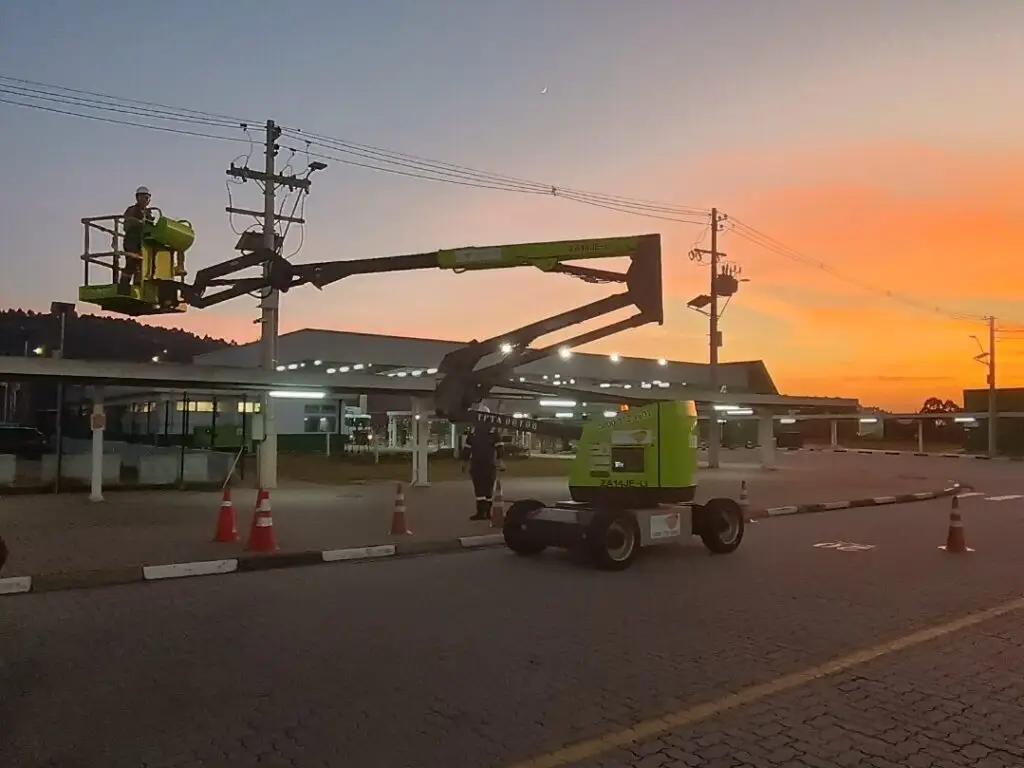
- Electric shock: constant danger in maintenance near live networks, requiring the use of equipment for working at heights with adequate insulation.
- Falling objects: suspended tools and materials can hit people on the lower level if there are no safety nets or tool lanyards.
- Weather conditions: strong winds and rain can compromise the worker’s stability and the adhesion of contact surfaces.
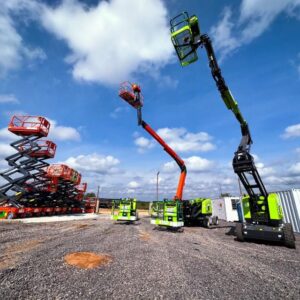
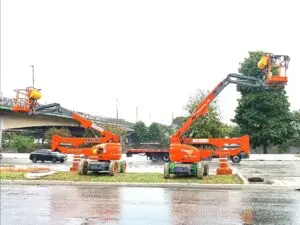
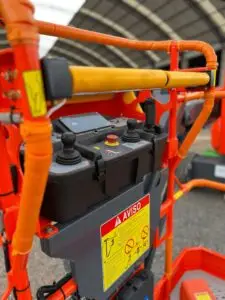
To mitigate these issues, the use of insulated electric platforms, available in Tecnogera’s portfolio, Tecnogera, is a differentiator that reduces electrical risks and offers greater operational stability.
What are the main equipment for working at heights?
The correct selection of safety devices is crucial for the effectiveness of the fall protection system and for the comfort of the worker. The market offers several solutions that should be chosen based on the Risk Analysis (RA) specific to each task.
- Safety lanyard: a connecting device that links the harness to the anchor point, which can be single, double, or with energy absorber.
- Fall arresters: automatic retention equipment that locks instantly in case of sudden acceleration, essential in vertical or horizontal lifelines.
- Parachute-type harness: a basic item that distributes the impact force across the worker’s body, minimizing injuries in case of fall arrest.
- Carabiner: metal connector with safety lock used to join different components of the PPE KIT for working at heights.
- Anchorage: structural points where protective equipment is attached to ensure they can withstand the load in case of an incident.
- Protective gloves: protect hands against abrasion and cuts when handling ropes and metal structures.
How to prevent accidents when working at heights?
Accident prevention requires a multidisciplinary approach that combines technology, strict management, and constant operational awareness of those involved.
It is not enough to just provide the mandatory PPEs, it is necessary to ensure that the entire work ecosystem is aligned with current safety standards.
The adoption of good practices begins with detailed planning and extends to post-operation, ensuring that each stage is monitored and evaluated. Below, we detail the pillars to keep the work environment free from serious risks.
NR-35 training and worker qualification
Only trained and qualified professionals can work at heights, according to the guidelines established by NR-35 and complementary standards. The training should cover both theoretical and practical aspects, focusing on risk perception and the correct use of each safety component.
Technical training ensures that the worker knows how to react in emergency situations and use the safety lanyard strategically. Investing in continuous education reduces operational errors and increases productivity, as the employee works with greater confidence, technique, and full mastery of their functions.
Risk analysis of working at height
Before starting any activity, a Preliminary Risk Analysis (PRA) should be conducted to identify specific hazards and define the necessary control measures. This document is the guide that determines which Collective Protection Equipment (CPEs) and individual equipment will be used at the work front.
The analysis should consider the surroundings, the presence of electrical networks, and the resistance of available anchorage points. A PRA well-executed anticipates adverse scenarios and ensures that the team is prepared with the PPE for working at height suitable for that scenario.
Increase supervision of work according to height
Supervision of work at height should be constant, focusing on continuous risk assessment and checking the integrity of the equipment in use. The responsible supervisor must have authority to stop activities if they identify unsafe conditions or improper use of the fall arrest device.
This verification should cover everything from the assembly of anchorage systems to the behavior of employees on platforms. Maintaining active leadership in the field reinforces the safety culture and ensures that operational procedures are strictly followed by everyone.
Periodic evaluation for working at height
Periodic occupational health assessment is essential to ensure that the employee is physically fit to perform functions at high levels. Through the Occupational Health Medical Control Program (PCMSO), exams are conducted to rule out risks of sudden illness, such as epilepsy or vertigo.
Height PPE inspection checklist
Conducting a preliminary inspection of the equipment is a basic preventive measure that can prevent fatal mechanical failures during task execution. Each item of the PPE kit for working at heights must be visually and functionally checked before each work shift.
What to inspect on the full-body harness?
- Do the straps have cuts, abrasions, burns, or damage from chemicals?
- Are the stitches intact, without frayed or broken threads?
- Are the metal buckles and rings free of deformations, cracks, or rust?
What to inspect on the safety lanyard?
- Is the energy absorber sealed, without activation or broken stitches?
- Do the hooks and carabiner function correctly with automatic locking?
- Does the rope or strap show excessive wear or signs of solar degradation?
How to properly use the lanyard when working at heights?
The correct use of the safety lanyard requires it to be always connected to a secure anchor point, preferably above the worker’s head. When moving, the double model is essential to ensure that the professional is never disconnected while switching between attachment points.
It is prohibited to tie knots in the straps or connect it in a way that increases the fall factor, which would nullify the function of the energy absorber. Tecnogera advises that the free fall distance is always calculated to avoid impact with the ground or lower obstacles.
What is the CA (Certificate of Approval)?
The Certificate of Approval (CA) is the document issued by the Ministry of Labor that ensures that the PPE has been tested and approved according to quality criteria. Without this registration, the equipment does not have legal validity for professional use, leaving the company exposed to sanctions and the worker in danger.
Tecnogera operates exclusively with certified equipment , ensuring that the entire rental fleet meets the highest resistance standards. Using only items withvalid CA is a non-negotiable commitment to safety. Which PPEs are valid?
The validity of the equipment is determined both by the manufacturing date and the condition verified in periodic inspections. See the estimate:
The validity of the equipment is determined both by the manufacturing date and the condition verified in periodic inspections. See the estimate:
| Equipment (PPE) | Estimated Validity | Remarks |
| Safety belt | 3 to 5 years | Depends on the manufacturer and usage conditions. |
| Lanyard with absorber | 2 to 5 years | Must be discarded immediately after a fall. |
| Fall arrest device | 3 to 5 years | Requires periodic maintenance and lubrication. |
What is the relationship between working at heights and NR-35?
NR-35 establishes the legal standard for all activities at heights, defining the responsibilities of employers and employees in risk management. It serves as the main guide for equipment selection, requiring each device to be suitable for the task and in perfect condition.
Compliance with this standard is what differentiates professional operations from improvised activities that put lives at unnecessary risk. Compliance ensures that the company adopts the fall arrest device and energy absorber correctly, aligning safety with operational efficiency.
What are the consequences of not complying with the standard for working at heights?
Non-compliance with NR-35 guidelines results in serious impacts that go far beyond immediate administrative sanctions for the organization. For example:
- Risks to physical integrity: falls from height are among the leading causes of death in construction, according to official occupational safety data.
- Legal implications: civil liability for moral damages and criminal liability for negligence of managers in case of fatal accidents.
- Financial losses: heavy fines imposed by the Ministry of Labor and immediate shutdown of work fronts and construction sites.
- Reputation damage: loss of brand value in the market and difficulty in participating in bids that require strict compliance.
Factors to consider when working at height
In addition to using equipment, it is necessary to observe environmental and logistical factors that may influence the safety of elevated operations. Adequate lighting of the work area and the stability of the ground where auxiliary equipment is positioned are fundamental points.
Clear communication between the ground team and the worker at height prevents positioning errors and speeds up rescue in case of incidents. At Tecnogera, we offer consultancy to ensure that the rental of equipment for work at height considers all these external variables.
What is a CPC?
Collective Protection Equipment (CPCs) are devices installed to protect all workers circulating in a given area simultaneously. Unlike PPE, CPC does not depend on the individual action of the employee to provide safety, being the first line of defense.
Common examples include guardrails, safety nets, safety signs, and fixed lifelines installed on roofs or facades.
The priority in risk management should always be the installation of Collective Protection Equipment (CPEs) even before defining individual items.
How does equipment rental for working at heights work?
The Tecnogera offers an End-to-End model that simplifies safety and energy management for your company, ensuring equipment is always up-to-date. Our process is focused on delivering the exact solution for your project’s specific needs, with specialized technical support.
- Technical consultancy: we analyze your demand to recommend the best platform or access equipment.
- Fast delivery: efficient logistics to ensure your construction or maintenance schedule is not delayed.
- 24h support: technical assistance available to resolve any issues immediately.
- Maintenance included: all equipment undergoes rigorous inspection before and during the rental period.
Rent the best equipment for working at heights at Tecnogera!
Choosing Tecnogera means investing in cutting-edge technology and a partnership committed to “zero accidents” in your operations. Our fleet of electric platforms is equipped with modern safety devices, ensuring your team works in compliance with the law.
Do not risk the safety of your employees with outdated equipment or without guaranteed provenance. Count on those who are a national reference in energy and safety solutions for complex work.
Contact us and gain peace of mind and performance.
Frequently asked questions about equipment for working at heights
What are the mandatory PPEs for working at heights according to NR-35?
The mandatory PPEs defined by NR-35 include a parachute-type safety harness, safety lanyard (single or double), fall arresters, and a helmet with a chin strap. The exact selection of these items depends on the risk assessment and may also require the use of carabiners and specific gloves.
What is more cost-effective, renting or buying equipment for working at heights?
Renting is financially more advantageous as it turns fixed costs into variable ones (OPEX), ensuring modern equipment and maintenance included without the burden of depreciation. Market data indicates that renting reduces operational costs by up to 30% compared to acquiring and managing your own fleet.
What is the leading company in equipment rental for working at heights?
Tecnogera stands out as a leader in the sector, combining energy and safety solutions with one of the most technological and safest fleets in Brazil. Our authority is validated by years of experience in major infrastructure projects and partnerships with the largest industries in the country.
How to check if the CA (Certificate of Approval) is valid?
To verify validity, simply access the official Ministry of Labor portal (CAEPI System) and enter the number printed on the equipment. It is essential that this check is part of the receiving checklist for any PPE kit for working at heights.
What is the difference between a lanyard and a fall arrester?
A lanyard is a fixed-length connector used for positioning or restraint, while a fall arrester is a mechanical device that automatically locks during falls. There are sliding fall arrester models (for ropes or cables) and retractable ones, which offer greater freedom of movement to the worker.