Regulatory Standard 35 (NR35) establishes the minimum requirements and protective measures for performing work at heights.
Its primary goal is to ensure the safety and health of professionals involved, directly or indirectly, in activities conducted above two meters from the lower level where there is a risk of falling. NR35 guides the planning, organization, and execution of these tasks.
Understanding NR35 is essential to prevent accidents and ensure a safe working environment. In this text, we will cover its main aspects, from purpose and importance to the responsibilities of employers and employees, including the latest updates to the standard.
Index:
What is the purpose of NR 35?
What is the importance of NR 35?
What does Regulatory Standard 35 (NR35) say?
What height does NR 35 require?
How to comply with Regulatory Standard 35 (NR35)?
Employer’s duties
Employee’s duties
Mandatory training
What PPE is required for work at heights?
Consequences of non-compliance with NR 35
What are the main activities at height?
Key changes in the NR 35 update
Other important regulatory standards
Regulatory Standard 5 (NR 5)
Regulatory Standard 6 (NR 6)
Regulatory Standard 7 (NR 7)
Regulatory Standard 17 (NR 17)
Regulatory Standard 10 (NR 10)
Regulatory Standard 33 (NR 33)
Ensure greater safety for work at height with Tecnogera
What is the purpose of NR 35?
NR35 addresses the safe execution of work at heights. The standard aims to prevent falls and other accidents, protecting the physical integrity and health of workers during their activities.
The standard defines responsibilities, safety procedures, equipment requirements, and training.
By following NR35, companies implement a safety management system for activities at height. This includes everything from preliminary risk analysis to constant supervision, aiming to create a prevention culture where each step is planned and executed with a focus on everyone’s safety.
What is the importance of NR 35?
NR35 is very important for companies. By complying with the standard, a company shows it is meeting its legal obligations, and compliance avoids fines. Implementing its guidelines significantly reduces the number of workplace accidents, which decreases labor lawsuits and other costs.
The professional training required by NR35 enhances the qualification of employees, making operations more efficient. Companies that prioritize safety, like Tecnogera by providing modern and safe equipment, demonstrate responsibility and value their human capital.
What does Regulatory Standard 35 (NR35) say?
NR35 details requirements and protective measures, covering planning, organization, and safe execution. It requires Risk Analysis (RA) and, when applicable, a Work Permit (WP) for non-routine activities.
It also specifies the need for supervision, the importance of fall protection systems, and emergency procedures. The standard clearly defines the responsibilities of employers and workers, promoting a safer work environment.
What height does NR 35 require?
According to the standard, work at height is any activity performed above two meters from the lower level where there is a risk of falling. This definition is crucial as it sets the criteria for applying NR35’s requirements.
Therefore, any task under these conditions must strictly follow the standard’s provisions. This includes using appropriate equipment, such as aerial platforms, which must meet all safety standards.
How to comply with Regulatory Standard 35 (NR35)?
Compliance with NR35 involves measures starting with planning and risk assessment. It is essential for the company to develop specific operational procedures for each type of work at height, based on a detailed Risk Analysis (RA).
The company must ensure that only trained and authorized workers perform tasks involving work at heights. Providing and enforcing the use of Personal Protective Equipment (PPE) and Collective Protective Equipment (CPE) is mandatory.
Companies like Tecnogera facilitate this compliance by offering equipment with safety devices, such as the anti-crush bar on their platforms and other equipment required by NR35.
Employer’s duties
NR35 establishes the employer’s duties. It is their responsibility to ensure the implementation of protective measures and conduct the Risk Analysis (RA). They must also develop operational procedures for routine activities at height, adopting a checklist of activities.
The employer needs to ensure the issuance of a Work Permit when necessary and guarantee that work at height only begins after protective measures are in place.
The employer’s responsibility is to supervise compliance with the provisions and organize training, which must be conducted periodically.
Employee’s duties
The duties of employees are also outlined in NR35. They must comply with legal provisions and the employer’s procedures, cooperating in the implementation of the standard.
It is the worker’s duty to stop their activities, exercising the right of refusal, when they perceive or identify serious risks that could result in accidents. Correct use of PPE, care for their own safety and that of others, and participation in training are fundamental.
Mandatory training
NR35 requires effective, specific, theoretical, and practical training for workers performing work at heights. The minimum duration is eight hours, covering standards, risk analysis, prohibitive conditions, potential risks, and preventive measures.
The training must also cover protection systems, equipment, and emergency procedures, including rescue and first aid procedures.
This training must be periodic, repeated every two years or when specific situations require refreshers.
What PPE is required for work at heights?
PPE – personal protective equipment, is essential to contribute to the safety of workers at elevated heights.
We list some of the indispensable items for professional protection:
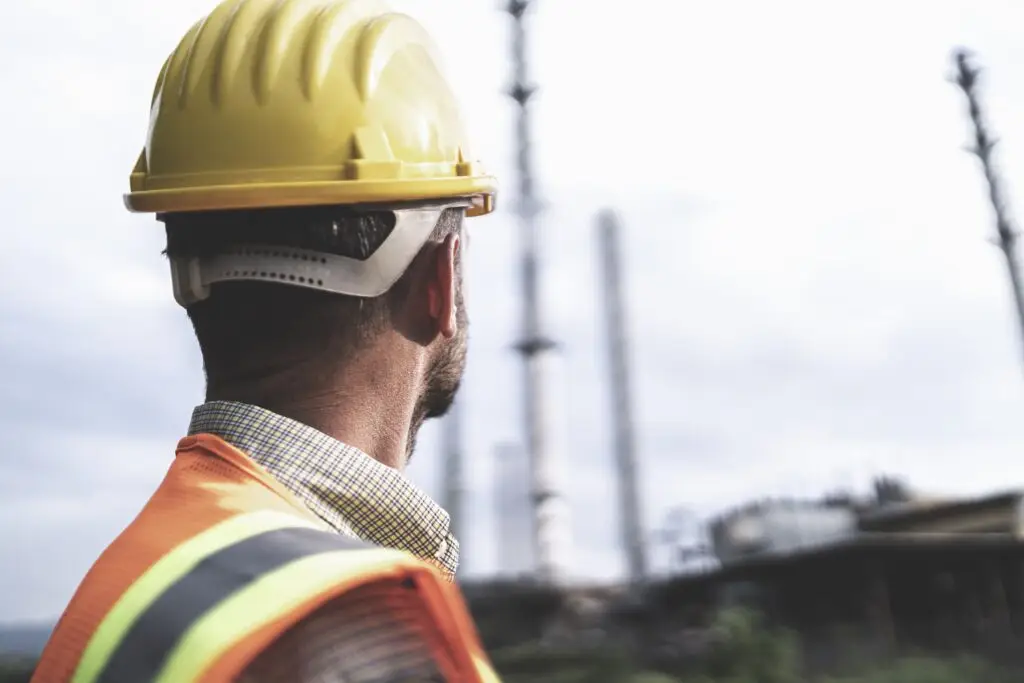
- Helmet with chin strap
- Safety harness
- Safety glasses
- Safety boots
- Lanyard
- Fall arrest device
Consequences of non-compliance with NR 35
Non-compliance with NR35 can lead to serious consequences for employers and employees. There is an increased risk of severe and fatal accidents. Legally, the company may face heavy fines, shutdowns, and civil and criminal lawsuits.
Besides financial costs, the company’s reputation may be damaged and compromised. Labor lawsuits and compensations can affect the financial health of the business. Compliance with NR35 is an investment in safety and sustainability.
What are the main activities at height?
NR-35 sets the rules for work at heights and identifies the most common activities performed at height. We list some:
- Building maintenance;
- Roof work;
- Work on energy towers;
- Painting in elevated locations;
Additionally, there are tasks that require specific equipment at elevated heights, such as aerial platforms. To operate them, professionals must be knowledgeable about NR-35 provisions.
Key changes in the NR 35 update
As of January 2024, NR35 underwent significant updates, including some important changes. One of the main changes is the harmonization with the Occupational Risk Management (ORM) and the Risk Management Program (RMP) of NR1.
The new Annex III (Ladders), effective since January 2024, details requirements for manufacturing, use, and maintenance. Annex I (Rope Access) was also updated. These changes enhance safety practices, requiring a review of procedures and training.
Other important regulatory standards
In addition to NR35, other NRs are crucial and directly relate to work at heights:
Regulatory Standard 5 (NR 5)
NR5 aims to prevent work-related accidents and illnesses, promoting worker health through active participation in safety.
Regulatory Standard 6 (NR 6)
NR6 addresses Personal Protective Equipment (PPE). It defines employer responsibilities regarding provision, training, and enforcement of use, and the requirements for each PPE.
Regulatory Standard 7 (NR 7)
NR7 covers the Occupational Health Medical Control Program (PCMSO) and promotes and preserves worker health with periodic medical exams.
Regulatory Standard 17 (NR 17)
NR17 addresses ergonomics and provides for adapting work conditions to the psychophysiological characteristics of workers, seeking comfort, safety, and performance, relevant for work at heights.
Regulatory Standard 10 (NR 10)
NR10 deals with Safety in Electrical Installations and Services and is vital for work at heights near electrical networks. Tecnogera, as a provider of energy solutions, strictly follows the recommendations of NR10 and NR35 together.
Regulatory Standard 33 (NR 33)
NR33 addresses Safety and Health in Confined Spaces and establishes requirements for identifying, evaluating, and controlling risks in confined spaces, which may be accessed during work at heights.
Ensure greater safety for work at height with Tecnogera
Having understood NR35, we emphasize: safety is paramount. At Tecnogera, safety is a value connected to our energy solutions. Our fleet of electric aerial platforms is among the most modern in the country and equipped with anti-crush bars, an essential safety feature.
We continuously invest in team training for safe and efficient operations, aligned with NR35.
By choosing Tecnogera’s solutions, your company benefits from cutting-edge technology and a partner fully committed to safety.
Want to bring technology and safety to your company? Contact us.