Major soccer games and sporting events rely on infrastructure that goes far beyond the field. Lighting, broadcasting, security systems, big screens, climate control, catering, and temporary structures require a reliable power supply to ensure operations run smoothly without interruptions.
In this context, temporary power in stadiums can be used as the main source for temporary structures, to boost electrical capacity, or as a backup system for emergencies.
The solution allows for adapting the power supply to the needs of each event, reducing risks and contributing to the continuity of operations.
What is temporary power in stadiums?
Temporary power in stadiums is an electrical supply solution used for a specific period to meet demands that cannot or do not need to be met exclusively by the venue’s permanent infrastructure.
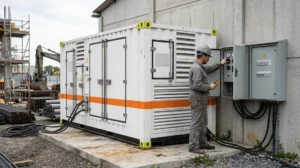
The setup may involve generator sets, transformers, transfer panels, distribution systems, and other equipment, according to the project’s characteristics.
This type of solution can be used both in scheduled events and in contingency situations.
Temporary power is not only used in emergencies
One of the main points is that temporary generation does not need to be activated only when there is a failure in conventional supply.
It can also be planned in advance to:
- serve temporary structures;
- increase available capacity;
- power specific areas of the event;
- maintain operations during construction or maintenance;
- create a backup source;
- reduce risks related to power supply.
In this way, the generator becomes part of the event’s infrastructure planning.
When to use temporary power in stadiums?
The need for a temporary generation solution varies according to the structure and type of event. The main applications include games, shows, construction, maintenance, and temporary installations.
Games and sporting events
During a soccer match, different systems operate simultaneously to ensure the stadium’s operation.
In addition to field lighting, there is equipment related to broadcasting, communication, security, catering, hospitality, and fan experience.
A temporary generation can be used to meet certain loads or as a contingency system, depending on the electrical planning of the operation.
Shows and large events
Stadiums also host shows, festivals, and other events that can significantly alter the electrical demand of the location.
Stages, sound systems, scenic lighting, big screens, food areas, VIP boxes, and brand activations can increase the energy needs.
In this scenario, a temporary solution allows for scaling the supply according to the structure set up for each event.
Temporary structures
Fan zones, VIP areas, sponsor spaces, booths, press structures, and food points can be installed inside or around the stadiums.
As these structures have a limited duration, temporary generation can be an alternative to provide energy to the equipment installed in these spaces.
Construction and maintenance
Renovations and interventions in the electrical infrastructure may require the temporary shutdown of certain circuits or areas of the stadium.
In these cases, temporary generation can help maintain essential activities during the execution of the work.
The planning should consider which loads need to remain energized, for how long, and what conditions are necessary for the installation of the equipment.
Contingency situations
Backup power is another important application in stadiums.
An interruption in conventional supply can affect essential systems for operation and, depending on the situation, compromise the experience and safety of the public.
Therefore, generators can be integrated into a contingency strategy, allowing priority loads to be kept running when there is a failure in the main source.
Why is temporary power important for stadiums?
The electrical infrastructure of a stadium needs to keep up with the needs of each operation. A game, a construction, and a big show, for example, have different demands.
Temporary generation offers flexibility to adapt the power supply to these scenarios.
The main benefits include:
- Operational continuity: reduces the impact of supply interruptions.
- Energy security: creates an additional layer of protection for critical loads.
- Flexibility: serves temporary structures and specific demands.
- Scalability: allows scaling generation according to need.
- Planning: enables anticipating risks and defining contingency strategies.
- Versatility: can be used in different types of events and operations.
What can be powered by a generator in a stadium?
The definition of the loads served depends on the electrical design, the sizing of the equipment, and the needs of each operation.
Among the systems that may require energy are:
Lighting
Field and indoor and outdoor area lighting is essential for night games, shows, and other events.
Temporary structures may also require their own lighting, especially in outdoor areas.
Broadcasting and communication
Major sporting events have television, radio, production, and communication teams.
Transmission equipment and support infrastructure need adequate power supply to operate throughout the event.
Screens and panels
Screens, LED panels, and other visual communication equipment are part of the audience experience and can also be used in sponsor activations.
Security systems
Equipment and structures related to event security may depend on continuous power supply.
Therefore, priority loads must be identified during the solution planning.
Catering and hospitality
Kitchens, bars, restaurants, boxes, and VIP areas may concentrate electrical equipment with significant demands.
In events with temporary structures, these loads also need to be considered in the sizing.
How to choose a generator for a stadium?
There is no single generator model suitable for all stadiums or events.
The choice should consider the characteristics of the operation and the demand to be met.
1. Evaluation of electrical demand
The first step is to identify which equipment will be powered and what the expected demand is.
It is also important to consider equipment that has demand peaks during startup or events.
2. Definition of priority loads
When the goal is to create a backup solution, it is necessary to define which systems must remain operational in case of an interruption.
This definition helps establish the necessary power and operation strategy.
3. Equipment sizing
The quantity and capacity of generator sets must be defined based on the project’s demand.
Inadequate sizing can create operational risks, while an oversized solution can represent unnecessary costs.
4. Energy distribution
In addition to generation, the project needs to consider how the energy will be delivered to the consumption points.
Depending on the application, transformers, electrical panels, cables, transfer systems, and other components may be necessary.
5. Installation and technical support
Operation also involves installation, testing, refueling, maintenance, and monitoring of the equipment during the contracted period.
Therefore, relying on a specialized company can simplify solution management and contribute to a safer operation.
What is the difference between temporary power and emergency power?
Although the concepts are related, they meet different needs.
Temporary power is used during a specific period to meet a specific demand. It can be the main source for a temporary structure or complement the existing infrastructure.
Emergency poweris related to the continuity of essential loads when there is a failure in the main source.
In a stadium, both solutions can be part of the same plan.
For example, a generator can power a temporary structure throughout the event while also serving as a backup source for priority loads.
How does Tecnogera operate with energy for sporting events?
Tecnogera develops power generation solutions for different types of operations, including large-scale events.
The work may involve demand planning, equipment sizing, installation, operation, and technical support, according to the project’s needs.
The company also has experience in applications related to energy security in stadiums.
Energy security at Pacaembu Stadium
In one of Tecnogera’s applications in a soccer stadium, the company developed a solution to ensure power during a Copa Libertadores match at Pacaembu Stadium in São Paulo.
The project included generator sets, transformers, and Ramp Transfer Switchboard (RTS) to support the operation.
This type of application demonstrates how temporary generation can be integrated into the energy planning of major sporting events.
Experience in major events
Tecnogera’s work in events also includes temporary generation projects for different structures and demands.
At Taste of São Paulo, for example, the company provided a solution with 11 generators, totaling 4.8 MVA, to meet needs related to lighting, kitchens, and air conditioning.
Experience in different event formats allows for the development of solutions considering the specific characteristics of each operation.
Why plan energy before a game?
In a major sporting event, energy is present in practically every stage of the operation.
A failure can simultaneously affect lighting, communication, transmission, power supply, air conditioning, and other systems.
Therefore, advance planning allows you to:
- identify critical loads;
- assess possible risks;
- size the equipment;
- define installation points;
- plan the distribution;
- establish contingency procedures;
- conduct tests before the event starts.
The more complex the operation, the more important it is to treat energy as part of the overall event planning.
Temporary energy is a solution for different scenarios
Temporary generation is not limited to cases where conventional supply presents problems.
In stadiums, it can be used for games, shows, activations, fan zones, hospitality structures, construction, maintenance, and contingencies.
The main advantage is allowing the electrical supply to be planned according to the needs of each operation.
For organizers and infrastructure managers, this means having an alternative to increase the event’s energy flexibility and security.
Frequently asked questions about temporary energy in stadiums
What is temporary energy in stadiums?
It is an electrical supply solution used for a determined period to support structures, equipment, or operations of a stadium, and can function as a primary or backup source.
When does a stadium need a generator?
Generators can be used during games, shows, construction, maintenance, temporary structures, or as part of a contingency system.
Is a stadium generator only for emergencies?
No. The equipment can also provide power for temporary structures or supplement the available electrical capacity during an event.
What can a generator power in a stadium?
Depending on the project, it can support lighting, broadcasting, video screens, security systems, food areas, hospitality, climate control, and other loads.
How to size a generator for a stadium?
The sizing should consider the electrical demand, the loads to be supported, installation characteristics, operation time, and the purpose of the solution. The assessment should be carried out by specialized professionals.
Can temporary power be used in other sporting events?
Yes. The solution can also be used in arenas, sports centers, racetracks, soccer fields, fan zones, and other sports structures.
Count on Tecnogera for your operation
Power is one of the elements that support the operation of a large sporting event. Therefore, having a planned solution can make a difference in keeping structures and systems running safely and continuously.
Tecnogera offers temporary power generation, backup, and energy infrastructure solutions for different needs, with equipment and technical support tailored to the characteristics of each project.
Does your company need temporary power for a stadium, arena, or sporting event? Contact Tecnogera and find a suitable solution for your operation.