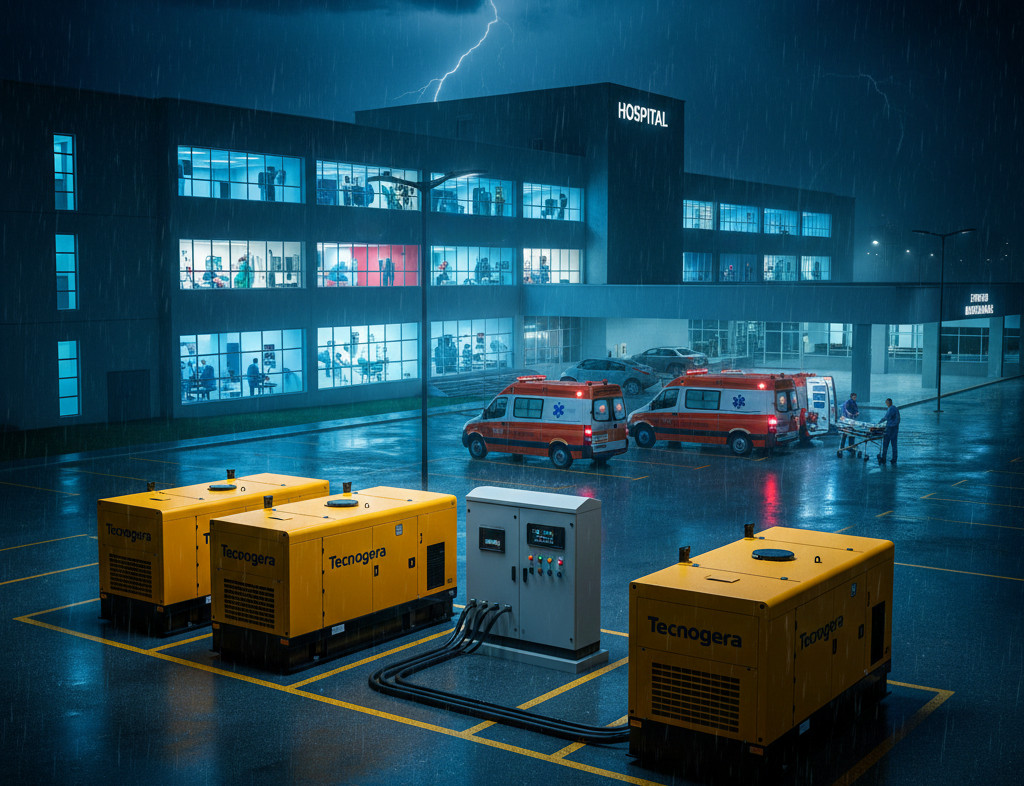
The hospital generator is a mandatory system to ensure patient safety and the continuity of healthcare services.
Its presence prevents power supply interruptions in critical areas, such as Intensive Care Units (ICUs) and surgical centers, while also ensuring the operation of strategic spaces like reception areas, medication rooms, kitchens, and storage areas for medicines, food, and other supplies, even in the event of a power grid failure.
Is it mandatory for a hospital to have a generator?
Yes, it is mandatory. According to regulations from the National Health Surveillance Agency (ANVISA), such as RDC number 50, dated February 21, 2002, and safety agencies, every healthcare facility performing critical procedures must have emergency power systems.
The absence of this equipment puts lives at risk and subjects the institution to severe legal sanctions, as well as endangering patients and staff.
The requirement aims to ensure that life support devices and monitoring systems do not stop functioning. In healthcare environments, electrical continuity is a matter of people and process safety and mandatory technical compliance.
Which NR covers hospital generators?
The NR-10 is the main regulatory standard addressing safety in electrical installations and services. It requires that power systems, including generators, undergo rigorous maintenance and safe operation to prevent electrical risks to professionals and patients.
Additionally, NR-32 sets specific guidelines for safety and health at work in healthcare services.
Both standards require that hospital generators be installed and operated by trained teams, ensuring protection against shocks, short circuits, and fires.
What does ANVISA’s RDC 50 say about emergency power?
The ANVISA RDC 50 mandates that critical areas, such as surgical centers and intensive care units, have uninterrupted power supply. The goal is for the emergency system to automatically take over the load in case of a public grid interruption.
The standard classifies hospital areas based on backup needs, requiring the generator to support complex medical equipment. Non-compliance with this resolution can lead to ward closures and fines for the administration.
The Vital Importance of Power Generators for Hospitals
Electrical failures in healthcare units can disrupt the operation of ventilators and life support monitors, creating immediate risks of condition worsening and death.
Additionally, the climate control and storage of thermolabile medications and vaccines depend on constant power to maintain their efficacy.
Interrupting a surgical center during a procedure can cause irreversible harm to patients, professional teams, and legal liabilities.
Generators for hospitals not only protect the unit’s reputation but also ensure that the technological infrastructure remains stable without significant fluctuations.
Tecnogera’s Solutions Fully Meet Hospital Standards
Tecnogera’s solutions are developed by specialized engineering to meet 100% of the RDC 50 requirements. We ensure that the institution is in absolute technical and legal compliance during all inspections.
Our projects consider all current NR specifications, eliminating risks of shutdowns due to infrastructure failures.
We offer security through modern equipment and certified processes that meet the stringent requirements set for healthcare institutions.
How Does a Hospital Generator Work?
The equipment operates integrated with an Automatic Transfer Switch (ATS), which detects power grid failures in milliseconds. As soon as a failure occurs, the engine is activated to take over the critical load without manual human intervention.
Response time is the determining factor in a generator in these environments, and it must be as fast as possible to prevent electronic shutdowns. Tecnogera uses the ATS in critical environments, such as hospitals and data centers, where this transition needs to be made instantly and with maximum safety.
How long does a hospital generator run?
Autonomy depends on the fuel tank size and the engine’s consumption under full load. It is common for emergency power systems for hospitals to operate for 12 or 24 continuous hours before needing refueling.
Tecnogera manages preventive refueling plans to ensure that operations never stop during prolonged blackouts. Our rental solutions include complete logistical support to ensure the necessary diesel flow.
Difference Between Synchronous and Asynchronous Generators for Hospitals
The synchronous generator is the recommended model for hospitals as it offers greater voltage and frequency stability. It is ideal for powering sensitive loads and imaging equipment, such as CT scanners and MRIs.
On the other hand, the asynchronous model is less stable and can cause interference in high-complexity medical electronics. At Tecnogera, we prioritize synchronous generators to ensure total protection of the healthcare unit’s technological assets.
What Are the Types of Hospital Generators?
- Diesel Hospital Generator: the most common type due to its robustness, high power, and ease of fuel storage.
- Gas Generators: an option for locations with a natural gas network, offering cleaner combustion and less logistical refueling needs.
- BESS Systems (Batteries): provide instant and completely silent power, acting as a high-speed backup for sensitive areas with pre-determined periods.
Technical Specifications a Hospital Generator Must Meet
- Low Noise Level: essential to maintain patient comfort and rest in inpatient wards.
- Immediate Response Time: automatic activation in a few seconds to prevent medical equipment shutdown.
- High-Efficiency Filters: systems ensuring fuel cleanliness and engine reliability in continuous use.
- Controlled Emissions: equipment that complies with environmental standards and prevents air contamination near the hospital.
How to Choose the Ideal Hospital Generator for Your Operation?
Choosing the generator for the hospital sector requires a strategic analysis of the criticality of each medical area. Administrative support areas have different energy demands than an Intensive Care Unit (ICU) or emergency room, for example.
By renting generators with Tecnogera, we help you identify the best model for your needs, ensuring that the equipment supports starting peaks of large machines.
Our technical decision focuses on patient safety and full compliance with ANVISA regulations.
How to Size a Hospital Generator?
Sizing is an engineering study that analyzes the sum of all loads from devices and climate control systems. It is not a basic calculation, as it must anticipate the behavior of sensitive medical equipment and electric motors.
Tecnogera conducts this technical survey to avoid undersizing, which causes failures, or oversizing, which generates excessive costs. We guarantee absolute reliability through calculations made by specialists.
Tecnogera’s Differentials in Hospital Generator Rental
When you rent generators with Tecnogera, we offer 24-hour technical support for any operational urgency.
Our fleet includes state-of-the-art equipment, ensuring high energy efficiency and reduced fuel costs.
We ensure quick delivery and installation, a crucial point for healthcare institutions with immediate demands.
We eliminate the client’s concern by taking full responsibility for the energy security.
How Does Hospital Generator Rental Work with Tecnogera?
- Technical Visit and Project: our engineers visit the client to assess the site and develop a customized and efficient solution.
- Installation: we carry out the complete assembly with a specialized team, following all hospital safety protocols.
- Commissioning: we test the entire system under real load to validate the automatic backup operation.
- 24h Support: we monitor the operation and offer uninterrupted technical assistance to ensure total peace of mind.
Installation of Generator Sets in Hospital Environments
Installation in healthcare facilities requires special care with logistics, acoustic isolation, and cable routing. Our specialized workforce manages these challenges without interfering with the medical care routine.
Technicians use appropriate materials to reduce vibrations and follow strict hygiene and organization standards. This ensures a safe integration between the generator and the main electrical panel of your unit.
Preventive Maintenance of Hospital Generators
When opting for rental, preventive maintenance and corrective maintenance are already included in the service. This ensures that the generator is always ready to act in any electrical emergency.
We perform periodic tests and part replacements at no extra cost to the client. Tecnogera commits to keeping your operation available throughout the contract.
Ensure 24/7 Hospital Operation with Tecnogera’s Solutions
Ensure your healthcare institution operates with total security through the experience and technical leadership of Tecnogera, a reference in energy solutions.
We offer complete packages that combine cutting-edge technology and application engineering for the healthcare sector.
Our competitive edge is delivering extreme reliability, allowing medical teams to focus on patient care and the well-being of their staff.
Count on the partnership of those who understand the complexity of hospital generators and offer 24-hour specialized support.