The ISO 14001 certification has evolved from a competitive advantage to a strategic requirement that directly impacts the efficiency, costs, and reputation of large-scale operations in Brazil.
In managing large operations, the pursuit of efficiency and predictability is a constant. Optimized processes, waste reduction, and risk mitigation support business profitability and longevity.
Faced with this challenge, ISO 14001 emerges as a management tool to achieve operational excellence.
It sets an international standard for implementing an Environmental Management System (EMS). Its application goes far beyond obtaining a badge to display on the company’s website or promotional materials.
It’s a detailed roadmap for systematically and continuously identifying, managing, monitoring, and controlling environmental impacts. It involves creating a culture of responsibility that permeates all levels of the organization.
Ignoring the importance of the standard allows internal gaps to become tangible operational and financial risks.
What ISO 14001 is and why it matters to your operation
ISO 14001 is the technical standard that defines the requirements for an effective Environmental Management System.
Its goal is to enable an organization to develop a framework for environmental protection and a swift response to changing environmental conditions, always balanced with socioeconomic needs.
The standard focuses on creating a cycle of continuous improvement, allowing the company to maintain profitability while progressively reducing its environmental impact.
For managing a large operation, the importance of the standard unfolds into four critical areas.
The first is risk management. Compliance with ISO 14001 forces a deep analysis of processes, identifying potential environmental liabilities, such as improper waste disposal, excessive energy resource consumption, or emissions outside standards, which could result in heavy fines and legal sanctions.
The second area is cost efficiency. A well-implemented EMS invariably leads to optimized use of raw materials and energy. This tighter control over inputs, a direct consequence of process mapping, results in less waste and a clear reduction in operational costs.
Thirdly, there’s the strengthening of image and reputation. The certification acts as a public and internationally credible testament that the company takes its environmental responsibilities seriously. It also enhances brand perception with customers, investors, and the community, serving as a pillar for ESG strategies.
Main impacts of non-compliance with ISO 14001
The decision not to pursue ISO 14001 compliance or to maintain processes misaligned with its principles results in severe consequences that go far beyond environmental impact. For management, the effects are directly felt in performance indicators, financial results, and the company’s ability to compete.
The first is regulatory risk. Brazilian environmental legislation is complex, and inspections are rigorous. The absence of a documented and auditable management system exponentially increases the company’s exposure to fines, activity embargoes, and other penalties that can compromise cash flow.
Another critical point is chronic operational inefficiency. Processes not monitored from an environmental management perspective tend to consume more resources than necessary, meaning higher costs for energy, water, raw materials, and disposal, continuously eroding profit margins.
Brand devaluation is another severe impact. The lack of a recognized seal like ISO 14001 can be interpreted as negligence or indifference, driving away customers and investors who prioritize partners with a strong socio-environmental commitment.
Having robust suppliers and partners is a pillar of any large company. It is part of Tecnogera’s history and differentiators to deliver reliability so that its clients can operate with maximum safety.
How lack of compliance can stall business and compromise results
More pragmatically, non-compliance with ISO 14001 acts as an insurmountable commercial barrier in many cases.
Increasingly, corporations and government agencies require their suppliers to have the certification as a prerequisite for closing contracts.
Without the seal, your company may be automatically disqualified from important public tenders and private bids, missing the chance to participate in lucrative projects.
This barrier is common in export businesses. European and North American markets, for example, impose high environmental standards that are practically validated by the certification.
Lack of compliance limits the company’s growth, hinders its expansion into new markets, and can even lead to the loss of customers who decide to update their purchasing policies to include environmental requirements.
How to identify and correct gaps in your internal process
The journey to ISO 14001 compliance is a structured project based on the continuous improvement cycle known as PDCA (Plan, Do, Check, Act).
The first step is to conduct a comprehensive diagnosis (gap analysis) to identify the gaps between current processes and the standard’s requirements.
This assessment should focus on areas such as waste management, energy and water consumption, atmospheric emissions, effluent treatment, and the environmental emergency response plan.
Based on this survey, management can outline an action plan. This step involves defining an environmental policy, setting goals (such as “reducing energy consumption by 15% in one year”), assigning responsibilities, and setting deadlines for each correction.
One of the most critical areas is energy management. The source, quality, and reliability of the energy used impact production and environmental performance. Therefore, correcting gaps involves a thorough analysis of the plant’s energy matrix.
Solutions like distributed generation can offer greater autonomy, control, and efficiency in consumption, being a strategic alternative for companies seeking more independence from the conventional grid.
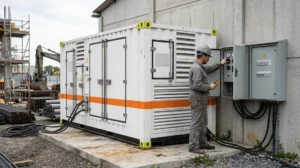
Ensuring an energy supply, even during peak demand, scheduled maintenance, or network failures, is crucial for operational continuity. Often, the solution involves implementing a robust and well-sized backup system.
To do this, understanding the different types of generators and their applicability is necessary to choose a solution that meets both the operation’s needs and the environmental goals of your EMS.
A modern and well-maintained piece of equipment, for example, optimizes fuel consumption and significantly reduces pollutant emissions, contributing to the standard’s objectives.
After implementing the improvements, the next step is verification, with monitoring and measuring results to prove the effectiveness of the actions.
With processes adjusted and results in hand, the organization can then hire an Inmetro-accredited certification body to conduct the final audit.
Certification validates your Environmental Management System, but operational excellence depends on continuous execution and reliable partners.
Maintaining the robustness of your energy management, a pillar of your EMS, is a fundamental step in this process. To ensure the efficiency and safety your operation demands, explore Tecnogera’s solutions.