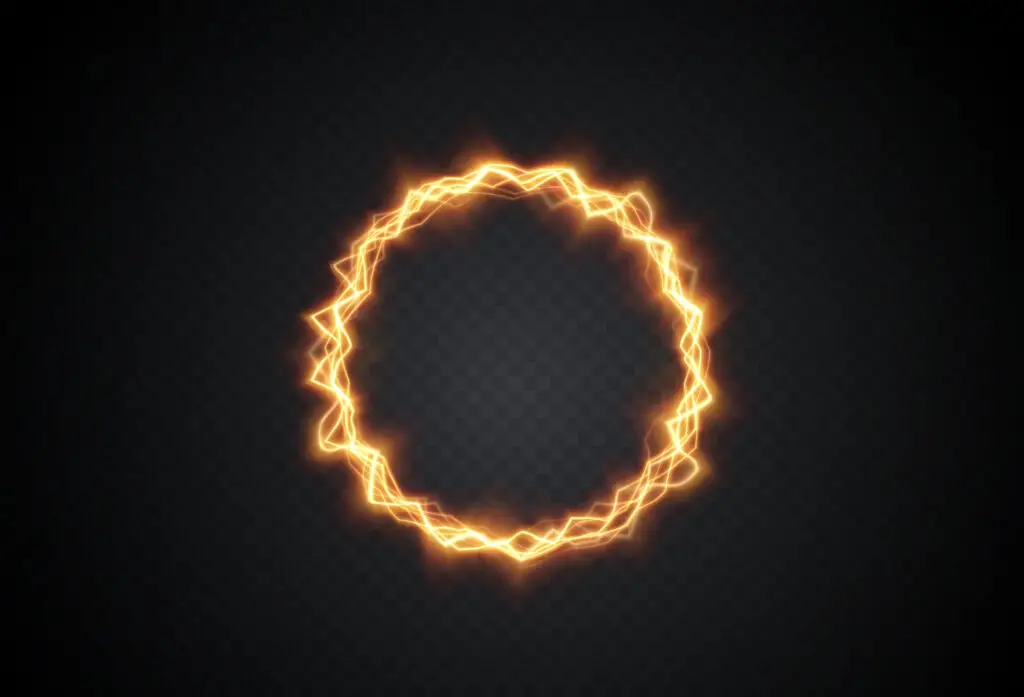
The Corona effect is an electrical phenomenon that occurs when the air around a high-voltage conductor becomes ionized. This ionization creates a luminous discharge, usually violet in color, and results in energy loss to the atmosphere, noticeable as a glow and a characteristic hissing sound.
This phenomenon, although it has industrial applications, represents a significant challenge for the efficiency and safety of electrical systems. Understanding its causes and consequences is essential to ensure the stability and longevity of equipment.
Index
- How does the corona effect occur?
- How to avoid the corona effect?
- How to take advantage of the corona effect?
- What are the consequences of the Corona effect?
- Causes and factors that intensify the corona effect
- Corona effect on different electrical equipment
- How to measure the corona effect?
- Find complete energy solutions for your business at Tecnogera!
How does the corona effect occur?
To understand the Corona effect, think of air as an electrical insulator. However, its insulating capacity has a limit, known as dielectric strength. When the voltage on a conductor is very high, the electric field around it becomes extremely intense.
This intensity is even greater at points with sharp curves, edges, or irregularities on the conductor’s surface. When the electric field exceeds the dielectric strength of the air, it “tears” electrons from the gas molecules, composed of nitrogen and oxygen.
This process is called ionization. The ionized air around the conductor becomes partially conductive, creating a small current flow that dissipates energy in the form of light (the violet glow), heat, sound (a hiss), and chemical reactions, such as ozone production.
How to prevent the corona effect?
Preventing the Corona effect is crucial to minimize energy losses and avoid equipment damage. Prevention involves careful planning and continuous maintenance, ensuring maximum efficiency of the electrical system.
The main prevention strategies include:
- Proper line design: using conductors with larger diameters and bundling cables (bundles) helps reduce the electric field intensity on the surface.
- Use of guard rings (or corona rings): installed on insulators and high-voltage terminations, these rings distribute the electric field more evenly, avoiding concentration points.
- Preventive maintenance: regular cleaning of insulators removes dust, pollution, and moisture, which are factors that facilitate the onset of the Corona effect.
- Monitoring and early detection: the use of technologies, such as ultraviolet cameras, allows identifying the Corona effect before it causes significant damage.
Relying on energy solutions specialists, such as Tecnogera, ensures the application of best maintenance and monitoring practices to protect your assets.
How to take advantage of the corona effect?
Although undesirable in power systems, the Corona effect is harnessed in a controlled manner in various industrial and technological applications. Its ability to ionize gases is the key to these uses.
Among the main applications, the following stand out:
- Ozone production: Corona discharge is an efficient method for producing ozone gas, used in water treatment and air purification.
- Electrostatic precipitators: used in industries to remove dust particles and pollutants from gas streams, improving air quality.
- Surface treatment: the plasma generated by the effect is used to modify the properties of polymer surfaces, enhancing their adhesion.
- Advanced research: new technologies explore the effect for sterilizing medical equipment and even in ion propulsion systems.
What are the consequences of the Corona effect?
The consequences of the Corona effect on electrical systems are predominantly negative and can have significant technical and financial impacts.
The main problems include:
- Energy losses: the discharge represents a continuous loss of energy to the atmosphere, which can reach hundreds of kilowatts per kilometer in transmission lines. This translates into a direct economic impact, increasing operational costs.
- Equipment deterioration: the ozone and nitrogen oxides produced by the effect are corrosive and attack insulating materials, such as rubber and polymers, accelerating their aging and leading to premature failures.
- Audible noise: the characteristic hissing of the Corona can be a source of noise pollution, especially in areas near substations and high-voltage lines.
- Electromagnetic interference: the discharge generates radiofrequency noise, which can cause interference in communication, radio, and television systems (RFI/TVI).
Causes and factors that intensify the corona effect
Various factors can initiate or exacerbate the Corona effect. Knowing them is essential for accurate diagnosis and the implementation of effective preventive measures.
- Conductor geometry: tips, edges, and small diameter conductors concentrate the electric field, being preferential points for the onset of the effect.
- Environmental conditions: rain, fog, snow, and high humidity reduce the air’s insulation capacity, facilitating the occurrence of Corona at lower voltages.
- Presence of particles in the air: dust, pollution, and salinity (in coastal areas) deposited on conductors and insulators create irregularities that intensify the local electric field.
- Surface irregularities: scratches, corrosion, impact damage, or even insects and water droplets on the conductor’s surface act as points of high field concentration.
- Influence of operating voltage: the most direct factor. The higher the system voltage, the greater the intensity of the electric field and, consequently, the probability and severity of the Corona effect.
Corona effect in different electrical equipment
Although it is most famous in transmission lines, the Corona effect is not limited to them and can occur in any component of an electrical system where there is an intense electric field, such as in transformers, circuit breakers, bushings, and even in the winding of high-voltage motors and generators.
In general, the manifestation and consequences of the corona effect vary depending on the equipment. In bushings and insulators, the effect usually occurs on the surface, especially at points of high curvature or where there is contamination by moisture and dust. It manifests as a violet glow and a hissing noise, degrading the surface of the insulating material and potentially creating a conductive path that leads to flashover (electric arc).
In circuit breakers and transformer terminals, the corona appears on live edges and connections, generating noise, radio interference, and, mainly, the degradation of the surrounding insulating medium (whether air, oil, or SF₆ gas), which compromises the component’s insulation capacity.
Inside equipment such as motors, generators, and transformers, the phenomenon is even more critical and usually occurs in the form of partial discharges. These discharges happen in small bubbles or voids in the insulating material of the windings.
Although it is externally invisible, the ozone and other chemical byproducts generated by the corona aggressively attack the varnish and insulation of the coils. This continuous chemical attack weakens the insulation, accelerates its aging, and can, over time, lead to a short circuit between turns or to the casing, resulting in the catastrophic failure of the equipment.
Behavior in transmission lines
In high and extra-high voltage transmission lines, the Corona effect is a constant phenomenon and one of the main sources of losses. It is visible at night as a bluish or violet glow around the cables and insulators and is accompanied by a constant hissing sound.
In these systems, managing the Corona effect through design (cable diameter, use of bundles) and maintenance is a central concern to ensure energy efficiency and network integrity over long distances.
How to measure the corona effect?
Detection and quantification of the Corona effect are carried out with specialized equipment, which allows identifying the problem before it causes serious damage.
The most common measurement techniques are:
- Visual inspection with UV cameras: cameras sensitive to ultraviolet light are the most effective tool, as they capture the radiation emitted by the discharge, making the Corona visible even during the day.
- Acoustic measurement: directional ultrasonic microphones can detect the high-frequency sound (hissing) generated by the effect, allowing the source of the discharge to be located precisely.
- Radio Interference Measurement (RIV): specific equipment measures the electromagnetic disturbances caused by the Corona, assessing its impact on communication systems.
- Loss monitoring: the analysis of energy measurement data along a line can help quantify the total losses attributable to the effect.
Find complete energy solutions for your business at Tecnogera!
The Corona effect is a reminder that the stability of an electrical system depends on robust design and careful maintenance. Failures and energy losses can compromise the productivity and safety of your operation.
At Tecnogera, we understand the challenges of the sector and offer complete solutions to ensure the energy reliability of your business. Our expertise ranges from equipment maintenance to the provision of temporary energy for critical situations.
Whether to plan preventive maintenance or to ensure the continuity of your operation with the generator rental, our team of experts is ready to design the ideal solution for you. Contact us and strengthen your energy infrastructure.