The Growth of Renewable Power Generation
The renewable power generation market is rapidly expanding in Brazil and worldwide. According to the Chamber of Electric Energy Commercialization (CCEE), wind power generation in the country grew by 61.5% in the first two months of 2017 compared to the same period in 2016. Operating plants produced a total of 3,495 average MW in January and February, compared to 2,164 average MW generated in the first two months of the previous year.
This productivity increase resulted from the activation of 77 new wind farms over a year.
Generators for Solar Energy
A solar power generator is a device that converts sunlight into electricity for use in homes or businesses. This is known as photovoltaic energy. There are two types of solar power generators: the solar power generator with battery and the grid-connected solar power generator.
The battery-powered generator consists of photovoltaic panels, a charge controller, batteries, and an inverter. They can be installed in fixed or mobile stations (with wheels). They are generally used in regions without access to the electrical grid, mainly for lighting and water pumping.
Grid-connected generators are the most common. They only have photovoltaic panels and an inverter.
Generators for Wind Energy
Wind energy generators are called wind turbines. You may have seen one: they are those large turbines that look like windmills. When the blades of this windmill start to move, they automatically begin to rotate a generator inside these turbines. The generator’s function is to transform this circular motion (mechanical energy) into electricity.
Generators for Biomass Energy
Biomass is transformed into energy through the conversion of raw materials (such as sugarcane bagasse) into an intermediate product that will be used in a prime mover. This machine will produce the mechanical energy that will drive the electric power generator.
The Market in Numbers
- Hydroelectric plants are the main power generators in Brazil. They account for over 100 Gigawatts of the Brazilian electrical grid’s production capacity, which corresponds to 61% of the country’s installed power.
- Operating wind farms have an installed capacity of 10 Gigawatts, or 7% of the national power generation capacity. There are over 400 plants in operation. Another 160 plants are under construction, adding 3.8 GW of capacity.
- Wind farms are the fastest-growing power generation segment. About 33% of new energy sources under construction are wind energy.
- According to data from the Brazilian Wind Energy Association (ABEEólica), in terms of the energy matrix, wind energy is currently the most competitive source, with a reasonable difference from the second or third source, considering that large hydroelectric projects, which are the most competitive, are no longer discussed. All these factors make Brazil one of the few countries capable of meeting the Paris climate agreements comfortably and at no cost.
- Brazil has 167 wind energy plants and 74 solar energy plants in the pre-construction phase.
- In a prominent position, Brazil aims to have wind power generation as the country’s second-largest energy source by 2020 and as the fastest-growing economic sector, ranking fourth in the world as the country that invests the most, eighth in wind energy generation, and tenth in installed capacity.
- The New Energy Outlook 2016 report, produced by Bloomberg New Energy Finance (BNEF), predicts that solar, wind, and biomass energy will attract $237 billion in investments worldwide by 2040.
- Major technology corporations like Apple, Amazon, and Google are investing in plants and creating their own electricity generation parks with wind and solar sources.
- The costs of renewable energy generation are already, on average, lower than fossil fuels worldwide. With the market’s rapid expansion, the costs of this energy system could be lower than fossil fuels in ten years, and as a result, 100% of the world’s energy consumption could come from renewable sources by 2050, according to a report released by the Renewable Energy Network for the 21st Century (REN21), in partnership with the UN Environment.
Summary
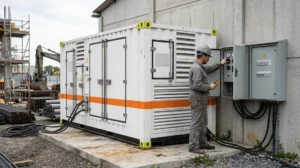
Tecnogera is directly connected to this market with its expertise in commissioning and load bank supply. In wind farm commissioning, we conduct tests directly on wind turbines, and in solar plants, the load bank tests power sources and converter units in a short mobilization period.
This way, any system failure can be identified and corrected to prevent future accidents and avoid losses during the initial operation phase.
It is important to have an experienced supplier to handle complex projects requiring technical capacity and structure, such as plant construction. Tecnogera has proven expertise in temporary plants up to 100 MW, as well as preventive maintenance and performance testing in each load center for rental, such as real load services.
Committed to quality service for its partners, we have a highly skilled team and equipment from the best national and international brands, constantly modernized to ensure greater operational safety, time optimization, and cost savings.
During commissioning, even small problems in load banks – almost impossible to occur in new and constantly maintained equipment like Tecnogera’s – can cause a domino effect on the schedule. Additionally, poorly executed commissioning can result in diagnostic and problem-solving failures, leaving companies and industries exposed to the very risks they wanted to avoid.
The Best Option in Load Bank Rental
Tecnogera has been operating in the energy sector since 2005, working in the rental market of power generator sets, load banks, transformers, substations, QTA, QTR, electrical cables, fuel tanks, and all accessories and services for a complete solution.
We are a multinational company operating in Brazil, Argentina, and Peru, with service capacity throughout Latin America, 24/7. The company has a highly qualified team and equipment from the best national and international brands, kept in constant renewal.
Tecnogera offers its clients projects with Turn Key solutions, delivering a complete service for immediate use in segments such as mining, construction, oil and gas, financial institutions, industry and commerce, agribusiness, entertainment, telecommunications, utilities, and retail network expansion plans.
Tecnogera supports utilities in providing energy to entire cities and helps overcome capacity constraints, such as during seasonal peak periods. Tecnogera’s vision is to be the most agile and efficient company in reliable temporary energy solutions, leading in Latin America.
Still have questions? Contact us.